
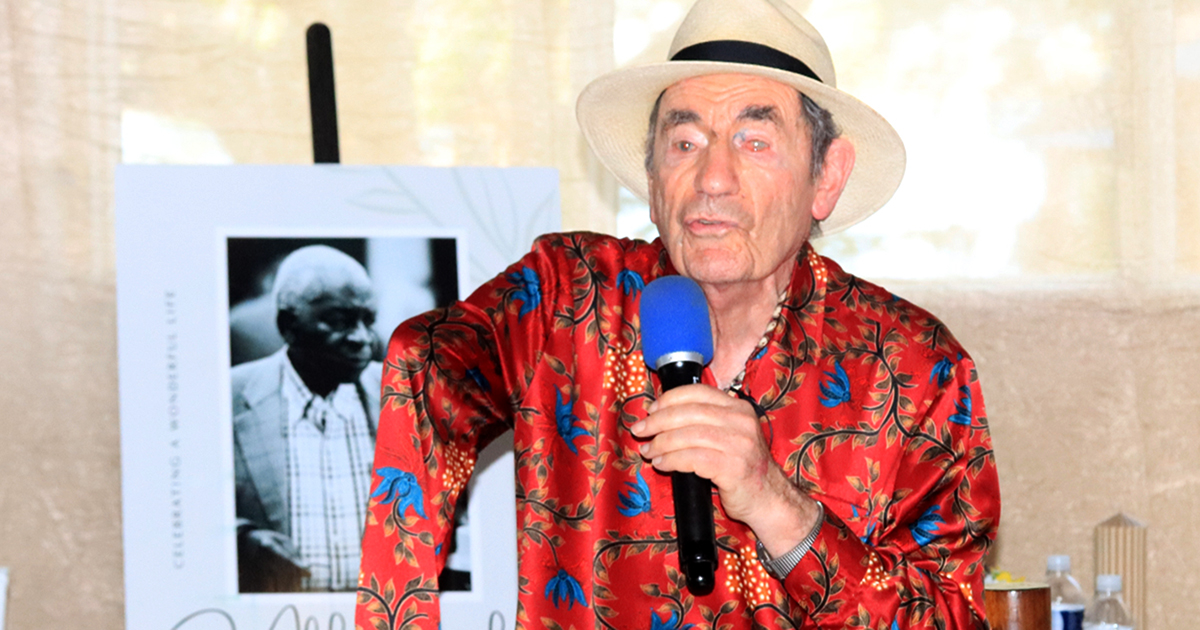
The life and legacy of the late Dr Languta Alpheus Manghezi, a researcher and political activist from Chavani village, were celebrated at Shiluvari Lodge in Elim on Saturday, 16 November. More than 200 attendees gathered for the occasion, organised by the Timbila Poetry Project, Guyo Books, and the Manghezi family, to honour Manghezi, who passed away in May 2024 and was buried in Denmark.
Tributes were delivered by prominent figures, including Justice Albert "Albie" Sachs. Sachs praised Manghezi's unwavering commitment to social justice and his affirmation of Tsonga cultural pride, and he shared a moving account of the circumstances surrounding Ruth First's assassination. Sachs vividly recalled how Manghezi, as one of the pallbearers at First's funeral, carried her coffin draped in the ANC flag. Ruth First was assassinated in 1982 by South African security forces as part of their campaign against anti-apartheid activists.
Other speakers included Hosi Hlekani Mkhari of the Njakanjaka traditional authority, who called for a statue to honour Manghezi's contributions to liberation, and Dr Nadja Manghezi, his wife, affectionately known as "the lady from the ocean." She charmed guests with her wit and recounted her love story with "the man from the mountain."
Several speakers reflected on the current state of the country, contrasting it with the ideals for which Manghezi and others fought. George Mashamba, an ANC veteran and former Robben Island prisoner, attributed the nation's struggles to corruption and the greed of "tenderpreneurs." Well-known journalist Mathatha Tsedu lamented the poor state of housing in post-apartheid South Africa.
Born in 1934, Manghezi was known for his work on migrant labour, cooperatives, and peasant economies, advocating for the rights of the oppressed in South Africa and beyond. His work took him to Tanzania, Mozambique, Sweden, and other countries, leaving a significant mark on African studies and liberation movements.
Manghezi's contributions to documenting the lives of migrant workers made him a respected figure in oral history. His wife spoke of his empathy and respect for people's stories, often shared in their mother tongue, Xitsonga. "Speaking Xitsonga helped people feel comfortable sharing openly, even when critical," she said.
Dr Nadja also shared the challenge of digitising 25 old cassette tapes of Manghezi's work. "I'm not good with technology, but I'm trying. After digitising them, I'll need someone to translate them," she said.
Manghezi grew up herding cattle at the foot of Mount Rivolwa (Luvhola). As one of the few literate boys in his village, he often read letters from migrant workers. A committed freedom fighter, he remained deeply rooted in his culture, which influenced his academic work.
He earned his PhD in sociology from the University of Uppsala in Sweden in 1976 and worked in several international cities, including Johannesburg, London, and Maputo. His research focused on cooperatives, peasant political economy, and migrant labour. Manghezi also served as principal of the Solomon Mahlangu Freedom College in Tanzania.
Vonani Bila, director of Timbila Writers' Village, praised Manghezi as a beacon of hope for rural communities. "He was the first PhD graduate in Chavani and surrounding areas. He studied at the Jan Hofmeyr School of Social Work, which trained black social workers like Ellen Khuzwayo, Winifred Madikizela-Mandela, Joshua Nkomo, and Eduardo Mondlane," Bila said.