
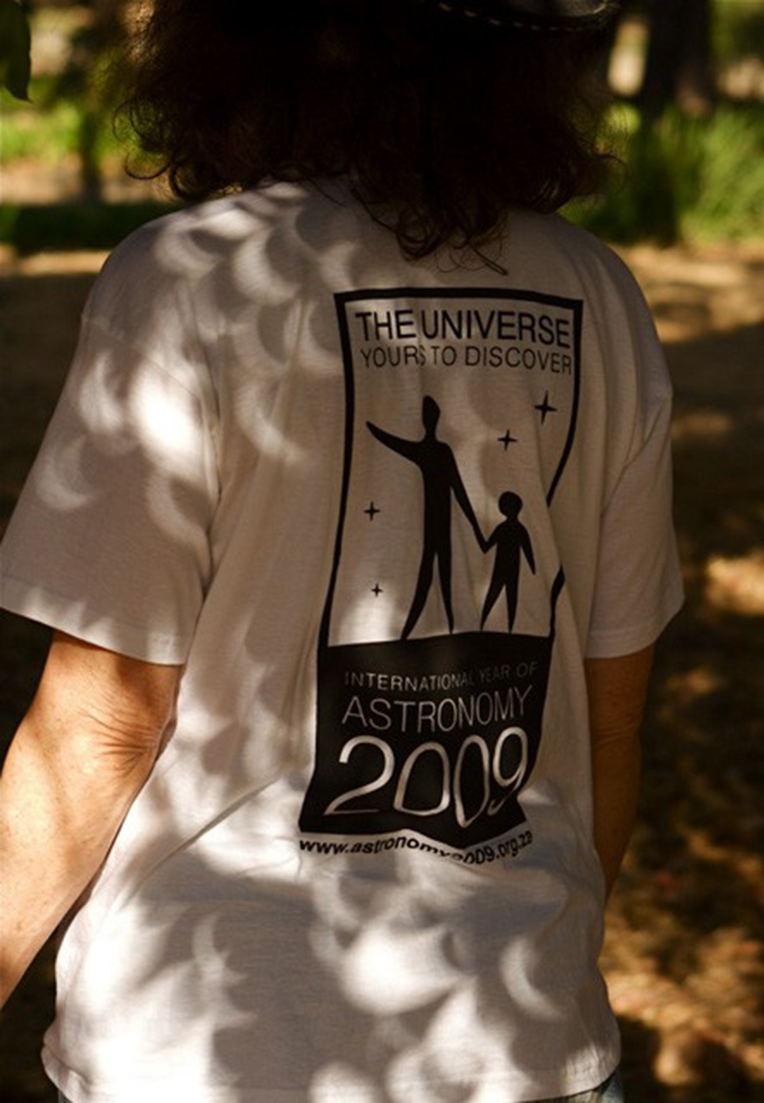
Residents of the Soutpansberg can look forward to yet another view of a partial solar eclipse on Thursday, 1 September, provided it is not overcast or raining.
This will be another rare opportunity to see the solar system in action. For a short time, the moon will pass between us and the sun, and instead of seeing the sun as a round disc, it will have a "bite" out of it. This "bite" is the moon, and the size of the "bite" changes as the moon slowly moves along.
A solar eclipse occurs when the moon blocks sunlight that normally falls on the earth. (During a lunar eclipse, the earth's shadow falls on the moon.) A solar eclipse can only occur at the time of the New Moon. Because the plane of the moon's orbit is tilted slightly, in most months the sun–moon–earth alignment is not exact and the moon's shadow misses the earth. When the alignment is correct, the sun is eclipsed. If the alignment is exact, then the eclipse is either total or annular (ring-shaped), depending on the distance to the moon. If the alignment is good but not perfect, then a partial eclipse is seen.
In a calendar year, between four and seven eclipses (solar and lunar combined) can occur; at least two and at most five will be eclipses of the sun. From any given location, there will be, on average, a partial eclipse every couple of years and a total solar eclipse once in 375 years.
The next total solar eclipse visible in southern Africa will be in 2030. The next partial solar eclipse visible from southern Africa is late in the afternoon of 26 February 2017. The next lunar eclipse is on 16 September (from 18:54 to 22:54 SAST). However, the moon only passes through the dim, outer portion of the earth's shadow, so it is likely to go unnoticed. Careful observation, perhaps with binoculars, could reveal the very slight darkening of the moon.
The eclipse is on Thursday morning. The moon will take roughly two hours to move across the sun, and the exact time when it is best to look depends on where on earth you are. Roughly speaking, around 11:00 SAST is maximum eclipse. But it's a lot of fun to watch as the eclipse progresses. At first, only a tiny bit of the sun is eclipsed. Then, as the moon moves along in its orbit, more of the sun is covered. Depending on where in Africa you are, a greater or lesser proportion of the sun will be covered. Eventually, the moon moves away and the sun is completely uncovered again.
According to Mr Kos Coronaios (079 148 4934) of the Soutpansberg Astronomy Club (SAC), eclipse times for Louis Trichardt are 09:26 to 12:45 local time, with the eclipse at 48% maximum at 11:03. The SAC will be at Ridgeway College on the day, providing a live feed as well as the opportunity to view the eclipse safely with a telescope. (Information supplied by the Astronomical Society of Southern Africa).