
By Thembi Siaga, Anton van Zyl and Maanda Bele
Are we paying too much for our essential food items in Vhembe, or is the cost of living in this region reasonable compared to other parts of the country? The answer is not straightforward - it largely depends on where you live and where you shop.
Over the past few weeks, this newspaper set out to determine whether the cost of living for poorer households in Vhembe compares favourably with that of city dwellers. We also explored whether some areas are cheaper to live in than others, particularly regarding food prices.
 |
How we conducted the price comparison
Before diving into the findings, it is important to acknowledge that comparing food baskets is not a new concept. We drew inspiration from several sources, notably the data journalism site The Outlier. Their methodology is based on the work of the Pietermaritzburg Economic Justice & Dignity Group (PMBEJD), which has been tracking the prices of a 44-item food basket purchased by women in low-income households.
"The basket includes the foods and the volumes of these foods that women living in a family of seven (an average low-income household size) typically try to buy each month," The Outlier explains.
To simplify our comparison (since we lacked the manpower to track 44 food items across multiple stores), we focused on 17 essential food items – which were identified as must-have items necessary to feed a family.
It is worth noting that we did not choose the items ourselves, and some may not be considered essential in Vhembe. However, for consistency and comparability, we adhered to the established list.
Visiting the shops
We conducted our survey across three regions: Elim, Nzhelele, and Louis Trichardt. In Elim and Nzhelele, we visited three stores, while in Louis Trichardt, we surveyed four. The stores included Shoprite, Boxer, Spar, Checkers, and OBC. However, because this exercise was not meant to compare specific supermarket brands, we have not named individual stores. The assumption is that residents typically shop at the stores available in their area.
The PMBEJD basket references some specific product brand names, but we focused on commonly available and reasonably popular products. We also sought out the cheapest options in the most convenient packaging formats - for instance, we mostly used the widely available 12.5kg bag of maize meal rather than a 30kg bag.
The PMBEJD basket specifies certain food volumes required each month. Where exact weights were unavailable, we calculated unit prices and scaled them accordingly. For example, if the basket required 10kg of potatoes but only 5kg bags were available, we doubled the price.
What is also crucial to note is that timing influences food price comparisons as stores frequently run promotions on certain days. We did not attempt to predict price fluctuations but simply visited the 10 stores between 22 February and 14 March.
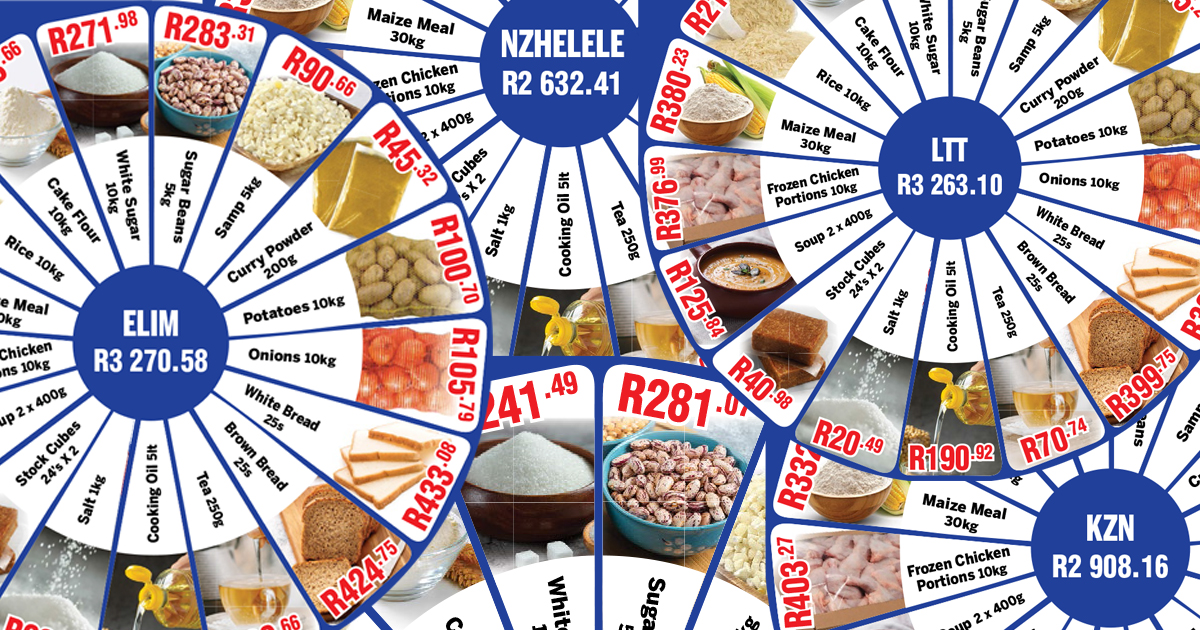
For comparison, we used the December 2024 PMBEJD food basket, which had a total cost of R2,908.16.
Which region had the cheapest food?
Surprisingly, the cheapest region turned out to be Nzhelele, where the average cost of the food basket was R2,632.41. This was largely due to lower prices for bread (around R11 per 700g loaf), sugar beans, and samp. Onions also sold for an average of R69.67 per 10kg bag. The cheapest store in Nzhelele offered the basket for R2,509.98 - some R545.38 less than the average across all Vhembe stores surveyed.
The most expensive region was Elim, though it was closely followed by Louis Trichardt. Initially, Louis Trichardt appeared to be the priciest, but after data from a fourth town store was added, Elim edged it out by R7.48.
The average cost in Elim's three stores was R3,270.58. The cheapest store in Elim offered the basket for R3,085, while the most expensive store charged R3,479.59.
Louis Trichardt's average was R3,263.10, but what stood out was the extreme price variation. The town, despite its proximity to supply chains and stronger purchasing power, had some of the most expensive stores. One store priced the basket at R3,670.56 – a total of R1,160.58 more than the cheapest store in Nzhelele.
Why shopping around matters
We also calculated a "shop-around" price - assuming that consumers compare prices and selectively purchase items from different stores rather than buying everything in one place.
With this approach, Louis Trichardt's ranking improved significantly. The cheapest region remained Nzhelele, where the adjusted food basket cost R2,464.97. Louis Trichardt followed at R2,505.76, with Elim at R2,865.03.
The importance of shopping around was especially evident when comparing the price of specific products. For instance, the average price for 5kg of frozen chicken portions was R190.50. However, prices varied dramatically: in one Louis Trichardt store, a 10kg bag cost R219 (or R109.50 for 5kg), while another store charged R254.99 for 5kg - and even advertised it as a "special."
Should Vhembe have its own food basket?
Many local shoppers pointed out that the PMBEJD food basket - designed for Pietermaritzburg - may not reflect the buying habits of Vhembe residents.
Due to the high cost of living, many consumers prefer purchasing meat and vegetables from butcheries or local markets, which often offer better prices than supermarkets. Smaller butcheries also allow for more affordable, custom quantities. However, shopping habits vary according to availability, product type, and whether consumers prioritise price, quality, or convenience.
For those struggling with rising food prices, this data highlights the importance of being aware of regional price variations. While not everyone can travel to the cheapest areas for groceries, understanding price trends can help consumers make informed decisions and potentially save money. What is also very important is to be aware of prices of essential food items. Check the newspaper for the store's leaflets and use these as a guide to do your shopping.
 |
 |
 |