
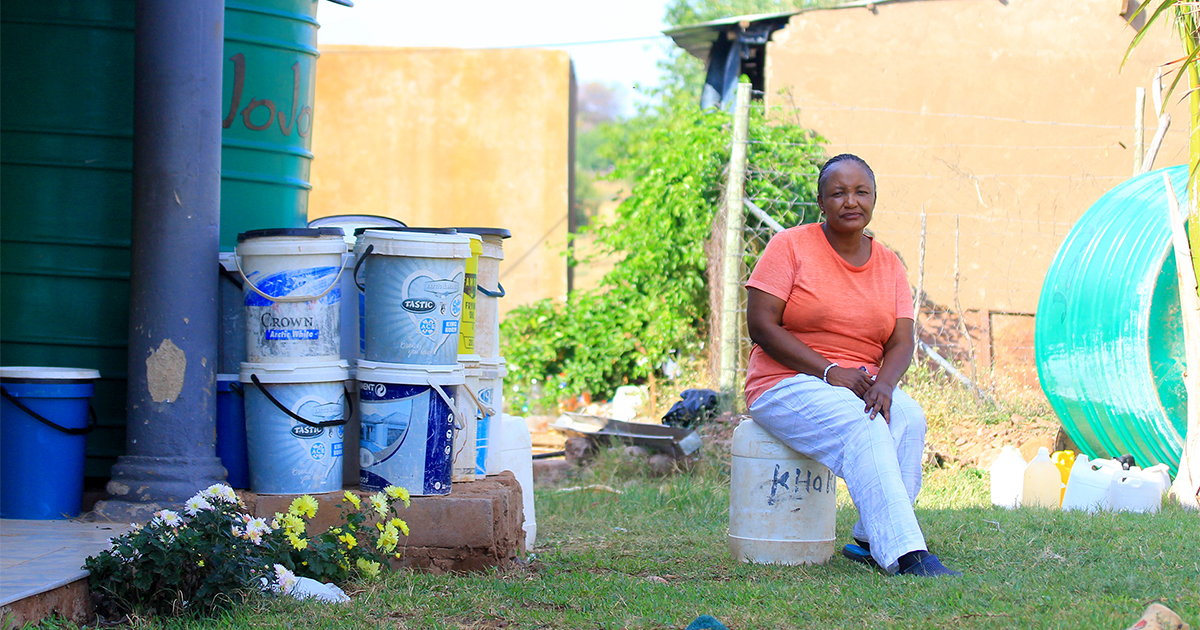
For more than 20 years, residents of Ha-Matsa and its five sub-villages in Vhembe have relied on untreated fountain water, which they share with livestock. A promised R664-million water project remains incomplete, and access to clean water is still a daily struggle.
The villages of Ha-Maswinga, Ha-Malivhusa, Mutiti, Muledane and Liphakha — which fall under Ha-Matsa in the Nzhelele area — are home to about 4,800 households. Ha-Matsa has two reservoirs and one borehole, but it is not pumping enough water. According to residents, it takes almost five days to fill the reservoir.
Most private boreholes drilled by households have dried up. Some residents walk more than two kilometres to buy water from one of the few functioning boreholes, where a 20-litre container costs between R3 and R5, and a drum costs R90.
Others hire donkey carts to transport water. On average, residents spend about R1,200 to refill a 2,400-litre tank. Some still rely on a nearby mountain spring, using a community-managed rotational system to share the limited supply.
"Even though we can get sick from sharing water with animals, we don't have a choice," said resident Constance Khakhu, who lives with a leg disability. She drilled a 60-metre borehole in 2010, but it dried up after four years.
"I later extended it by 30 metres and only found mud," she said. Another resident, Elina Davhana, said her family's borehole had also dried up within five years.
"Since then, we've been getting water from the fountain. Back then, we used to fetch water using buckets from another fountain closer to our homes. Sometimes the water is dirty because of cattle, but we don't have any other option," she said.
In response to the ongoing shortages, residents raised R12,000 — about R50 per household — to buy pipes that connect directly to the spring. With help from unemployed local youths, they laid a basic piping system linking the spring to old communal taps installed during the apartheid years.
The system has been running for three years and was recently upgraded with larger-diameter pipes to improve water pressure. But maintenance is a challenge, and frequent pipe bursts require constant repairs.
During a visit by Limpopo Mirror, some residents were seen walking more than 3,5 kilometres to fix damaged pipes, while others pushed wheelbarrows to collect water from homes with functioning boreholes.
"It's not easy to maintain because the pipes are low quality," said community coordinator Khathutshelo Matsa. "We're asking for donations, so we can buy stronger pipes and extend the system."
Residents have also built a small stone-and-cement wall at the spring to collect and filter out leaves and unwanted debris before the water flows downhill. They want to fence off the area to prevent animals from contaminating the water, but say several requests for municipal assistance have gone unanswered.
Ha-Matsa's traditional authority leader, Khosi Vho Philemon Matsa, said the community felt abandoned. "Our people are risking their health using water shared with animals because their pleas for help have been ignored."
Vhembe District Municipality spokesperson Matodzi Ralushai confirmed that it takes nearly five days to fill the reservoir. He said the villages were included in the municipality's medium-term plan to drill new boreholes in the 2025/26 financial year and were also part of Phase 4 of the Mutshedzi Water Treatment Plant project.
The project officially started on 10 September 2021. According to the municipality's 2020/21 Integrated Development Plan, the Mutshedzi Water project was budgeted at R664 million and is expected to be completed by 30 June 2025. A feasibility study is currently under way.
Ralushai said the completion date is anticipated to be revised to 30 August 2025. He said water was currently being supplied through boreholes and water tankers as a temporary measure. A borehole in the nearby village of Manyii was meant to supplement Ha-Matsa's supply, but cable theft and vandalism have delayed the plan.
"The community may have connected water from the stream illegally, but no case has been reported. Ha-Matsa was provided with communal taps, not individual household connections," he said.
Ralushai said the project had made steady progress, with water issues resolved for 48% of the intended beneficiaries. He added that several challenges had slowed down the work.
"These include a four-month delay in budget maintenance approval, late delivery of construction materials by foreign suppliers, and heavy rainfall during February, March and April 2025. There was also community unrest in Dzanani, which was not related to the project but still disrupted progress," he said.