
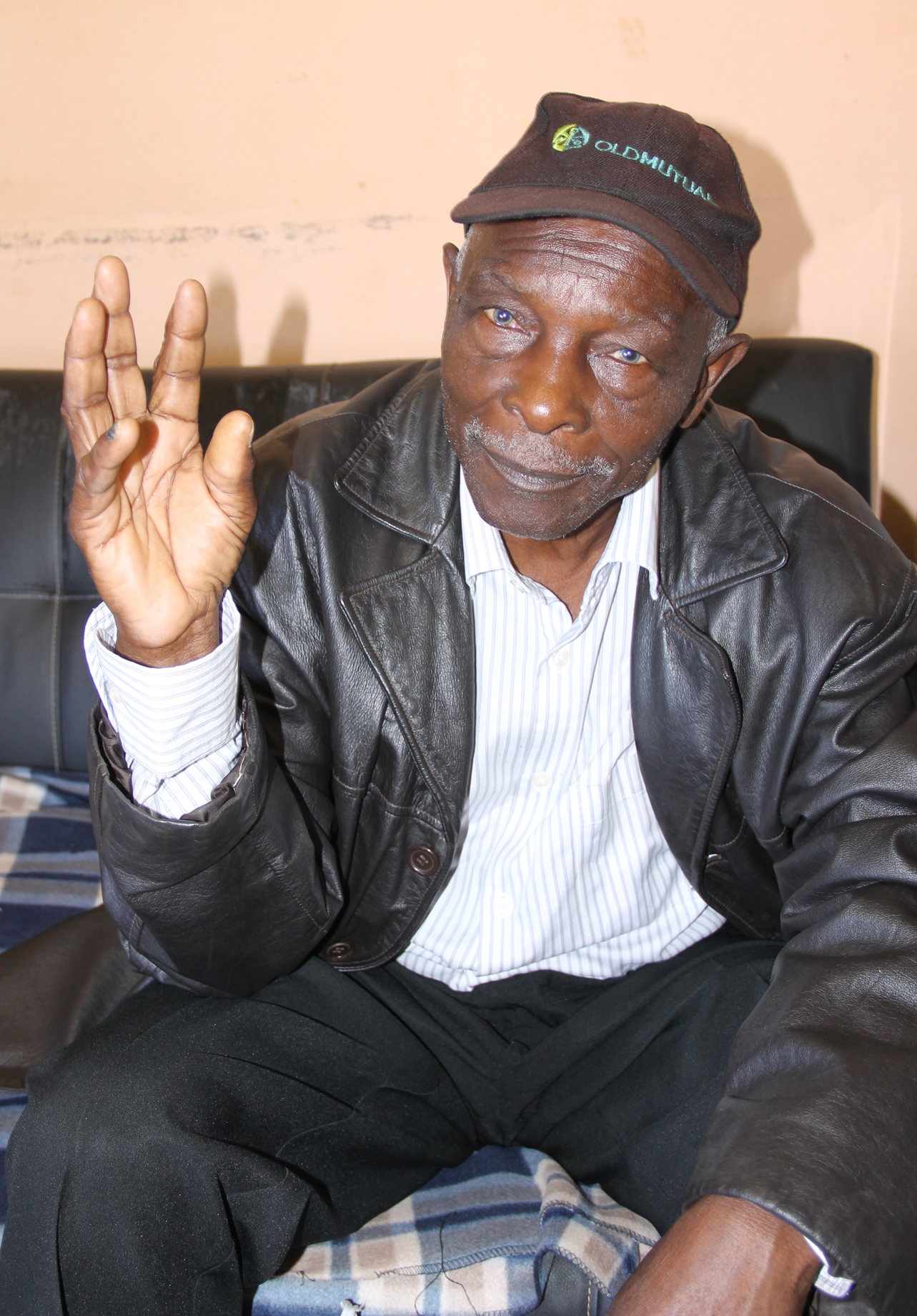
Hundreds of mourners attended the funeral of the world-renowned and legendary sculptor, Mr Samson Mudzunga, on Saturday. The funeral service of Mudzunga (80), whose arts career spanned more than three decades, was held at his homestead at Shanzha outside Thohoyandou.
Mudzunga passed away after a short illness on Monday, 16 April. He was in Johannesburg at the time of his death.
Throughout the years, Samson Mudzunga had built up a reputation for making massive wood drums of extraordinary shapes, and he became world famous for his "burial" performances. These performances were not only entertaining and captivating, but they had an important message about progress and preserving the Vhavenda cultural heritage.
He used his art as a medium to engage with the community on issues that affect them and the cultural direction that society takes. He made it a point that his art did not end with the mere creation of objects; he used his objects to stimulate further engagement with the audience.
Inspired by the need to open discussions on taboo topics, he sought to question and challenge people's unfounded belief in superstition that denied them the opportunity to flourish. His burial performances challenged the fear of death among black people. In his own words, "black people believe that it's a taboo to portray death. One is cursing oneself to death; instead, only God knows the day each of us will pass on," he said.
His love for mystic drums that had different themes and shapes and traditional dances was no secret and it came as no surprise that he was buried in one of his specially crafted drums. As he was royal by birth, certain rituals and protocols were observed during the funeral.
A praise singer, who is a senior member of the family, was on hand to praise the iconic artist when his coffin left his home and when it was lowered into his grave.
Speaking during the funeral, Mr Ndoweni Malala, who referred to Mudzunga as his "father" and who had worked closely with Mudzunga for years while still at the Thohoyandou Arts Centre, said that one needed to be close to Mudzunga in order to understand him. "Mudzunga was one of the greatest artists of our times. I was fortunate to be close to him and I learnt a lot from this icon. When I heard he was not well, I had to drive to Johannesburg to see him and we deliberated on many things. We have lost a giant in the arts, but we are consoled by the fact that his art will remain with us forever," said Malala.
Cllr Mashudu Madzivhandila, who represented the Thulamela mayor, described Mudzunga's death as a great loss to his municipality and the country at large. "Mudzunga put our municipality on the map and his death came as a blow to us. We are appealing to the family that his legacy should not die, but one of the family members should pick up his baton and carry on," he said.
Mr Vincent Netshivhodza of the Department of Arts and Culture in Vhembe said Mudzunga's death had shocked them. "He passed on when we were still trying to entertain the case of his missing money and assisting with the intellectual properties rights. We are greatly saddened," said Netshivhodza.
Having showcased his work internationally and at national art galleries, Mudzunga always ensured that every completed work was seen by local people before it was taken away. He occasionally staged performance exhibitions at his kraal in Shanzha village.
As a cultural activist, Mudzunga always invited cultural dance groups to entertain guests and tourists who attend the events.
Mudzunga was born in 1934 and as a boy he started moulding clay. When he turned 15, he started teaching himself to carve and the pieces he made he sold and made money for the family.
After completing standard 5 at Thononda outside Thohoyandou, Mudzunga went to Johannesburg where he worked as a gardener. After working for eight years as a driver for a Johannesburg packaging company, he had a premonition that he would lose his job. That was when he decided to pursue art again.
In 1988, he had carved enough sculptures to enable him to stage an exhibition at the gallery of the Federated Union of Black Artists (FUBA). Mudzunga held a follow-up exhibition at the Zona Gallery in Norwood where his bosses visited the show and they accused him of earning a double wage and not adhering to company time. He was fired and this signalled a turning point in his artistic career.
Mudzunga's incarceration in 1997, on charges of arson and damage of property, led him to continue carving in prison. His mother, aged 110, died while he was in prison. She was buried near his brother's house and not his. This caused a rift in the family, exacerbated by the selling of two of his works by his son for far below their worth.
In 2014, Mudzunga accused his lawyer and manager of witholding his payment for international performances. He also accused a gallery owner of selling drums without his consent. The two men denied Mudzunga's accusations.
From 1996 onwards Mudzunga had been involved in performances as well as the exhibition of his creations and drums. In 2006, he performed at the Jack Shainman Gallery in New York in 2006, and at his exhibition at the Contemporary Museum in Honolulu, Hawaii.
Thulamela Municipality honoured him with a gold award for his outstanding work in the arts.
He had three wives and 15 children from his marriages, 25 grandchildren and four great-grandchildren.