
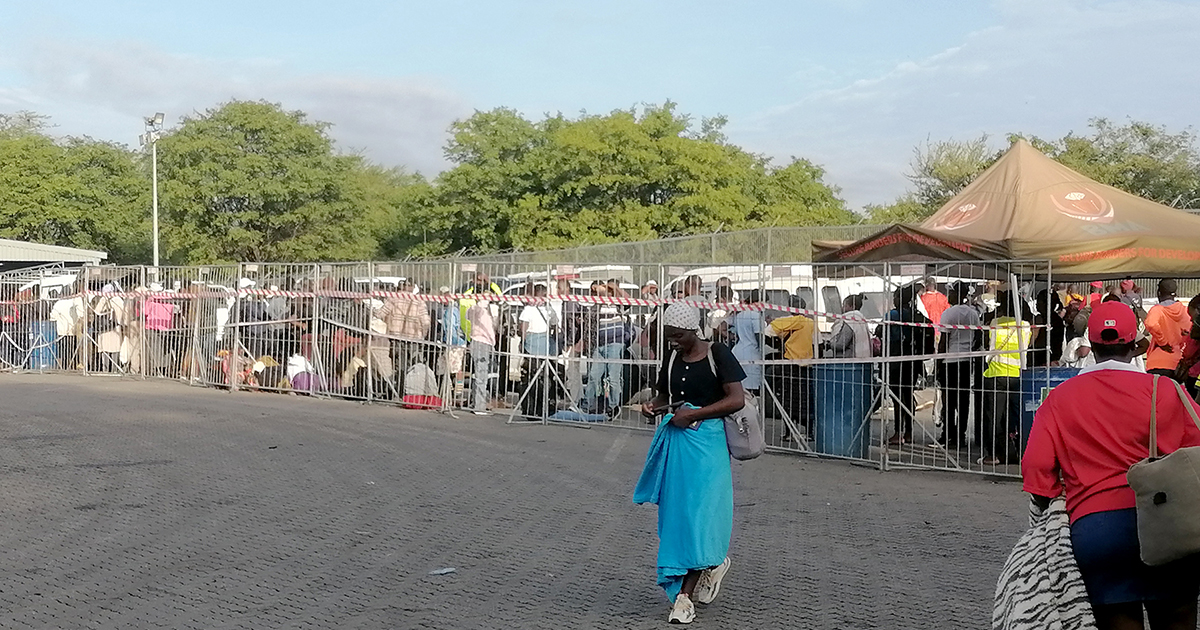
At around 08:00 on Monday, 5 January, Danai (not her real name), a 30-year-old woman from Harare, left her bags behind in the long queue at the Beitbridge border post on the South African side.
Looking visibly tired, she said she could no longer stand in the snaking queue, which she had joined at around 05:45. Danai went to look for a place to sit nearby while waiting for her travel documents to be processed.
Like me, Danai was one of hundreds of travellers from Zimbabwe returning to South Africa for work after the December holiday that day. I had met her earlier that morning on the Zimbabwean side of the border at around 04:45, and we joined the queue at the same time.
Like many others, we were anticipating long delays in the processing of our travel documents to exit Zimbabwe. The process, however, was unexpectedly quick. In less than an hour, we were served.
We then walked for about 15 minutes to the South African side, where we joined a slow-moving queue at around 05:45.
A few metres into the South African side, two men wearing yellow reflective vests stood nearby. Some travellers walked towards a caged area where the queue appeared shorter, the route leading to the usual immigration offices, while others joined a much longer, snaking line. I asked which queue we should join.
“Follow the others,” replied one of the men in a yellow reflective vest, who appeared to be directing heavy vehicles leaving South Africa for Zimbabwe. Confused, Danai and I decided to join the longer queue. There were nearly 200 travellers ahead of us, all waiting to be processed.
We later learnt that no services were being rendered to travellers who had joined the shorter queue. (Experienced travellers know that the shortest queue is often not the fastest.)
Pedestrians and travellers using light vehicles were separated by blue plastic drums, with Border Management Authority (BMA) officials and police positioned in front of the queue.
The queue moved slowly.
“Would you kindly look after my two bags? I can no longer keep standing. I am going a few metres away to sit and will join you later,” Danai said, removing her shoes and jacket.
A short distance away, she spread her jacket on the pavement and sat down. Several other travellers were sitting throughout the area, some even lying down or napping as they waited.
In a media statement issued on 11 December 2025, the Border Management Authority said its commissioner, Dr Michael Masiapato, would be at the Beitbridge border post from 2 to 5 January, focusing on processing capacity, ensuring maximum deployment levels and maintaining stability throughout the return-leg operations. For travellers like Danai and me, this meant very little.
In another statement released on 4 January 2026, the BMA said: “In response to long queues and extreme heat conditions, the BMA has prioritised small children, the elderly, and vulnerable travellers.”
However, during the time I was in the queue, I observed several elderly travellers and small children crying, with no visible prioritisation.
“How do you rate BMA services this year?” I asked a man standing next to me in the queue. “Do you see any difference compared to previous years during the return leg?”
“There is no change at all. I am not sure why the process takes so long,” said the man, who was travelling to Johannesburg.
As we approached the front of the queue, Danai rejoined me. It then became clear that there was confusion in the processing system. Motorists and pedestrians were being processed at the same point, but motorists were prioritised, further slowing the movement of pedestrians. We were served at around 11:00.
Many travellers are hoping that the One Stop Border Post Bill, adopted by the National Assembly in November last year, will improve the facilitation of trade and the movement of people. The Bill defines a one-stop border post as a port of entry jointly operated by two countries at a single location, based on mutual legal and administrative agreements. It outlines procedures for enhanced cooperation, shared risk and information management, and reduced border-crossing times. Each country’s laws will apply equally within the common control zones, ensuring that any violations are addressed through existing bilateral and trade agreements.
A media enquiry was sent to the BMA on 6 January this year for clarity on what caused the delays on the South African side for Zimbabwean residents returning to South Africa for work. At the time of going to press, no response had been received.