
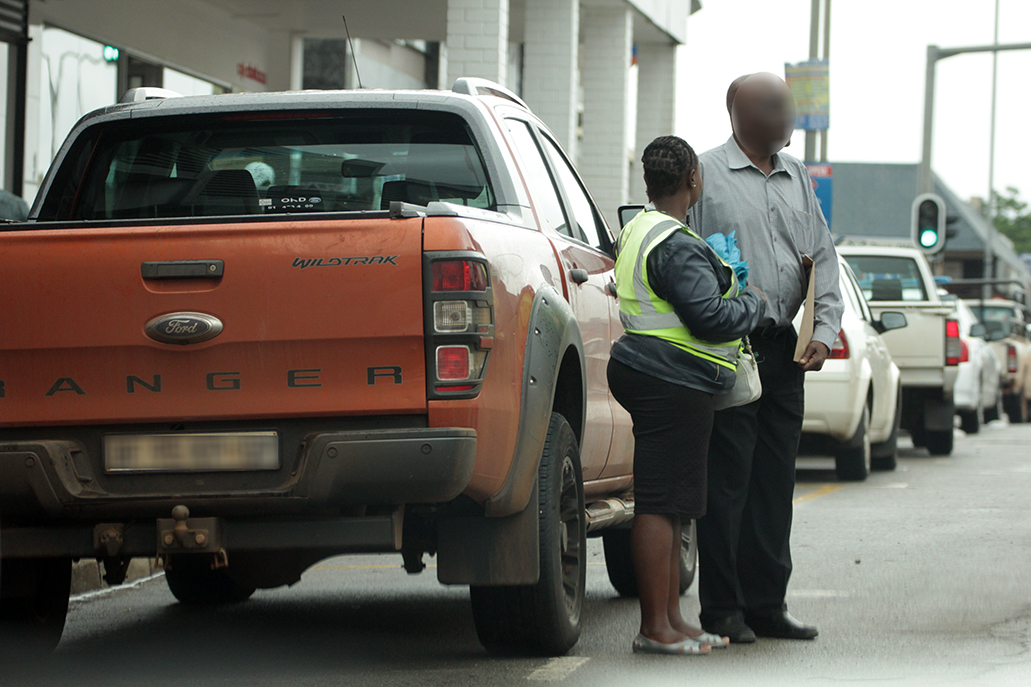
When the current parking metre system made its grand debut in Louis Trichardt, it allowed the Makhado Municipality to collect money and create employment … or did it?
At the time, residents openly expressed their doubts about the new system. Almost six years later it would seem that some of their fears have become a reality, and that the system might even be operating illegally.
The Zoutpansberger first picked up on these allegations towards the end of 2017. Ever since, more and more residents have openly questioned the parking system, with many bluntly admitting to not paying for parking ever.
For those who do pay, the concern is in whose pocket their hard-earned money ends up.
Originally, the parking system was to operate from Mondays to Fridays between 08:00 and 17:00, and on Saturdays the system was to operate between 08:00 until 13:00. Sundays and public holidays the system was not operational. The tariffs were R3.00 (0-30 minutes), R8-00 (30-60 minutes) and R12.00 (60-90 minutes).
The last couple of months, however, the system has been plagued by allegations of irregularities.
For example, meter attendees have been spotted working irregular hours – sometimes not at all – or moving to streets outside the borders of the CBD, which never formed part of the municipality's original plan. On social media, residents also shared their experiences of fluctuating parking fees. Some claimed they were requested to pay R20 for parking time that fell in the R3 zone.
Curious about this situation, the newspaper enquired from the Makhado Municipality in January about the alleged irregularities with their system. The municipality's spokesperson, Mr Louis Bobodi, was firm in his response, saying that no irregularities occurred as far as the municipality was aware. "The project is still under the management of Rirothe Trading and Investments," he wrote in his response dated 29 January.
In an attempt to determine if people do in fact still pay for parking, Bobodi was asked to provide details about the declared income or loss of the parking system. Ever since the parking system came into play, the newspaper could not find the income thereof tabled anywhere in the municipality's budget.
"The parking fees are still as proclaimed and promulgated. Any person wishing to have information from the municipality is by law required to request it formally in terms of the Access to Information Act," he responded.
This is exactly what the newspaper did – it brought a formal Access to Information application, requesting all documents and contracts pertaining to the tender that was set out in 2010 to procure the parking system.
This is what the newspaper learned:
In 2010, the Makhado Municipality advertised their intent to install new parking metres in Louis Trichardt under tender no. 105 of 2010. A total of eight companies submitted proposals, of which six where acceptable to the municipality. Among them was Rirothe Trading and Investment CC, which ultimately landed a three-year contract with the municipality to manage parking in Louis Trichardt's CBD.
Among the documents the newspaper requested, no memorandums could be found to show whether the municipality had consulted with relevant stakeholders (motorists, shopkeepers, and property owners) before implementing the system.
This contract was signed on 21 October 2011, in which Rirothe agreed that they would render a parking-management system by means of attendants who control handheld timing devices, without the municipality's having to fork out additional cash for the system.
Rirothe's contract came to an end on 30 October 2014 and the newspaper could find no proof that it has been renewed since then. Bobodi remained mute when repeatedly being asked as to the current status of Rirothe's contract.
So, who is supposed to get the money?
According to the service contract, the municipality is supposed to receive an allocation of percentages on turnover to the effect of 5%.
When Bobodi was asked why this income does not reflect anywhere in the municipal budgets, his response was ambiguous. "The question of compensation of or for the loss regarding parking fees can be directed to the service provider [Rirothe] who has the record, if the loss does exist. But no loss had ever been reported to the municipality as yet," said Bobodi. Follow-up questions regarding this were left unanswered despite several follow-up emails.
As to the remaining 95% of the turnover, it was agreed between the parties that it would be allocated to the patent-right holder (20%), local partner (5%), the management company (35%) and small, medium and micro-sized enterprises (SMMEs) would get 35%.
Despite only receiving 5%, the municipality is at the head of the operational layout of the system and is labelled as the "project sponsor". The patent-right holder (Thixiht) supplies the hand-held parking meters to the contracted parking-management company (JV) which is managed by Rirothe as the "management company."
This system further branches out into SMMEs from which "illegal parking attendants are converted to trained and professional legal parking attendants."
According to this structure, the parking attendants only pay over the fees and commissions for using the system. The balance is retained and taken home every day - a process that supposedly happens every afternoon at 17:00 when the data is downloaded from the hand-held devices onto the computer that is managed by Rirothe into a software programme.
But wait, there is more…
Upon studying the documents, several other questionable concerns popped up.
One major red flag was a clause in the service agreement that states: "The municipality can get between 5 and 10% Max but on condition that they offer effective law enforcement. We can process everything for law enforcement for 25% of the fine. The municipality must add a couple of percent onto the fines. But it has to be a prerequisite that we get the fines."
This clause was included in the contract as an attachment that was duly initialled by the then municipal manager and Rirothe's representatives, despite several legal matters arising from this.
According to the Makhado Municipality Local Authority Notice 163 (Parking Meter and Parking Ground By-Laws) if the driver fails to pay for parking, he/she has committed an offence and can be fined by an enforcement officer. The by-laws, however, do not specifically allow for a service provider company to be appointed also as an enforcement officer. At the time the system was launched, the municipality confirmed that Rirothe would have the authority to issue motorists with fines for non-payment of parking fees.
Bobodi again confirmed this in his email, saying that notices for parking meter offences are issued by Rirothe and that the matter is dealt with between them and the Department of Justice and Constitutional Development.
The by-laws further mention that a duly appointed service provider needs to supply the municipality within seven working days with a report that deals with parking statistics. National parking laws also stipulate further that only duly authorised traffic officials can issue a fine when they are in your presence when you did not pay your parking fees.
As far as the newspaper was able to determine, Rirothe is not part of the municipal traffic department, which means they cannot issue fines. Informally, the newspaper has also tried to determine if the traffic department has ever, since the start of the parking system, issued fines for non-payment. The municipality, however, seemingly does not keep record of this, because the response was that fines are issued for many transgressions.
In conclusion, it would seem that payment is "optional". However, non-payment can affect the meter attendant. These attendants' salaries are directly linked to the parking fees they collect. According to the agreement between the municipality and Rirothe, the attendants earn a commission income, which can range from anything between R1 200 and R2 000 per month, excluding the tips they might receive.