
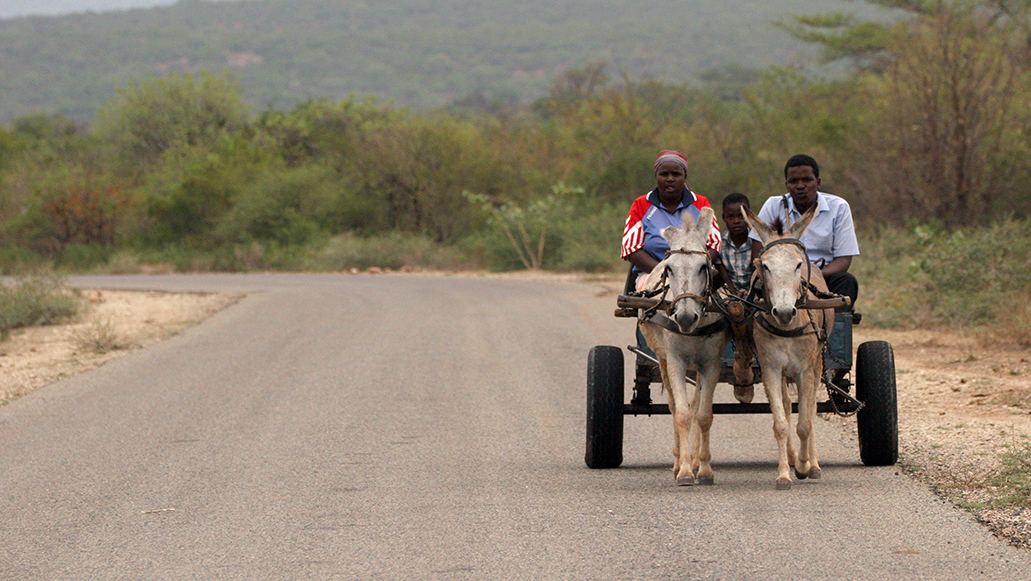
Local donkeys are fast becoming a valued ass-et. Traditionally, donkeys have been used for farming, transport and warfare. These days, however, it seems that they are becoming more and more a popular choice to farm with – or poach.
Last week the Zoutpansberger/Limpopo Mirror reported on the NSPCA (National Council of Societies for the Protection of Animals) and their growing concern for the safety of donkeys. Following the article, the newspaper approached one of the Soutpansberg's leading experts on donkeys, Dr Peta Jones, to uncover some more details.
According to the NSPCA, there is a growing trend to slaughter donkeys to sell their hides. The hides fetch an attractive sum, leading to some donkeys' being captured illegally. More often than not, these donkeys are also treated poorly.
According to Jones, the sudden Chinese demand is worrying because this spurs on all sorts of freelancers to buy as many donkeys as they can get their hands on. "The freelancers, who think that the price of donkeys will suddenly increase, buy them cheaply and then keep them under dreadful conditions while they get around to slaughtering and skinning them," explained Jones.
Reportedly, salted donkey hides are currently fetching between USD$250 and USD$325 in Hong Kong and Dong'e E'Jiao in Shandong, China.
There is, however, a benefit to this. The fact that the price of donkeys has increased, said Jones, will hopefully help people realize the true value of donkeys. "The good news is that some African countries – notably Niger – are worried enough about all their donkeys' disappearing that they have banned the export of donkeys, dead or alive," said Jones.
According to the NSPCA, the hides are soaked and then stewed to produce or release a substance known as ejiao, also referred to as donkey-hide gelatine or more commonly as ass-hide glue. In preparation, ejiao is mixed in hot water or wine and used to treat a variety of conditions, including bleeding, dizziness, insomnia and a dry cough.
During February this year the China Daily newspaper reported that a shortage of donkey hides has resulted in a deluge of fake ejiao products and imitations. As of 2015, China reportedly had a market demand of 10 million donkey skins and/or leather annually.
The newspaper further reported that China produces approximately 5 000 MT of ejiao annually, while at the same time having a donkey-hide supply that can only produce 3 000MT. The supply gap is filled by skins from mules, horses, pigs, oxen and now seemingly from South African donkeys.
Back home, however, donkeys routinely get sent to abattoirs. According to Jones, the meat is sold for inclusion in various products, including those purporting to be beef, and particularly salami. "Not everybody willingly eats donkey meat, but some populations do, notably in Namibia," said Jones.
"As for salami, I am told by Italian experts that it should be made from pork, but I remember reading many years ago that zebra meat was being exported to Italy to make salami, so it is no great jump in reasoning to conclude that the recipe changed somewhere along the line and that, in South Africa at least, donkey meat would be used," Jones added.
Another donkey product that is gaining popularity, especially overseas, said Jones, is donkey milk. "Especially in Europe, donkey milk products are very popular, which may result in a special breed of dairy donkey," said Jones.