
By Thembi Siaga, Anton van Zyl and Maanda Bele
If you need to stick to a very tight budget when buying essential groceries, your best option is to shop around rather than filling your trolley at a single retailer. By comparing prices and sticking to a grocery list, you could save more than R1,000 a month.
This is one of the key findings from our Vhembe food-basket survey for April. The latest survey is the most extensive we've done, with prices collected from 15 stores across four regions in Vhembe. We also expanded our list of essential items from 17 to 20, adapting it to include more locally popular products.
This was our second survey of the year. The first was done in March, inspired by the data journalism site The Outlier. Its methodology is based on the work of the Pietermaritzburg Economic Justice and Dignity Group (PMBEJD), which tracks the prices of a 44-item food basket typically bought by women in low-income households.
The aim of our survey was not to find the cheapest store. We deliberately avoided focusing on brand names, instead comparing prices between regions. The thinking is that if you live in a place like Elim, you are likely to shop at one of the nearby stores. The question is whether you are paying more for groceries than someone living, for example, in Thohoyandou.
How was the survey done?
Finalising our Vhembe food basket took time and extensive consultation. The challenge was to limit it to essential food items for a family of seven, working within a monthly budget of about R3,500. The consumption volumes were largely based on the PMBEJD's standards, with a few minor adjustments.
After we published the March results, we engaged with some store owners about possibly adapting our methodology. It was pointed out that the timing of a survey can significantly affect prices. Most stores use "national" pricing, which is then adjusted for local market conditions. Products delivered early in the week typically carry national prices, but if an item is in high demand and there is strong local competition, the store may lower the price. For this reason, it is better to survey prices later in the week, after such changes have been made.
We aimed to complete the survey over two days, just before the Easter weekend. Thirteen stores were surveyed at that time; two others, both in the Nzhelele area, were only visited a week later. We had to adjust for outliers — cases where cheaper options were no longer available.
We tried to stick to popular brands, such as Thokoman peanut butter (which appears to be a favourite), but price was the most important factor. In many cases, house brands were the cheapest option and were used in our calculations. In Nzhelele, some items were out of stock when we visited, so we used the same product's price from Thohoyandou, or calculated the average from the other three stores.
 |
|
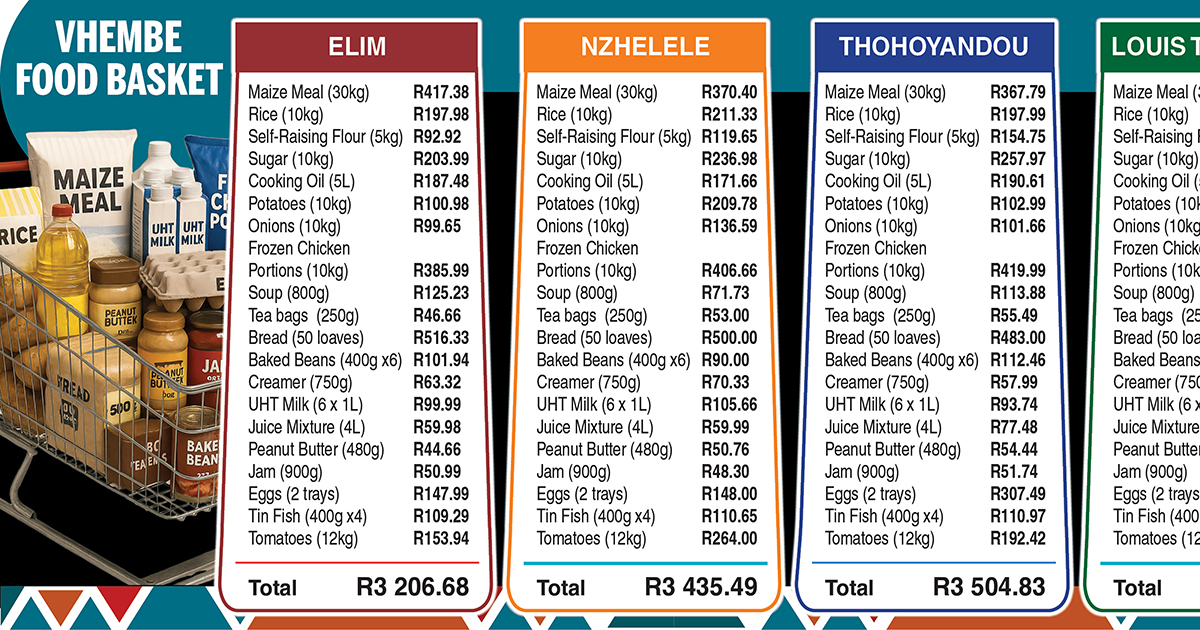
The April survey results. |
Which region is the cheapest?
The short answer is Elim — although it is not quite that simple. Interestingly, in our previous survey, Elim had been the most expensive.
This time, Elim's average basket came to R3,206.69, well below the Vhembe average of R3,425.74. Only three stores were surveyed in Elim: Shoprite, Boxer and Spar. Their prices were fairly similar, suggesting healthy competition. All three also cater to low-income households.
Louis Trichardt had the most expensive basket. The four stores surveyed there were Checkers, Boxer, Shoprite and Spar. A store like Checkers does not typically focus on low-income consumers, which is reflected in the pricing. At an average of R3,598.20, shopping in the "big town" is significantly more costly than in outlying areas.
In March, the cheapest basket was in Nzhelele. This month, it remained competitive at R3,393.25. The stores surveyed were Shoprite, OBC, Spar and Boxer. Thohoyandou's average was R3,504.84, with the same set of retailers surveyed.
To add an extra layer of comparison, we checked the websites of Checkers, Pick n Pay and Shoprite. The average cost of the basket online was R3,817.90 — noticeably higher than the regional average in Vhembe.
Do not just buy — shop around
One thing our survey made clear is the importance of shopping around. Do not simply head to your nearest store and start filling your trolley. The difference between the most expensive and cheapest baskets was R1,992.48. If time and transport are not a concern, you could pay as little as R2,531.62 for the same 20 essential items.
Nzhelele showed the biggest variation between high and low prices — a gap of R1,159.39. This was mainly because of fresh produce such as tomatoes and potatoes. Some stores are clearly better at sourcing these products locally at competitive prices.
The most consistent prices were found in Elim, where the difference between the highest and lowest-priced baskets was just R552.22.
Certain items, such as bread, have a big impact on the overall cost. We compared only 700g "house brand" brown bread, which typically sells for between R9 and R11 per loaf. At stores where only branded bread was available, we used the regional average.
Looking at the "outliers" again shows the value of checking prices. In Louis Trichardt, one store charged R249.99 for 5kg of frozen chicken portions. Two blocks away, another store offered the same item for R179.99 — a potential monthly saving of R140.
Are prices increasing?
Because the April survey used a slightly different list and methodology to March's, we cannot yet determine whether the average food basket in Vhembe is getting more expensive. We'll only be able to make that comparison after the next survey, using the same methodology and products.
The survey also does not include other essentials such as cleaning products. Unfortunately, we do not currently have the resources to carry out a more comprehensive study. For now, this remains a labour of love — a dedicated effort to give our readers the kind of information that can help them make informed choices.