
The Department of Social Development in Limpopo (LDSD) disbursed R271.7-million to organisations that cater to the needy in the 2023/24 financial year. In Vhembe District alone, the department supported more than 200 non-profit organisations.
The newspaper analysed grants to non-profits based on information supplied by the Limpopo DSD, following a Promotion of Access to Information request. The request was for details of all grants paid by LDSD between 2014 and 2024, but they have so far only supplied the requested information for the 2023 and 2024 financial years.
Based on the list of beneficiaries for the two years, the extent of the need in the province is clear. (Click here for the list of beneficiaries)
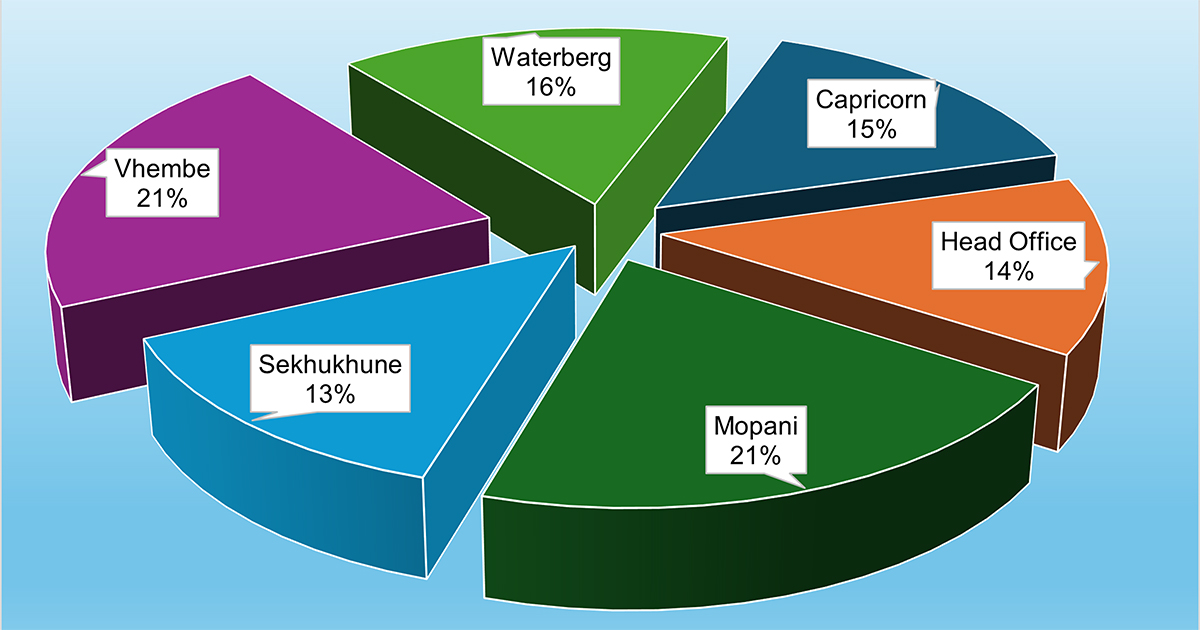
Of the money disbursed, Vhembe District received the largest slice of the funding "cake," with R57.06-million being disbursed to organisations that provide a variety of services to marginalised people and communities.
 |
|
A breakup of the regions indicating what percentage of the DSD's "cake" these received. |
Mopani District received R55.88-million and Waterberg District received R44.55-million.
More than R50-million was spent on supporting drop-in centres. Combined with the R30-million spent on youth-care centres, this means that almost 30% of the LDSD's budget was focused on dealing with matters affecting young people.
The need to cater to older people is also reflected in the expenditure, with R17.52-million spent on old -age services, and a further R12.35-million on assisting homes that cater for older persons. Organisations that offer community-based care received R22.42-million.
A large number of victim-empowerment projects were also funded, which is indicative of the problem of gender-based violence in the province. This sector received R20.72-million.
Big grants
The list of top 10 recipients include the Abraham Kriel Children's Home in Modimolle that received R9.13-million in funding in 2023/2024, which is slightly more than the R8.73-million the home received the previous year.
The Takalani Children's Home at Siloam in Nzhelele received R4.33-million to help meet their needs, compared to R4.25-million the previous year.
Another institution catering for the youth, the Holy Family Care Centre in Maruleng in Mopani District, received R3.78-million, while the Martha Hofmeyr Home in Polokwane, which cares for senior citizens, received R3.44-million.
The Epilepsy Home for the Disabled in the Elias Motsoaledi municipal area received assistance of R3.17-million, and the Noah's Ark Children's Home in Tzaneen received R2.7-million.
 |
|
A graph indicating what sectors the DSD grant money was spent on. |
Childcare prioritised in Vhembe
Seventy-eight institutions in Vhembe District drop-in centres received funding from LDSD. The total amount disbursed to these centres is just over R12-million. Two projects, the Takalani Children's Home (R4.33-million), and the CWM (The Christian Women Ministries) Children's Project in Musina (R1.62-) million, received funding for the running of youth centres.
The funding must have come as a welcome relief for the CWM Home. In 2021, it was reported that the centre was facing closure after LDSD had cut its funding, apparently because it had not renewed its registration in time to qualify.
At that stage, the centre catered for 41 children. CWM, seemingly, has sorted out the problems, and in 2022/23, the shelter received R1.42-million.
VEPs helped to combat abuse
There are 21 victim empowerment institutions listed in Vhembe. Of these, the biggest seems to be in Thohoyandou, with the Thohoyandou VEP receiving R587,599. The rest received funding around of R300,000, which probably helped to plug some of the gaps.
The fight against HIV/Aids is a priority, and 20 institutions in Vhembe benefitted from DSD grants. The two organisations that received the most funding were the Tshiendeulu Home-based Care Centre and the Pfanani Home-based Care & Aids Awareness Centre. Each received R478,466.
Substance abuse remains a problem in Vhembe, and 10 non-profit organisations dealing with this scourge were supported. The allocations to each varied between R100,000 and R285,400, which was allocated to the Xalamuka Rehabilitation Centre in the Collins Chabane region.
Two centres received funding under the banner "Behavioural Change." The Nyavhani Home-based Care Centre and the Zwoitwa Community Project Drop-in Centre both received R1.72-million. Both of these institutions are in the Thulamela municipal area.
The money goes a long way
The Zwoitwa Community Project Drop-in Centre is based at Tshitereke village, 15 kilometres north of Thohoyandou. The centre caters for 167 children and provides food daily. Apart from looking after children, the centre also caters for needy people. The centre not only provides meals twice a day to the needy residents of the area, but also assists them with chores such as washing their clothes.
When the newspaper visited the centre on Tuesday morning, manager Mrs Rejoice Phuluwa did not want to comment. She said she was not allowed to speak to members of the media.
The other project that the newspaper visited, is the Takalani Children's Home in Siloam. The centre received two allocations, a R3,78-million grant for the drop-in centre and a further R550,000 for family services.
The director of the centre, Mrs Dzivhuluwani Mudau, explained that they take care of 70 children. "They [DSD] give us a subsidy of R150 per child per day. The money is allocated according to the number of children we have. From this same R150, we also pay for school uniforms and other basic needs. We sometimes have to compromise on payments. The money is paid every six months after we claim it and confirm the number of children in our care," she said.
Mudau said that their responsibility was to ensure that all the children's needs were met. She added that although the money from DSD helped a lot, it was not enough to cover all the expenses. "It costs more than R6-million to run this home each year, and we rely mostly on donations. We are still lacking many things," she said.
 |
|
The organisations that received the biggest amounts in 2023/24. |
How Limpopo complied with DSD policy
In terms of the Department of Social Development's policy, the national department and all the provincial departments must publish "year-end reconciliation reports of all transfer payments" on their departmental websites within three months after the end of each financial year.
"The publication of information relating to transfers is an essential mechanism to improving transparency and accountability", according to the policy, which also adds: "The purpose of publishing this information is to ensure transparency and accountability."
Limpopo DSD does not have the reports on payments to welfare organisations available on its website. It has a handful of reports, but none of them contain the requested information.
To obtain the grants data, online publication GroundUp sent a PAIA request to DSD on 9 May.
On 24 June, the department sent the incorrect documents, and after this was pointed out, the department requested a 30-day extension to respond.
On 6 August, Nkanyane supplied the information for the 2023 and 2024 financial years but is yet to provide all the requested information.