
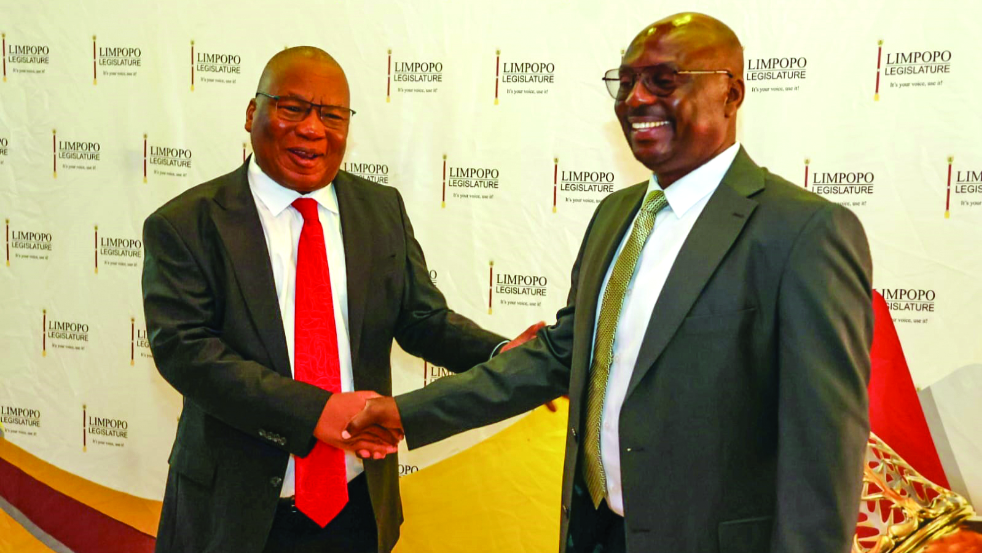
Limpopo MEC for Finance, Kgabo Mahoai tabled a R95.856 billion Provincial Budget for the 2026/27 financial year at the Limpopo Provincial Legislature in Lebowakgomo, on 10 March 2026, outlining how government will spend public funds to support service delivery, improve roads and infrastructure and drive economic growth across the province.
The budget prioritises catalytic projects aimed at stimulating economic development and job creation, while safeguarding essential services such as education, health, and social services, at a time when public finances remain under pressure and the demand for services continues to grow.
Limpopo’s total receipts amounts to R95.001 billion, most of which comes from national government transfers. The Provincial Equitable Share contributes R78.951 billion, accounting for 83.1% of the province’s income. Conditional grants from national government amount to R13.810 billion, while the province raises R2.240 billion in its own revenue, mainly through motor vehicle licence fees and health service charges.
The Department of Education receives the largest share of the provincial budget, amounting to R45.821 billion, which represents 47.8% of total provincial spending. The funding supports teacher salaries, the school nutrition programme, infrastructure improvements and e-education initiatives aimed at strengthening learning outcomes and matric results across the province.
Healthcare also remains a major priority. The Department of Health receives R28.684 billion, accounting for 29.9% of the provincial budget. The allocation supports hospitals and clinics, the employment of doctors and nurses and the upgrading of health facilities. It also supports preparations linked to the Limpopo Academic Hospital.
Mahoai says for the province to realise a sustainable economic development, its people should be healthy and educated.
The Department of Social Development receives R2.476 billion to support services for vulnerable communities. The funding assists care centres, social workers and non-profit organisations that provide support to families, children and older persons.
Infrastructure spending forms another key part of the provincial budget. Government allocates R9.393 billion for infrastructure projects in 2026/27, with R24.845 billion committed over the three-year spending period. Maintenance receives the largest share, with R3.020 billion allocated to maintain existing roads, schools and healthcare facilities.
Road infrastructure remains a major focus. The budget includes R1.95 billion for road upgrades and maintenance, including the ZCC Interchange. Government is also working to secure R1.3 billion to construct 17 new paved roads across the province.
Economic development also receives targeted investment. The province allocates R7.010 billion over three years to support economic growth and job creation. Major projects include R1.056 billion for the Musina-Makhado and Fetakgomo-Tubatse
Special Economic Zones, R338 million for agriculture and agro-processing projects, including Zebediela Citrus and Makgoba Farms, and R205 million for the Limpopo Tourism Agency to promote tourism and investment.
Mahoai says jobs are expected to be created during the construction phase of these projects while sustainable permanent jobs should be realised upon completion of the projects.
The budget also responds to recent floods that damaged infrastructure in some parts of the province. Mahoai started by tabling the 2025/26 Amended Adjustment Budget for the immediate intervention in this regard. He said the provincial government redirected R685.340 million within the 2025/26 budget for urgent disaster recovery projects, while the National Disaster Management Centre approved R53.3 million to assist with repairs in education, health and road infrastructure.
Over the medium-term expenditure framework, which is the next three years, Limpopo allocates R293.334 billion to provincial departments and public entities, reflecting continued investment in service delivery, infrastructure and economic development across the province. This means Limpopo is planning ahead and not just surviving the moment.