
The 12.41% electricity tariff increase, which takes effect in July, is expected to have the biggest impact on consumers following the adoption of Makhado Municipality’s 2026/27 budget. Apart from the higher electricity costs, the municipality’s new budget contains few major surprises.
Mayor Dorcus Mboyi described the budget as a “roadmap towards a better future” when she presented it on Friday, 26 June. She highlighted several challenges facing the municipality, including global economic uncertainty, rising costs and increasing pressure on service delivery.
The municipality’s primary strategic priority for the coming financial year is a R149-million investment in critical infrastructure, focusing on expanding electricity networks and upgrading strategic roads to improve links between communities and economic centres. Mboyi said R4 million had been earmarked for agricultural and arts cooperatives, while the resumption of mining operations was expected to create more than 700 permanent jobs.
To help finance the R1.778-billion budget, property rates and most municipal service charges will increase by 3.4%. The 12.41% electricity tariff increase is in line with the tariff approved by the National Energy Regulator of South Africa (NERSA).
Where will the money come from?
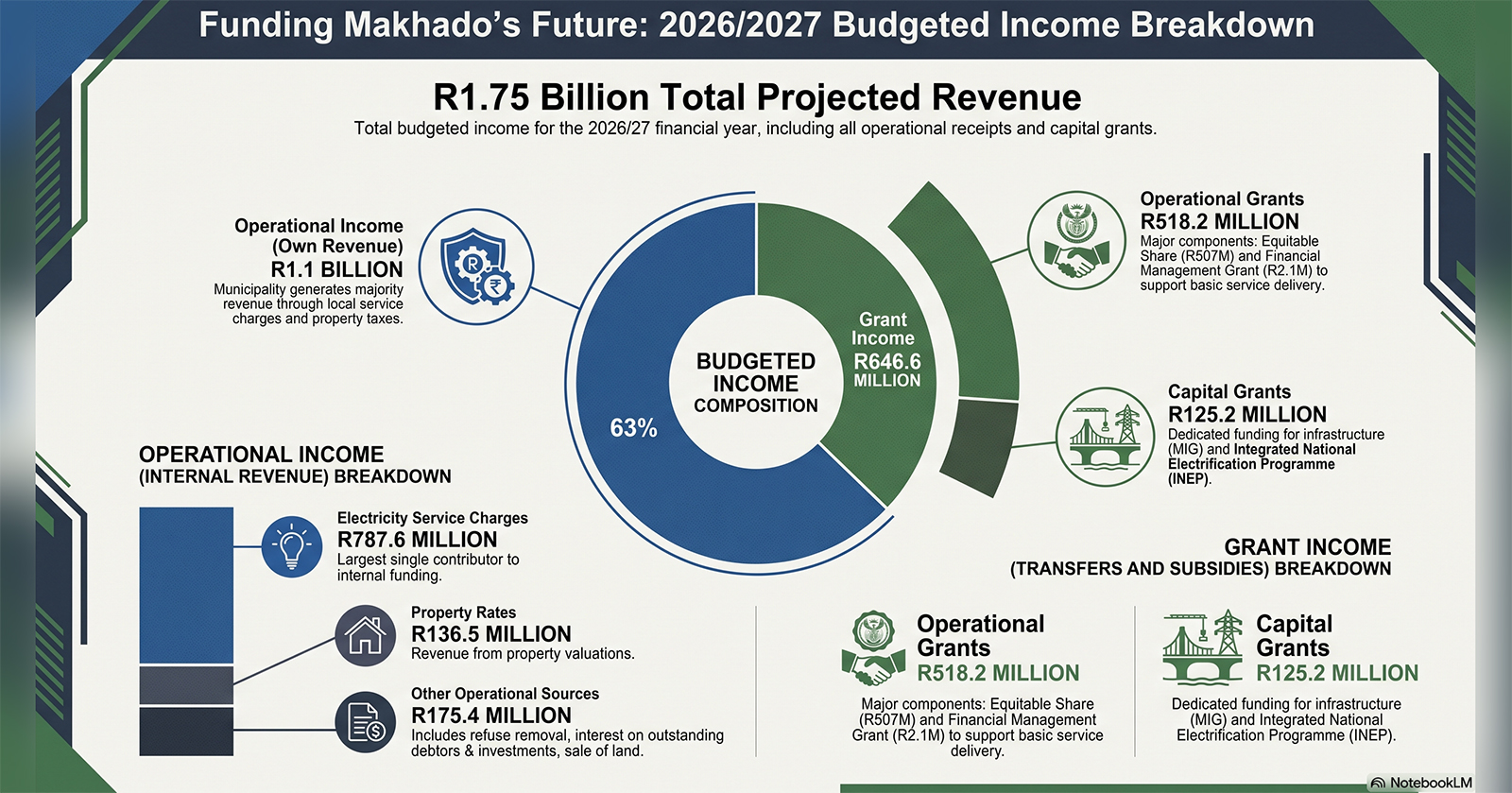
Makhado Municipality is one of only two municipalities in the Vhembe district licensed to distribute electricity. Electricity service charges, budgeted at R787.6 million, account for the largest share of the municipality’s projected R1.1-billion operating revenue.
Property rates are expected to generate R136.5 million, while interest on outstanding debt will contribute R51.8 million. Refuse removal charges are expected to bring in a further R17.2 million.
The municipality also sold several residential stands during the past financial year and hopes to begin collecting the proceeds. Around R70 million remains outstanding from auctions of residential stands, including those south of Pretorius Street and at Extension 9.
Revenue generated by the municipality will not be sufficient to cover all expenditure, however, and it remains heavily dependent on grants from national and provincial government to fund service delivery and infrastructure projects.
The main grants are:
Equitable Share: R507.068 million.
Municipal Infrastructure Grant (MIG): R112.837 million.
Integrated National Electrification Programme (INEP): R8.392 million.
Expanded Public Works Programme (EPWP): R3.346 million.
Financial Management Grant (FMG): R2.1 million.
The budget assumes a debt collection rate of 91%, although the municipality’s mid-year report indicates that some revenue streams, particularly electricity (41%) and “Other Revenue” (83% of the mid-year target), require close monitoring.
Main operating expenditure
The largest share (34.5%) of the municipality’s R1.52-billion operating expenditure will go towards bulk electricity purchases from Eskom. A total of R524.1 million has been budgeted for this purpose, just over 4% more than in the previous financial year.
Employee-related costs account for 29.5% of operating expenditure, amounting to R449.1 million, compared with R428.65 million in the previous year. Councillors’ remuneration is budgeted at R36.2 million.
The often-controversial contracted services budget has been reduced from R197.02 million in 2025/26 to R154.07 million. The municipality attributes the reduction to “reducing expenditure due to weighty cash constraints”.
Finance charges are expected to amount to R15.3 million, while inventory consumed are budgeted at R55.1 million. Interest and finance costs increased sharply during 2025/26, reaching almost four times the level recorded in 2024/25. Although they are projected to decline slightly in 2026/27, they remain almost three times higher than they were two years ago.
Capital projects
The municipality has budgeted R215 million for capital expenditure during the new financial year. Roads account for the largest share of the capital budget, with R132 million allocated to the construction of new roads and the rehabilitation of existing infrastructure.
Using R112 million from the Municipal Infrastructure Grant, the municipality plans to upgrade several key access roads, including:
* the road to Mavhoyi TVET College;
* Tshino Access Road and Madombidzha (50/50);
* Ramantsha to Ravele Road (Phase 1) and the Rabali to Divhani Access Road; and
* the Ring Road linking Nwaxinyamai, Tshivhade, Mavhina and Bungeni.
A further R12 million has been allocated to repair culverts and bridges damaged by recent floods. Another R5 million will be used to repair critical routes, including the Mbokota School to Paul Kubayi Road and the Shirley Primary to Dombani Road.
The municipality also plans to improve access to electricity and strengthen the stability of the existing network. A total of R8.3 million has been allocated to extend electricity connections to communities including Tsianda, Woyoza, Riverplaats and Muungamunwe.
Using internally generated revenue, the municipality will complete Phase 4 of the Main Substation and upgrade the Emmarentia, Boom Park and Roodewal substations.
A preventative maintenance programme will replace rotten poles and high- and low-voltage equipment across several wards, including Mara, Sinthumule and Kutama.
Stimulating the local economy
The municipality has earmarked R25 million to stimulate the local economy and manage urban growth. Projects include the completion of the Dzanani Taxi Rank and market stalls to support local traders and transport operators.
Roads and stormwater infrastructure will also be developed for new residential areas, including 164 stands at Tshikota, 700 stands south of Pretorius Street and 178 stands at Extension 9. A further R4 million has been allocated for township establishment in the area known as the grazing paddocks (Rietvlei portions).
The municipality has also budgeted R28.6 million for the procurement and maintenance of its vehicle fleet, including the purchase of a new refuse removal truck at a cost of R2 million.
Another R7.7 million will be invested in Information and Communication Technology (ICT) as part of plans to build a “smart municipality”, including the rollout of Wi-Fi at community facilities.