
By Anton van Zyl and Raymond Joseph
The relatively easy manner in which almost R25 million was siphoned from the National Lotteries Commission (NLC) is laid bare in a case heard virtually by the Special Tribunal last month.
The case provides insight into how the South African Sports Confederation and Olympic Committee (SASCOC) acted as a conduit for the diversion of lottery funds.
It assisted the newly registered Mshundakani Foundation, established just months earlier, to secure a multimillion-rand grant from the NLC for a supposed “Rio Roadshow send-off” shortly before the 2016 Olympic Games.
Many of the role players are from the Vhembe district and were also involved in other dodgy projects in the area, such as the building of the Vhafamadi Secondary School.
In a judgment delivered on 27 May this year, Judge BA Mashile set aside the R24.98 million grant awarded by the NLC to SASCOC in July 2016. The judge declared the underlying grant agreement unlawful and invalid and ordered the respondents who benefited from the grant to repay the funds.
The foundation was “an entity identified and effectively handpicked” by Alfred Nevhutanda, the former chairperson of the NLC board, according to the judgment.
Nevhutanda, who has been implicated in the looting of the lottery, is currently challenging President Cyril Ramaphosa’s authorisation of a Special Investigating Unit (SIU) probe into corruption at the NLC.
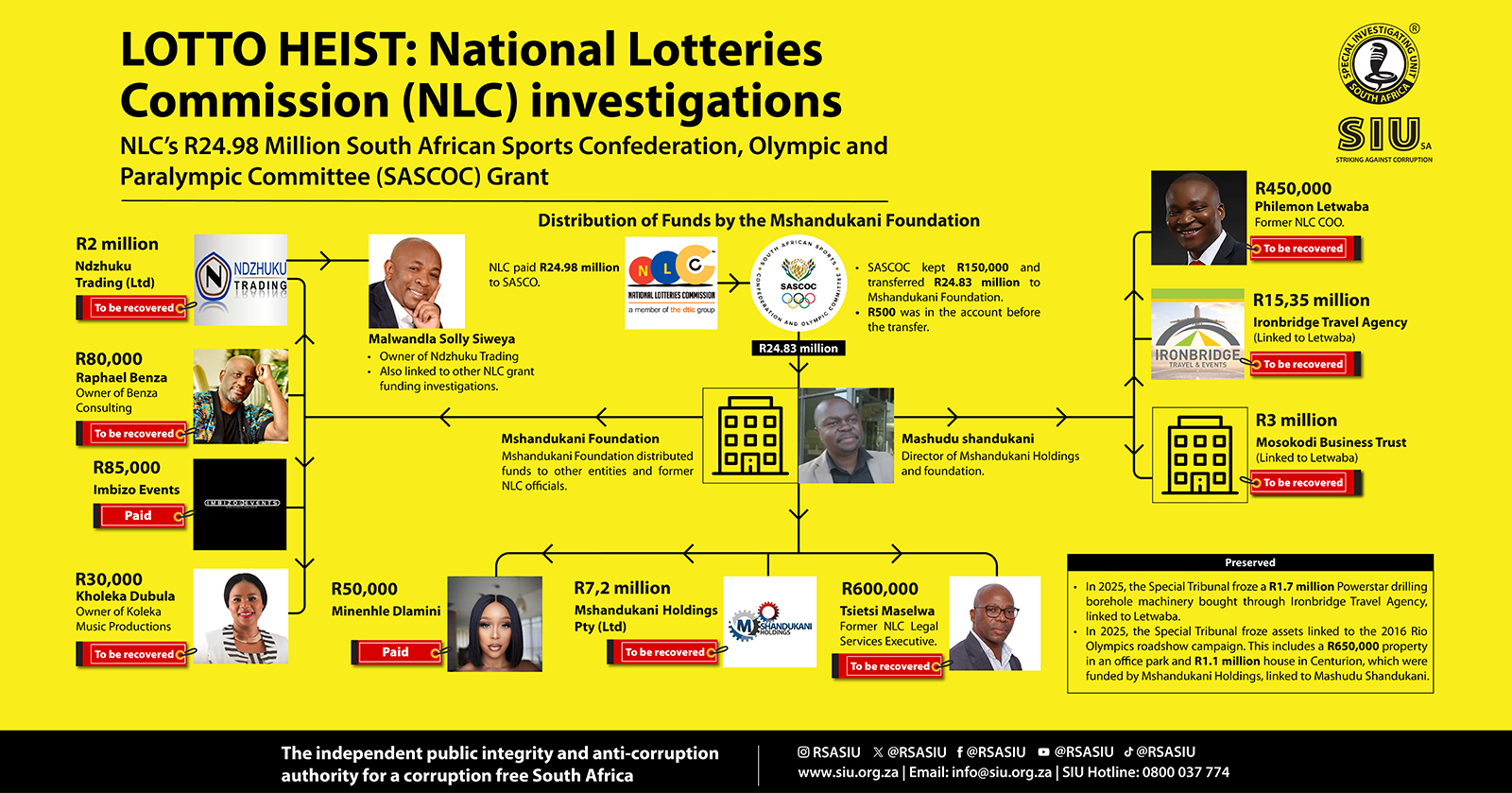
Once the foundation received the money from SASCOC, it distributed most of the funds to a network of companies, including several linked to former NLC chief operating officer (COO) Phillemon Letwaba. Letwaba and former NLC legal head Tsietsi Maselwa also benefited in their personal capacities.
Others who benefited from the grant included Solly Siweya, a businessman linked to other disputed NLC grants, and actress and TV presenter Minnie Dlamini, who has repaid R50,000 she received from the foundation. Imbizo Events, which received R70,000, has also repaid the funds it received.
In 2025, the Special Tribunal froze a R1.7 million drilling rig bought with funds from the Olympic grant by Ironbridge Travelling Agency, a company linked to Letwaba.
Also in 2025, it froze a R650,000 property in an office park and a R1.1 million house purchased by Mshandukani Holdings. Mashudu Shandukani, a director of the foundation, is also a director of Mshandukani Holdings.
A rush job to channel millions
The scheme was seemingly set in motion even before SASCOC submitted its funding application for R24.98 million to the NLC on 7 July 2016.
Five months earlier, the Mshundakani Foundation was registered. It had three directors: businessman Mashudu Shandukani and two women, Ndungiselo Reface Murandana and Mukundu Khumeli. The women, who were employees at Mshandukani Holdings, told the Tribunal their identities had been used without their knowledge or consent.
During the 2015/16 financial year, SASCOC had already received R189.37 million in funding from the NLC, while its grants for the 2016/17 financial year totalled R74.3 million. Even with funding for the Olympic Games, the amount raised concerns.
The NLC board chairperson, Alfred Nevhutanda, identified the Mshandukani Foundation as the organisation he wanted funded and instructed SASCOC to prepare a grant application for R34.8 million on the foundation’s behalf.
SASCOC told the Tribunal it was “placed in an unenviable position”, as it “could not readily reject a proposal advanced by Professor Nevhutanda, who at the time was the chairperson of the National Lotteries Commission and whose office was pivotal to SASCOC’s access to funding,” according to the judgment.
SASCOC argued that “any refusal to accede to the proposal carried with it the real risk of jeopardising its prospects of securing future financial support from the National Lotteries Commission.”
It proceeded to submit an application to the NLC’s Charities Distributing Agency (DA), which approved a reduced grant of R24.98 million.
An impossible timeline
The application was fatally flawed from the outset. The foundation had existed for only about five months and was unable to provide the required two consecutive years of audited financial statements.
The NLC’s distributing agency nevertheless approved the grant without conducting a site visit, verifying the information submitted, or requesting outstanding documentation, the judge found.
He was scathing of the DA’s role, finding that members who adjudicated the grant neglected their duties and acted outside their legal authority by failing to perform basic due diligence and statutory obligations.
Judge Mashile concluded that the DA’s decisions were “vulnerable to review under the principle of legality” because they ignored the rules designed to ensure the fair and equitable distribution of public funds.
The grant was awarded in July 2016 for a “Send-Off to Rio Campaign” — public awareness and promotional activities in support of Team South Africa’s participation in the Rio Games. There were, in fact, two separate Games in Rio that year:
* The 2016 Summer Olympic Games, held from 5 to 21 August 2016 in Rio de Janeiro, Brazil.
* The 2016 Paralympic Games, held from 7 to 18 September 2016, also in Rio de Janeiro.
For a legitimate “Send-Off to Rio Campaign”, funding would typically have covered public awareness events, media campaigns, send-off ceremonies, branded merchandise, promotional travel and accommodation, and community outreach activities.
However, the timeline shows such a campaign would have been virtually impossible. The application was submitted on 7 July 2016, approved on 13 July, and paid on 20 July — with the Olympic Games beginning 16 days later on 5 August.
A record dash to spend the money
The funds were paid into SASCOC’s account quickly, but little, if any, was used for Olympic awareness activities.
Once disbursed by the NLC, SASCOC transferred R24.83 million to the Mshundakani Foundation, retaining R150,000 as an administrative fee. Before receiving the funds, the foundation had only R500 in its bank account.
The foundation then rapidly distributed the money to a network of companies and individuals.
The largest beneficiary was Ironbridge Travelling Agency and Events, which received R15.35 million. A family member of then NLC COO Philemon Letwaba was its sole director.
Mshandukani Holdings, where Mashudu Shandukani was a director, received R7.23 million.
This was followed by R2 million to Solly Siweya’s Ndzhuku Trading, as well as smaller payments to Benza Consulting, Imbizo Events, Kuleka Music Productions and Minnie Dlamini.
The Tribunal heard that companies receiving funds via Ironbridge were linked to former NLC employees and their relatives. These included Letwaba and former NLC legal services manager T.S. Maselwa, who received R600,000. Mosokodi Business Trust, linked to Letwaba, received R3 million. Both Letwaba and Maselwa have since resigned.
The judge found that the funds were used outside the scope of the grant agreement, including for motor vehicles, goats, payments to panel beaters, network installations, décor for an unveiling event, and payments to entities linked to Letwaba.
None of these expenditures fell within the grant agreement. The final progress report submitted by SASCOC to the NLC was misleading, overstating disbursements and covering a period predating the actual payment of the grant.
Passing the blame
An almost humorous aspect of the case — were it not so serious — was the manner in which the various parties attempted to shift responsibility. There were 17 respondents in the case, including SASCOC, Mshandukani Holdings, companies linked to Letwaba, and several artists.
Vinesh Maharaj, SASCOC chief financial officer, argued that his actions were strictly professional. He maintained that SASCOC was never truly party to the funding proposal and acted under pressure from Nevhutanda. He also argued that the R150,000 retained by SASCOC was an administrative fee.
Judge Mashile was not persuaded. He held Maharaj liable for his role, finding that he facilitated payments despite awareness that the process was potentially unlawful and in breach of fiduciary duties.
Maharaj was held jointly and severally liable with SASCOC to repay the R150,000.
Mashudu Shandukani, a director of both the foundation and Mshandukani Holdings, was part of the group referred to as the “Shandukani Respondents”. Their defence was a complete denial of knowledge or wrongdoing.
Judge Mashile described these arguments as “hard to swallow” and found that Shandukani was a central participant in the scheme.
The Shandukani Respondents claimed they were unaware SASCOC had applied for funding on their behalf and that funds were used in accordance with their agreement with SASCOC.
The judge rejected these claims as “untenable” and “implausible”, citing evidence contradicting their version. He found the funds had been misappropriated for personal benefit.
He ordered Shandukani and the other implicated respondents to repay R24.83 million to the SIU. Costs, including those of two counsel, were awarded against SASCOC, Maharaj and the Shandukani respondents.