
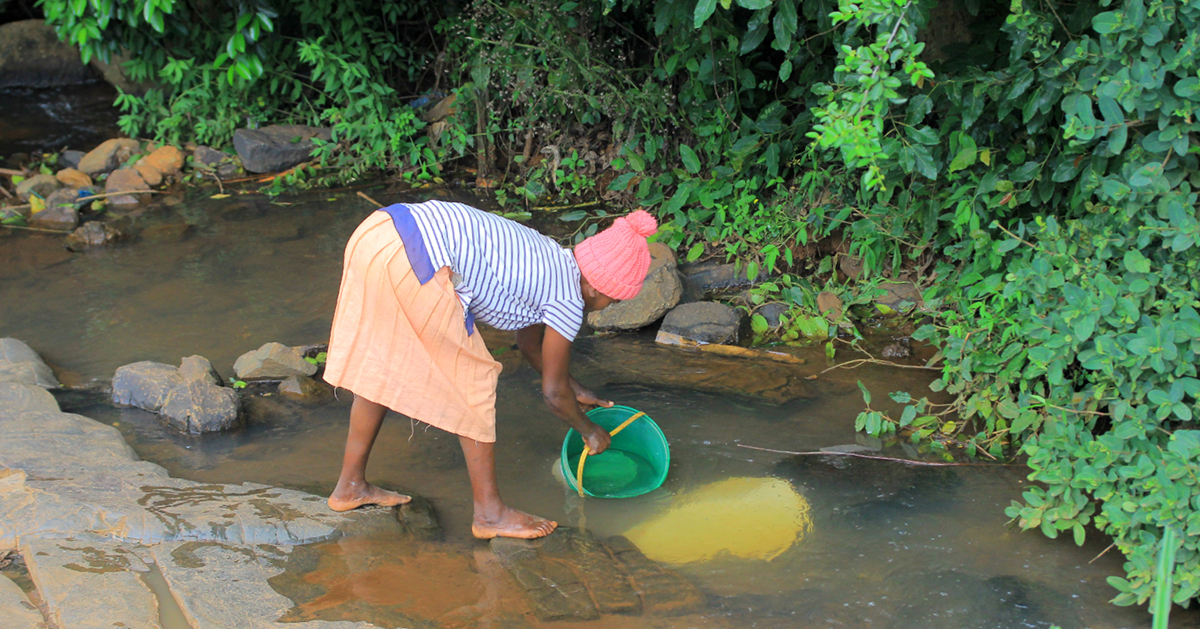
In Elim and the surrounding villages, residents continue to live without reliable access to clean water, despite multimillion-rand bulk-water projects that once promised relief. Years of frustration have left households paying for water or relying on the nearby river for daily use.
Many residents say they have lost hope of ever seeing water flow from their taps again. Water tankers from the Vhembe District Municipality (VDM) arrive rarely — some residents reported going more than six months without a single delivery.
Some villages do not have any boreholes drilled by VDM. Households, including pensioners, are forced to pay between R250 and R350 to refill their storage tanks, or R2 per 20-litre container from private sellers. A 200-litre drum costs R30 to refill. Others fetch water from rivers for washing and bathing. At Mabedengwa, no borehole is working, and some villagers walk to a nearby fountain to wash clothes. The village's only borehole, drilled during the apartheid era, has been non-functional for many years.
Limited access and dysfunctional boreholes
In several villages, residents receive water only for a few hours on Saturdays from a single borehole, and even then, only a handful of households get any supply. Limpopo Mirror visited five boreholes across different villages — none were operational. Valdezia is an exception, where some villages receive water throughout the day, but in most surrounding villages, water is available for only a few hours on Saturdays. In some areas, households get water for as little as two hours.
One of the boreholes at Tshuhari stopped working around May this year. A document titled Borehole Status at Elim Satellite shows the scale of the crisis: of 109 boreholes across 19 villages, only 45 are functional. On the ground, even fewer appear to work. At Elim Mabobo, a borehole drilled seven years ago was never completed, while communities such as Elim, Valdezia and Waterval face multiple dry boreholes and empty reservoirs.
Residents struggle to access water
At Tshuhari village, residents say their borehole has been broken since May and has never been repaired. "We have to buy water for R2 a container. Most of us depend on SASSA child grants, and that same money goes to buying water. When it rains, we collect rainwater for washing," one resident said.
In Magulule village, residents collect water from the Magulule River. "The water is not clean, but we have no choice," said Sarah Maphahla, filling a bucket. "We only buy water for cooking and drinking because we don't have enough for everything."
Not far away, in Vari village, 64-year-old pensioner Thiathu Sinwamali lives just a few metres from a large reservoir that has stood empty since 2012, after one of the boreholes broke and was never repaired. "The last time we received water was around 2012," she said. "I refill my 1,500-litre tank for R350 from private trucks. We are suffering. Grants aren't enough for both food and water, and we still have to pay for funeral policies. We feel neglected."
Communities say repeated pleas to VDM for water restoration have brought little change. Mishark Mabobo, chairperson of Tshuhari Pastoral Village, said, "Elim as a whole feels forgotten. Most boreholes are not working, and we can go for three months without water. Sometimes we only get it for a few hours on Saturdays."
Valdezia-Elim pipeline project remains on hold
The R215-million Valdezia-Elim bulk water pipeline — meant to address widespread shortages — has not started. This is according to VDM's Water and Sanitation Provision presentation to the National Council of Provinces (NCOP) in September 2023. The project aims to improve bulk supply to Elim, Vleifontein, Mailaskop, Tshitale and surrounding areas.
According to the official schedule, construction was expected to begin on 1 July 2024 and finish by 30 June 2025. But the project remains in the planning stage, with no funding allocated. The municipality estimates the cost at R215 million, but the current budget is R0 — meaning work cannot begin without external financial support.
Although VDM says boreholes are being repaired, the current budget for the Waterval/Elim scheme remains inadequate. Empty reservoirs reflect deeper infrastructure failures, with some taking weeks to refill and others remaining dry for years. Residents who cannot afford to purchase water are forced to rely on unsafe sources. "We know river water is not clean," said Maphahla. "But when you have no choice, you just hope it doesn't make you sick."
Private water sales fill the gap
A water seller from Elim, Dumisani Mugari, said he began selling water in 2017 with only R300 and now charges R350 per tank refill. "I source water from my home borehole. I applied for a licence last year, but it's still taking time," he said.
When asked about water quality, he said, "I believe it is safe, as we also use it at home for daily purposes."
In Vari, one homeowner has connected water with long pipes to nearby households and charges R250 per refill.
VDM spokesperson Moses Shibambu said the municipality planned to build bulk pipelines from Valdezia and Chavani to supply Elim, Mbokota, Shirley and neighbouring villages. He added that selling water for profit requires municipal authorisation under the Water Services Act. Private water sales are not authorised, and VDM is working with law enforcement to enforce its by-laws.
"Villages around Elim rely on underground water — boreholes and tankers in the meantime — while waiting for project funding," Shibambu said.
VDM's policies fall under national legislation, including the National Water Act and the Water Services Act, which prohibit unauthorised commercial water distribution. A 2018 statement by the Department of Water and Sanitation further confirms that water from private boreholes remains the property of the state and cannot be sold without proper authorisation.
Shibambu said the municipality was enforcing by-laws and had been drilling new boreholes as short-term interventions. Artisans, he added, had been appointed to repair non-functional boreholes. But none of the boreholes visited were operational.
"The municipality has investigated the private water seller and also found that they don't buy water from the water service authority. The municipality is also busy with the removal of illegal connections, hence we need the support of all community stakeholders to deal with these challenges," he said.