
By Elmon Tshikhudo and Anton van Zyl
The court ruling that traditional leaders may not charge compulsory levies has created mayhem and may also have a devastating impact on the ability of traditional councils to offer various services to communities. Several senior traditional leaders criticised the ruling, saying the courts do not fully understand how traditional law operates.
On 20 December last year, the Constitutional Court confirmed a previous ruling by the Limpopo High Court that traditional authorities are not allowed to raise taxes in any form, making compulsory payments for services such as the issuing of certificates illegal.
One of the Vhembe region's most senior traditional leaders, Mailausumbwa Kennedy Tshivhase, said the ruling would have an adverse impact on service delivery. He defended the practice of raising funds from residents, saying it is called "nduvho" and should not be construed as a tax or a levy.
"We do not charge a cent for services we render to our subjects. What happens is that residents contribute whatever they can afford. This is an age-old tradition practised by our forefathers and carried over generations. Stopping this would render traditional councils ineffective," he said.
Tshivhase was the only senior traditional leader approached last week who was willing to voice an opinion on the matter. The others were seemingly waiting for the Department of Cooperative Governance, Human Settlements and Traditional Affairs (Coghsta) to provide guidance. "What we are going to do is have a thorough look at the judgment and see what inputs we can make," Tshivhase said.
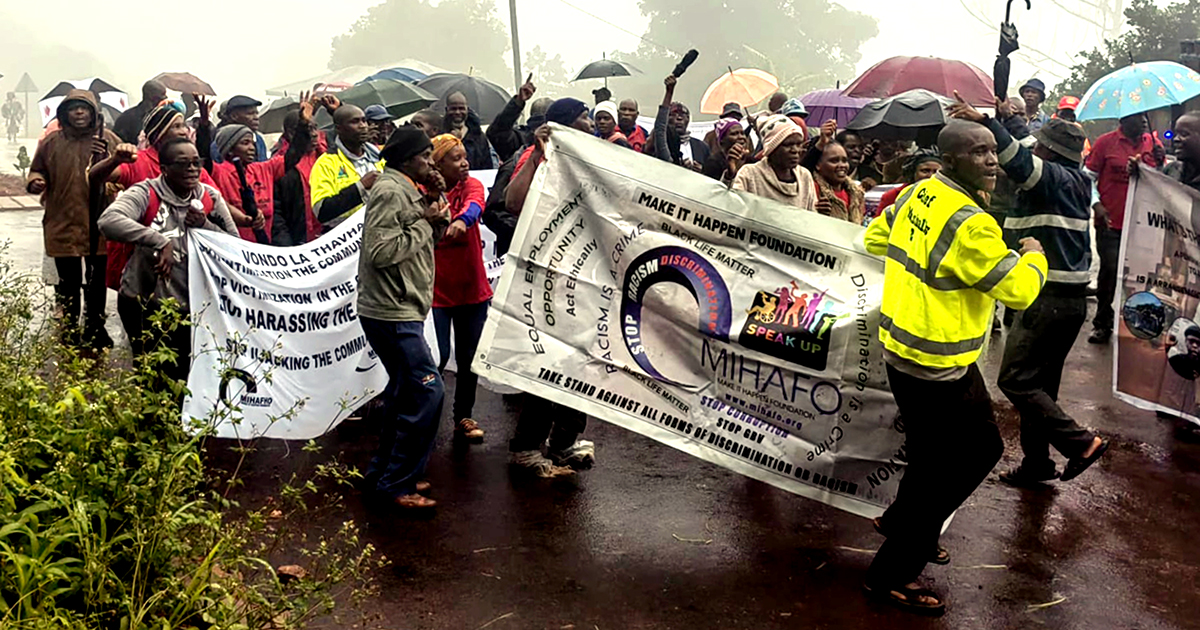
However, discontent with having to pay often-exorbitant fees to traditional authorities has been simmering for some time. Earlier this year, the Zoutpansberg Community Development Forum (ZCDF) convened a meeting at the Makhado Show Grounds to discuss, among other things, the fees charged in the Kutama area. Last Friday, a protest march was held at Mukumbani, organised by the Make It Happen Foundation (MIHAFO). During the march, protesters also complained about being forced to pay exorbitant levies to the Tshivhase traditional authority.
In the memorandum handed over to the Tshivhase Traditional Council, some of the levies were highlighted. A list of tariffs allegedly charged was also distributed. According to this list, residents must pay R100 to the musanda for a permission-to-occupy (PTO) letter, for example, when applying for a housing allowance. A further R500 must be paid to the khoro before the letter is issued. Opening a spaza shop costs R3,000 to the musanda and R6,000 to the khoro.
When Mailausumbwa Tshivhase was asked about these fees, he said there were no stipulated amounts for nduvho and that residents contributed freely and willingly, knowing it was for their own benefit.
The ZCDF also shared a list of rates charged in the Kutama area. According to this list, it costs R1,500 for a licence to open a spaza shop. Applying for a change of ownership certificate costs R800, while a PTO letter is only R100.
None of the lists specified that these were voluntary contributions, nor was it indicated whether some of the fees would be paid to the relevant municipality, which has the legal mandate to charge such levies.
The Legal Resources Centre (LRC), which represented the 11 applicants in the court case, responded on Tuesday to questions, including how they perceive the ruling will affect the collection of much-needed revenue by traditional authorities.
"Traditional authorities can only raise voluntary levies, following clear consultation with the community about the purpose, amounts, and necessity of these funds. Customary law supports this voluntary approach rather than compulsory levies," the LRC said.
In the case of services such as funeral funds for the maintenance of graveyards, the LRC said it would be more appropriate for local municipalities to take responsibility for such services. "These are essential public services that should be provided by local government. Municipalities are elected entities and should be accountable for delivering such services, with residents contributing to these through standard taxes or levies managed by the municipality. This ensures transparency and democratic control over such vital services."
Various stakeholders pointed out that it may now become very difficult for traditional leaders to raise the necessary funds for development projects.
"The court ruling does not prevent traditional leaders from leading or initiating communal projects, but it limits their ability to impose compulsory taxes or levies on residents. This ruling is important, because it ensures that no one is unfairly exploited, especially marginalised communities who rely on government support," the LRC said.
The LRC acknowledged that traditional leaders may face challenges in raising funds directly from their communities but said the ruling did not bar them from seeking funding or partnership opportunities with government bodies, NGOs, or other stakeholders for development projects.
"The focus should now shift to using transparent, legal, and voluntary methods for gathering support and funding, perhaps through collaboration with local municipalities or other institutions responsible for providing development and infrastructure services. The legal framework for such funding should be equitable and in line with democratic principles, ensuring that projects serve the needs of the community without placing undue burdens on residents," the LRC said.