
Duthuni's "King of Crocodiles" has defended himself against accusations of animal cruelty, saying he did not torture a Nile crocodile but was merely trying to protect both the animal and local residents.
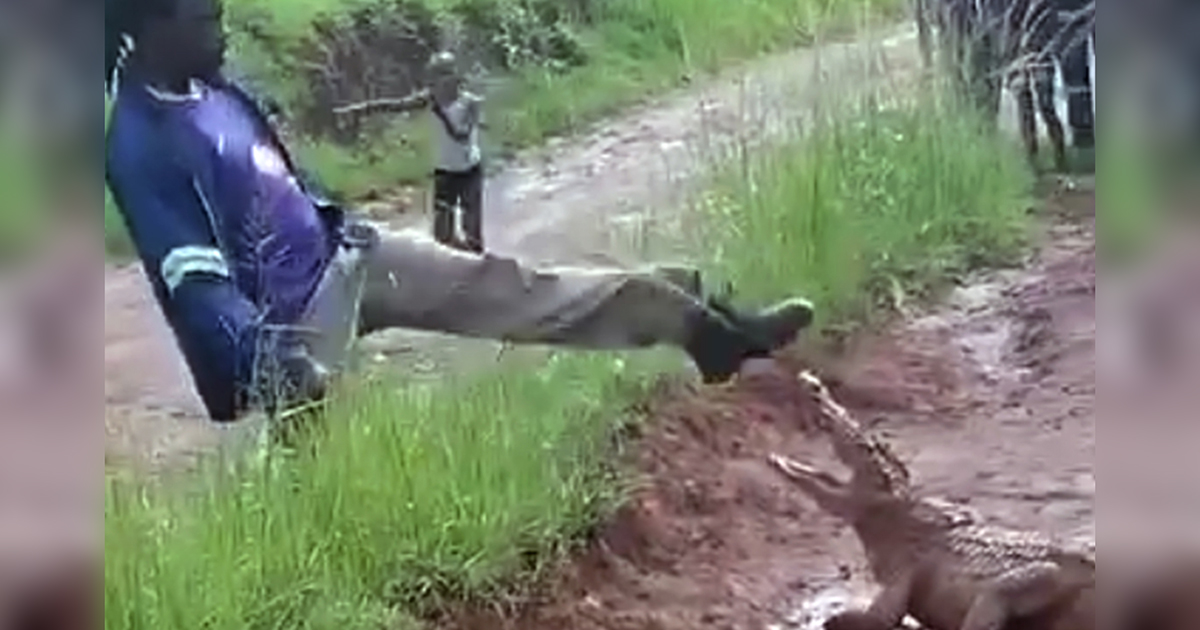
Robert Munyai became an instant social media "star" when a video surfaced of him teasing and injuring a wild Nile crocodile trapped in a ditch near Duthuni village. The area has had plenty of rain since January, with streams coming down in full force, forcing crocodiles to move to higher ground. The video quickly went viral on social media platforms such as Facebook and TikTok.
Munyai, a father of 12, claims he was trying to rescue the crocodile. He said he had placed his boots on its mouth to exhaust it and check whether it still had teeth as it was full of soil. "I called the police and warned them that if the crocodile died, people might kill it for its brain, which is poisonous. Moving away could have put us in danger," he said.
When asked if he knew that his actions had legal consequences, he said he did not. "I was protecting the crocodile and the people because some wanted to kill it. If authorities come for me, I will apologise. I didn't know someone was recording a video, and I only found out later," he said. Munyai claimed he had also reminded the group about a 2002 incident in which a crocodile was killed, and many people later died from poisoning linked to it.
But Munyai's actions did not sit well with animal lovers or institutions such as the National Council of Societies for the Prevention of Cruelty to Animals (NSPCA). The incident was reported to the SPCA's Louis Trichardt branch, and senior inspector Lawrence Khodobo investigated. He confirmed on Tuesday, 4 February, that a case would soon be opened under the Animal Protection Act.
"I can't say Munyai has been charged yet, because we still have the docket. It might be completed this week," he said. Khodobo added that he would be finalising the affidavits this week. "By Friday, we will probably register the docket. However, I can confirm that he will be charged under the Animal Protection Act 4," he said.
Munyai, however, remains adamant that he was only trying to "tame" the reptile, so that officials from Limpopo Economic Development, Environment and Tourism (LEDET) could capture and relocate it.
In the widely circulated videos, viewed by hundreds of thousands of people, other community members can be seen attacking the crocodile and injuring it.
In a press release issued by the NSPCA on 29 January, the incident was strongly condemned. "In the videos, the man is seen beating and kicking the animal on the snout. Later, he uses a slasher to slash at the crocodile, striking it multiple times in the mouth. At the same time, several others are seen stoning the injured and defenceless animal," the NSPCA said.
The NSPCA also criticised the behaviour of the bystanders, who "appeared to enjoy the behaviour, cheering the man on and stating that it should be killed".
The organisation is also not convinced that Munyai was acting in the animal's interest. "Upon further investigation, it was revealed that the man responsible had added to the crocodile's pain and suffering by hacking at the animal's teeth while it was still alive. Nature Conservation authorities later humanely euthanised the animal," the statement reads.
Munyai's argument that a crocodile's brain is poisonous is also not accepted as an excuse for his alleged behaviour. The belief that it can cause immediate death in humans is ascribed to superstition. While many health forums advise against eating animal brains because of high levels of certain proteins that can trigger medical conditions, there is no scientific evidence that a crocodile's brain is toxic.
The NSPCA has also warned against the distribution of videos depicting animal torture.
"The NSPCA is concerned about the number of acts of cruelty against animals that are being filmed for entertainment and circulated on social media. It is unimaginable that social media users can find animal torture and cruelty entertaining. Animals are sentient beings that, like us, experience positive and negative feelings such as happiness, sadness and pain. We implore all South Africans to treat all animals with the respect they deserve," the statement reads.