
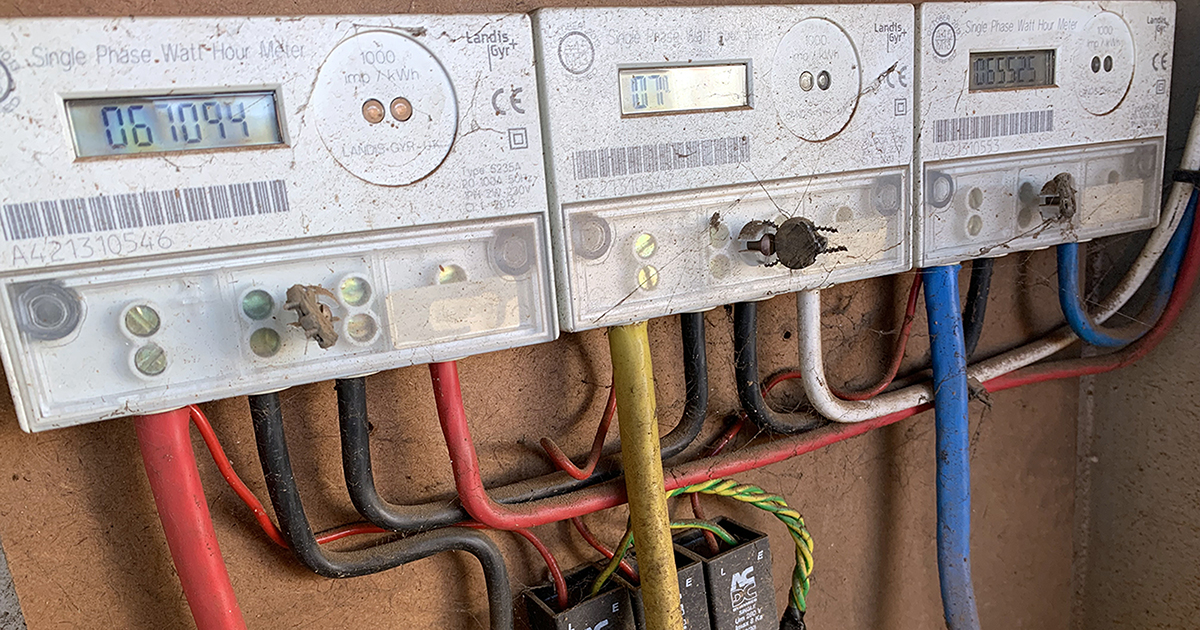
A somewhat bizarre situation has developed in the Makhado Municipality, where property owners who make electricity available to tenants may end up having to subsidise part of the costs. An interesting case is currently pending where a landlord is alleged to have contravened the legislation regulating the provision of electricity but, in fact, all he tried to do was cover his expenses.
The dispute between a tenant and landlord in Louis Trichardt's CBD started more than a year ago. From what could be established, the problem was initially about the non-payment of rent and services. The tenant fell in arrears, but much of this was attributed to the Covid-19 lockdown period and the tenant's lack of being able to do business.
In the war of words that erupted, the tenant started complaining about the landlord's alleged fraudulent manner in which he charged tenants for electricity consumed. She accused him of making profit from the sale of electricity, a practice that is not legal.
The dispute first made its way to the local municipality, who tried to dodge the bullet by referring it to the police. A charge of fraud was subsequently laid at the local police station. The police, not being able to convince the State to prosecute, referred the matter to the National Electricity Regulator of South Africa (NERSA) for investigation. NERSA had to be subpoenaed to investigate and produce a report.
On 23 December last year, NERSA filed its report, which reaches the conclusion that the landlord was non-compliant and in contravention of the relative legislation.
What did NERSA find?
NERSA inspected the premises where 16 shops were operating. The shops were found to all have their own Class 1 energy meters suitable for billing purposes. The landlord is charged for electricity, based on the readings of a bulk meter provided by the Makhado Municipality. The landlord receives a monthly bill from the municipality and then has to recover the costs from the tenants, based on the consumption of each tenant.
The first snag that NERSA found, was that the landlord's monthly invoices and statements did not reflect the "critical electricity information" needed. "The standards require that an electricity bill must contain a meter number, monthly reading period, monthly consumption and the tariff charged to the consumer," NERSA stated.
NERSA further found that the landlord had charged an average of R2,50 per unit of electricity consumed. How this cost was calculated was not specified on the tenants' invoices. The landlord "confirmed that the amount was determined based on what he needed to collect from each tenant on the property to enable him to pay the municipal bulk account," the report reads.
NERSA then came to the conclusion that the landlord was non-compliant because he provided the tenants with electricity on terms that were "less favourable … than those provided by Makhado Local Municipality". NERSA argued that the landlord should have charged the tenants only for basic electricity and the energy consumption.
But it's not so easy!
NERSA's report may indicate that the case is a "cut and dried" one, but the matter is not that simple. Much of this is also the result of the manner in which the Makhado Municipality charges bulk consumers for electricity. Municipalities that act as electricity re-sellers all have their own rate systems in place, and even though the tariffs correspond to some degree with what Eskom charges, some deviations occur.
The landlord involved in the dispute in Louis Trichardt purchases electricity from Makhado Municipality in the "Industrial Low Tariffs (Urban and Peri-Urban)" category. This specific category of user pays for three components of electricity, namely a basic charge, an energy charge and a demand charge.
The 2021/22 charge for energy in this category is R1,2247 per kWh. The basic charge (Industrial Low Tariff) would add another R1 129,39 to the bill. The demand charge, however, is the problematic one. This gets charged at R305,81 per kVA.
NERSA's finding was that the tenants should just have been charged an Urban and Peri-urban Tariff (Small Business Conventional), because had they each dealt with the municipality directly, this would have been the case. The tariffs would have been R1,8549 per kWh and the basic charge of R715,22 would have had to be shared among the tenants.
The tenants could also have been converted to a Commercial Pre-paid (Small Business) scale, which would have meant that a single energy tariff of R2,7107 would have been applicable.
An almost impossible calculation
Because of the specific category that the landlord found himself to be in, one of the most expensive aspects of his monthly bill is the demand charges. If, for instance, the demand peaked at 25 kVA at any time during the month, the cost on that item would be R7 739,75.
It would also not be as simple as saying that this amount should be divided by the 16 tenants. Some of them may be very "light" users and others may use more. Even if the electricity meters at every tenant's unit could record the demand, this would still not be a solution, simply because demand is calculated on the combined peak.
If, for example, three tenants use a welder for some work at their premises, this will influence the costs. An average welding machine uses between 7-12 kWh. If the tenants use the welding machines at different times, the demand will stay below roughly 10 kWh. If they use them simultaneously, the demand will jump to 30 kWh (adding R9 287,70 to the landlord's bill).
This is also a problem that is exacerbated by what is described as a "skewed" system being implemented by the Makhado Municipality. The controversial demand charges may have started off as a good idea, but after a decade or two, with regular increases, they became skewed. A comparison with neighbouring towns shows this clearly.
Had the same landlord owned a building in Tzaneen, the situation would have been a lot different. He could have opted for Tariff B, with a three-phase connection not exceeding 75 kVA. The top-of-the-range connection would be one of 75 kVA, with a monthly cost of R3 522,34. The unit cost would be R1,7167 per kWh.
In Tzaneen, he could also have opted for a higher-capacity consumption, with a minimum demand of 100 kVA. The fixed monthly charge would be R3 632,06 with a consumption charge of (maximum) R1,3488 per kWh. Some seasonal charges are applicable as well as some discounts on this tariff scale.
If the landlord were situated in Tzaneen, calculating and dividing the fixed costs among the tenants would have been much simpler. No "surprises" would have surfaced as is the case in Louis Trichardt.
Do not even consider re-selling electricity
We spoke to a very experienced electrical engineer from Louis Trichardt, Mr André Slabbert, and asked him about the inconsistencies. He agreed that the way the Makhado Municipality is treating bulk users of electricity is totally skewed.
Slabbert explained that with any electrical connection larger than 50kVA, customers are forced into a bulk-connection configuration where the customer is billed for both demand (kVA rate) and energy (kWh units). "There is no alternative for customers requiring above 50kVA connection capacity," he said.
Slabbert said that he strongly advised his clients to try and avoid reselling electricity because this only caused tremendous problems. The best option is to let the tenants deal directly with the municipality and have prepaid meters installed. "Unfortunately, Makhado Municipality does not provide pre-paid metering on any three-phase connections," he said.
He reckons the Makhado Municipality's tariff structure will become more and more problematic and unmanageable. The reason for this is probably seated in a practice that started a few decades ago when the demand component was introduced. Every year, this component increases in line with the annual increases, which also means that the relative "weight" of the expense increases exponentially.
Slabbert reckons the Makhado Municipality should have its present electricity tariff structures investigated and re-calculated from scratch to get a new basic structure and rates and possibly introduce a tariff structure for medium-sized (51–100kVA) electricity connections.
Questions were sent to the Makhado Municipality's spokesperson, Mr Louis Bobodi. He was asked to respond in time for this week's edition but could not do so. Should a reply be received, a follow-up article will be published.
* The names of the business owner as well as the complainant have not been mentioned as the matter is still pending and the business owner may face prosecution. The NERSA report also makes no mention of personal enrichment or any element of deliberate fraud