
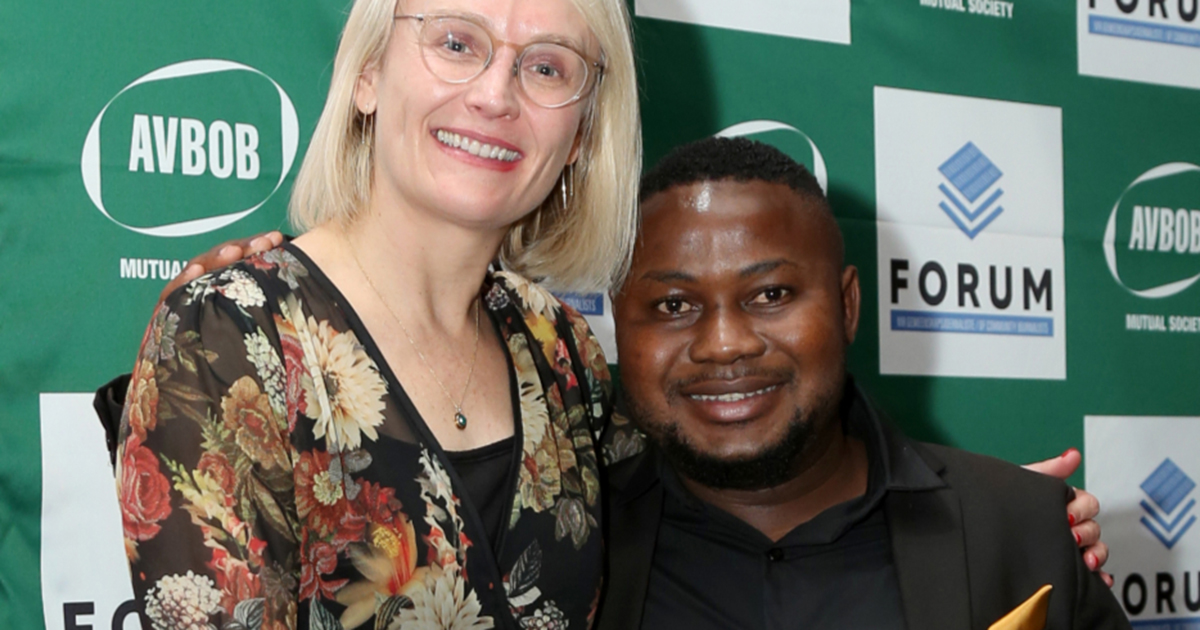
The Limpopo Mirror and Zoutpansberger's journalists have once again shown that reporters from independent publications in rural areas can compete with – and excel against – their national counterparts working for major media groups. Three journalists from Vhembe were among the top 10 in various categories during the annual AVBOB Excellence Awards of the Forum of Community Journalists (FCJ).
The winners were announced last Friday night at a prestigious function in Stellenbosch. Journalists showcased their work across categories, including front pages, back pages, free newspaper of the year, hard news and human-interest reporting. A record 541 entries were submitted, which took the 21 judges just over a month to evaluate.
Maanda Bele, who writes for the Limpopo Mirror, secured third place in the highly competitive Human Interest category. His story of 104-year-old war veteran William Sadiki impressed the judges.
The category winners were a team of four from the George Herald – Lizette da Silva, Kristy Kolberg, Alida de Beer and Michelle Pienaar – who also won the Journalist of the Year trophy.
But many felt Bele was unlucky to miss out on a higher placing.
Sadiki, who fought in the North Africa campaign, lives without basic amenities such as a toilet. "I felt it was important to tell his story because it reveals both his extraordinary contribution to history and the everyday struggles he still faces. Recognition without dignity is incomplete. Every story carries universal themes of resilience, injustice, or triumph," Bele said.
He added that he refused to see Limpopo stories as "small" or "regional." Human-interest reporting, he said, highlights struggles and victories while protecting dignity. "I frame people as survivors, not victims, and focus on their strength, not sensationalism," he said.
Bele said the awards reinforced the value of community journalism. "It proves that community journalism is not 'less than.' It is the heartbeat of storytelling. Powerful journalism does not only come from big city newsrooms but also from villages, townships, and small communities where stories matter deeply."
Looking ahead, Bele said his notebook remained full of untold stories. "Stories of unsung heroes, rural innovators, women building change quietly, and young people rewriting the narrative of their communities. My next plan is to continue digging for those voices and giving them a platform, because recognition means little if it does not open doors for others."
It was not only Bele who kept the Limpopo flag flying. Andries van Zyl, editor of the Zoutpansberger, finished fifth in both the Hard News and Investigative Reporting categories and seventh in the Sports Writing category.
Van Zyl said recognition was welcome, but that was not why journalists did the work. "We are watchdogs, a role that is increasingly difficult as some try to villainise the media. The stories I entered focused on ordinary people sharing frustrations or celebrations. The trick is to tell them in a way that readers and judges connect with," he said.
On investigative and hard news, he said the first step was to take emotion out of the issue. "That keeps you focused. Readers must find value in your reporting. If they say 'so what?' you have not met the standard."
To aspiring journalists, he offered simple advice: "Just keep writing. Some are natural writers, others take longer. Embrace mentorship and view criticism as part of learning. Every journalist grows every day."
Multi-award-winning Limpopo Mirror editor Anton van Zyl, who placed 10th in the Hard News category, said it was remarkable that journalists from rural areas continued to prove their mettle against the country's top reporters.
"I am disappointed that more of the Limpopo Mirror's journalists did not feature in the awards, because they punch well above their weight. Judges often do not fully appreciate the challenges they face. To still outperform journalists from the big media groups is almost unthinkable, but they do it," he said.