
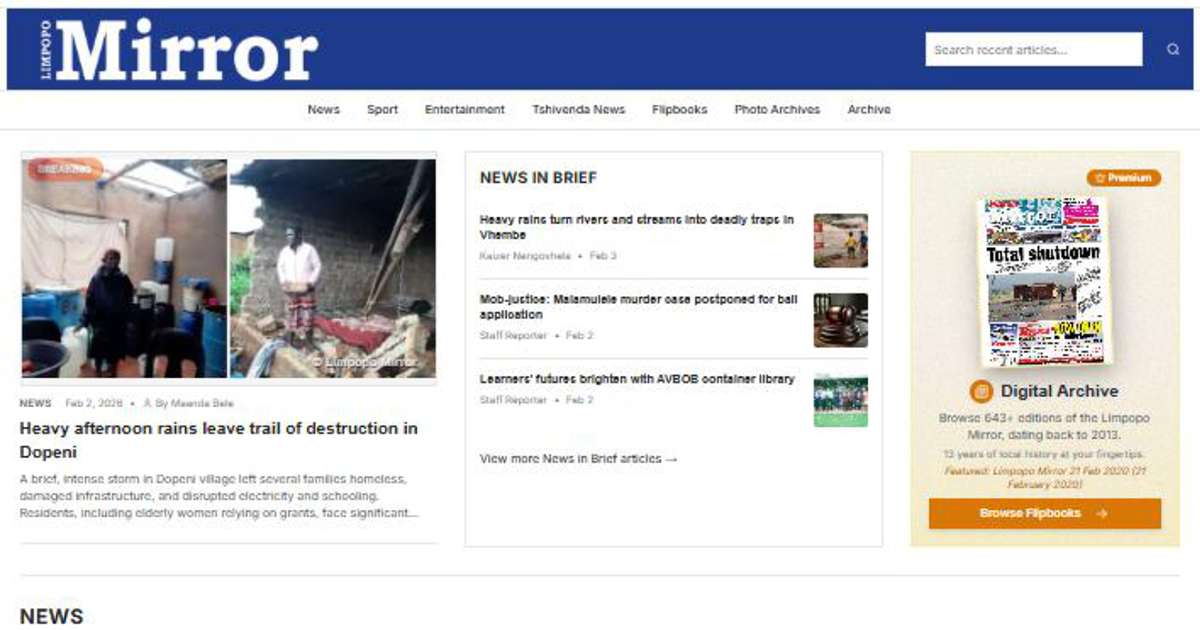
The Limpopo Mirror’s newly revamped website launched last weekend, marking a dramatic shift from print-focused publishing to daily digital news updates powered by artificial intelligence.
The new site introduces a token-based paywall for premium content, including access to digital archives dating back to 1990 and daily editions of the newspaper. It is also an attempt to replace the “broken” online advertising model with a more sustainable revenue model for local journalism.
From static pages to an AI-driven platform
The Limpopo Mirror has had a web presence since 1997, making it one of the oldest online news publishers in the country. It started with zoutnet.co.za, which later evolved into limpopomirror.co.za and zoutpansberger.co.za. Over the years, the websites moved from static pages to database-driven applications. None of these changes, however, were as dramatic and comprehensive as the latest overhaul.
The new website was developed from scratch using “vibe coding”, a relatively new approach to building web pages that uses artificial intelligence to generate code. In simple terms, it involves telling the AI, in layman’s terms, what you want it to build and waiting for it to produce the result.
The big difference is that no software programmers or expensive IT teams are involved. The ideas stem from the local publishers, and it is up to the local team to make them work. This means website features that were previously unaffordable for small local publishers can now be implemented easily and cheaply.
Daily updates replace weekly publication model
Previously, the website functioned largely as a digital copy of the newspaper. Once the Limpopo Mirror appeared on the street, articles were copied to the website. This has now changed dramatically, with daily news updates becoming the norm. Some articles will be available online only, although these will mostly be shorter, time-sensitive pieces.
The newspaper will focus on “deep dives”, helping readers make sense of what has happened. On the one hand, there will be quick responses to news through daily website updates, and on the other, the detailed journalism that has always been a hallmark of the Limpopo Mirror. Investigative pieces, consumer journalism and more opinion content will remain features of the printed product.
What readers can expect
The basic layout of the site has changed, but it still works in much the same way as before. The latest news is displayed on the homepage and category pages, and readers can click on links to read articles with photos. Content can also be enhanced with video clips and additional documentation.
The new site allows publishers to introduce new features quickly, such as sport updates or weather warnings. It also allows for the integration of new content streams by tapping into the resources of partner organisations.
Archives powered by an AI search assistant
Considerable work went into the archive section. At the time of going to press, 25,883 articles had been added to the archives, and 643 digital publications were already available on the site. These “flipbooks” date back to 2013, with plans to eventually host a complete digital archive dating back to the first edition published in September 1990.
A photo archive has also started taking shape. It currently contains only a few dozen images, but the aim is to add thousands of photos published over the past 35 years.
While some may see the archive as a space for “old-timers” or nostalgia, it uses the latest technology to enhance the user experience. An AI helper is available in the archive section to assist with searches. Instead of relying on keywords, users can explain what they are looking for, and the AI responds with a complete answer. The Limpopo Mirror is among the first publishers in the country to use such technology.
Token system replaces traditional paywall
Much of the website’s content will remain free, but some sections, such as the archives and flipbooks, will be behind a paywall.
The publication says it is moving into a new era of journalism in which everyone has a responsibility to help ensure its survival. In an age of misinformation, “AI slop” and the spread of clickbait, trusted journalism has become non-negotiable.
The reality, the publishers argue, is that the advertising model is broken, especially online, where publishers compete with millions of others for a small share of revenue. As the saying goes: “If you are not paying for the product, you are the product.” This means the “free” content is funded by selling audiences to advertisers, often at the lowest possible value.
For this reason, the Limpopo Mirror has introduced a token system that works much like a prepaid phone card. When visitors want to access premium content, they use a token. Tokens can be bought in packages of five, 12 or 25, starting at R50 for five tokens and going up to R200 for 25. Each token provides 48 hours of full access to the website.
This allows readers to download a digital copy of the newspaper, browse the archives or read premium articles. Tokens can be used at any time, meaning readers can activate one this week and another next weekend.
Experimentation and sustainability
The revamped website is also an experiment in sustainable revenue options. Publishers need viable ways to pay the journalists who produce daily news. Beyond the token system, other models will be tested, such as allowing readers to unlock tokens by watching short video clips.
It marks an exciting new journey, and the Limpopo Mirror invites readers to be part of it. Feedback is essential. If readers experience problems with the site, they do not need to contact a distant tech office. They can simply get in touch with the local team or visit in person.
The address, of course, is www.limpopomirror.co.za.