
"SA's major cities are running out of cash because they have become employment agencies instead of hives for the delivery of services." - Natasha Marrian, Business Day editor-at-large.
The debate about poor service delivery and the rising cost of staff has flared up in the past month. Across the country, municipalities are running out of cash, and some have resorted to dubious means to increase their income — such as pushing through inflated property valuation rolls while simultaneously raising tax rates. Others have started selling off assets or hastily developing land in an attempt to raise funds.
The critics say that municipalities need this additional revenue to pay the salaries of workers, councillors and highly paid senior managers. Once these salaries are covered, little remains for actual service delivery.
We analysed the financial statements of Vhembe's four local municipalities, as well as the district municipality, to assess the extent of the problem. What we found was a mix of reasonable and alarming — with no clear reward for financial discipline and widespread evidence of excessive salaries.
In one of the poorest regions in the country, the average monthly remuneration of municipal workers is R51,159. The five mayors take home, on average, R1.06 million a year, and some municipal managers earn more than R2 million annually.
|
|

Salaries consume budgets
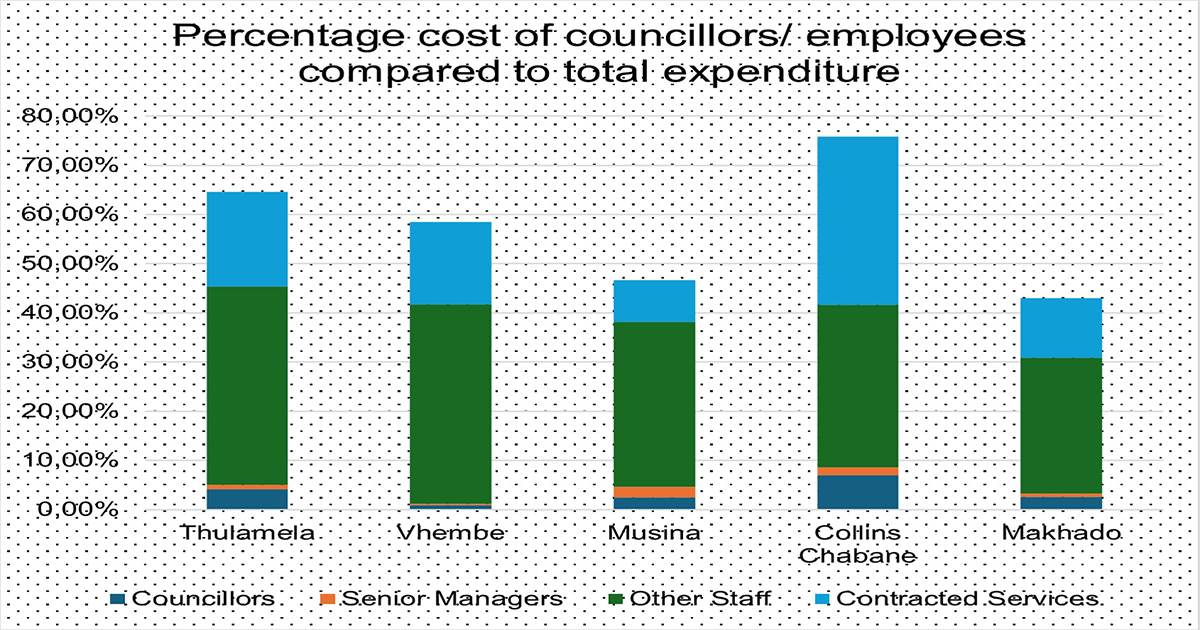
National Treasury publishes a uniform set of financial norms and ratios for local government. These guidelines suggest that between 25% and 40% of a municipality's expenses should be spent on salaries and councillor allowances.
Only two Vhembe municipalities fall within this range: Makhado at 30.85% and Musina at 38.19%. Thulamela is the worst offender, spending 45.32% of its budget on salaries and councillor compensation.
A further concern — one the auditor-general (AG) has raised repeatedly — is the rising cost of outsourced services. These are often tasks that could be handled by municipal staff but are instead handed to consultants, professional services and private contractors. National Treasury recommends outsourcing should make up no more than 2% to 5% of expenditure.
Only Musina comes close to this, outsourcing 8.45% of its work. In contrast, Collins Chabane outsources 34.26% of its services — meaning a staggering 75.85% of its total expenditure is paid to councillors, workers and people not on the municipal payroll.
Thulamela spends 64.61% of its budget on councillors, workers and contractors, while the Vhembe District Municipality allocates 58.47% of its expenses to the same.
|
|

Some very expensive employees
According to research by institutions such as Statistics SA, the average monthly income for workers in South Africa is roughly between R27,000 and R28,000 — though this varies widely across sectors and regions. In rural areas such as Vhembe, the average is likely to be much lower.
Yet in Vhembe, the average monthly salary for roughly 3,086 municipal workers (excluding senior managers) is R51,129. Councillors earn an average of R37,560 a month, while senior managers collect R115,633 a month on average.
|
|

It should be noted that the figures are not entirely reliable. They were drawn from the most recent publicly available budget documentation and annual reports from each municipality. For example, the Vhembe District Municipality (VDM) reports having 343 councillors — though it should only have 59.
Thulamela's budget claims there are only 334 posts available, but that the municipality has 362 permanent employees and 96 contract workers. Queries about these discrepancies were sent to the spokespersons of both municipalities but were ignored.
Figures from the annual reports were used as they appeared to be more accurate. According to the latest report, Thulamela has 564 employees, with 130 posts vacant. VDM's latest budget shows a headcount of 1,332 permanent employees and six senior managers.
|
|

Who earns the most?
The highest-paid mayor in Vhembe is Thulamela's Sarah Rambuda, who earns R1.17 million a year. The only mayor earning under R1 million is VDM's Freda Nkondo, who receives R989,830.
Thulamela also boasts some of the best-paid politicians in the country. The Speaker earns R1.36 million annually, and the Chief Whip receives R856,768 a year. Makhado has the best-paid councillors, with the 62 representatives collecting, on average, R45,372 per month.
As for municipal managers, the top earner is Makhado's Mr Kent Nemaname, with a salary package of R2.01 million per year. Thulamela's suspended MM, Mr Masala Makumule, earns R1.95 million. The highest-paid chief financial officer is in Musina — Mr Livhuwani Thomas Nephawe earns R1.9 million a year.
But these salaries do not seem to reflect financial performance. Under the leadership of Mayor Rambuda and Mr Makumule, Thulamela regressed to a qualified audit opinion last year. Only Makhado and Musina managed to retain unqualified audit outcomes, although both were flagged for various issues.
The situation is worsened by the additional expenses incurred, particularly by senior staff and politicians. The MEC for Cooperative Governance, Human Settlements and Traditional Affairs (COGHSTA), Basikopo Makamu, recently responded to a question in the provincial legislature, stating that municipalities not only have luxury vehicles for the exclusive use of mayors, Speakers and, in some cases, Chief Whips, but that these office-bearers are also chauffeured — at significant cost to taxpayers.
Not all municipalities responded to the MEC's request for information, making it difficult to compare such expenses across Vhembe. However, it was noted that Musina Municipality spent R1.29 million on two Toyota Fortuners and just under R1 million annually to employ two drivers.