
Consumers in the Makhado municipal area will be facing an increase in electricity tariffs of 15.1%, starting in July, along with a 5.3% rise in the cost of services such as waste removal. These tariff increases were announced during the presentation of the 2023/24 budget. As part of the budget, R290 million has been allocated to address the region's deteriorating road infrastructure.
Mayor Samuel Munyai described the budget as a "people's budget," emphasising its development through extensive consultation with the local communities. "We can no longer continue to work in a manner as if we are doing our people a favour," Munyai said. He said the time had now come for councillors and officials to work for the betterment of the region and not to disappoint people.
Munyai mentioned that one of the previous issues, the failure to fill crucial management positions, had been addressed. More than 101 permanent positions have been filled, and an additional 49 positions have been advertised and will be filled in the coming year. Most senior positions, including that of the municipal manager and various department directors, have already been filled, and the appointment of a chief financial officer is imminent.
However, the latest budget also shows that a considerable portion of the money collected from the "people" will be used to keep the municipality running and pay the salary bill. Munyai attempted to downplay this by stating that the R349,49 million salary bill represents only 25% of the operating expenditure. "The salaries and wages are budgeted for at an overall increment rate of 5,4%, based on the bargaining-council agreement," Munyai said.
What Munyai did not highlight is that the salaries of councillors will cost taxpayers an additional R31 million, accounting for 2.22% of the operating budget. The budget also allocates a considerable portion (17%) to consultants or "contracted services". The auditor-general (AG) has on several occasions criticised municipalities for the increased spending on outside contractors who, in many instances, are roped in to perform work because the permanent staff members are either not capable of doing the work or have not been capacitated to do what they were employed to do.
In the latest budget, Makhado has allocated R236,75 million for contractors, slightly less than the previous year's R253,38 million (adjusted budget). However, this figure represents a substantial increase compared to 2019, when the amount was R87,3 million. In total, more than 45% of the operating budget is allocated to salaries and contracted services.
Where will the money come from?
 |
The bulk of the income comes from profit made in reselling electricity. |
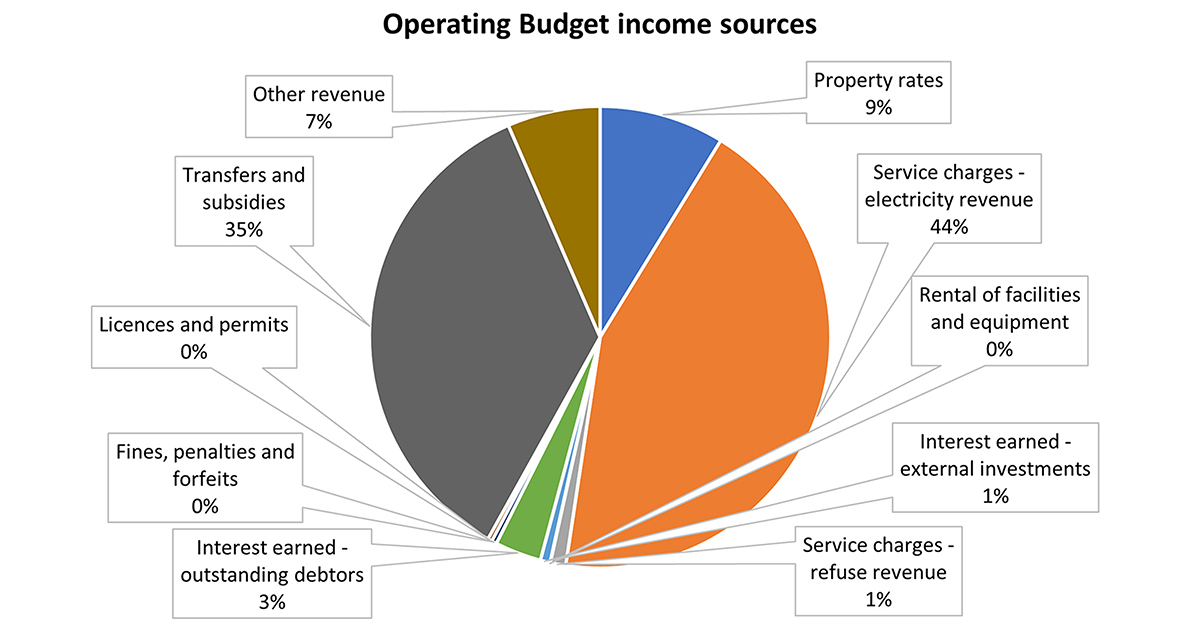
As far as the operating budget is concerned, the municipality's main source of income is still electricity. The revenue expected to be derived from reselling electricity will be R608,56 million, or 44% of the income. This is 15,1% more than the previous year's provisional figure of R528,73 million.
What is surprising is that Makhado seemed to have made more money from electricity sales in 2022/23 than the previous year, when only R388,76 million was accrued. This also happened amidst the worst period of load shedding in the country's history. The income was expected to be significantly lower, yet this does not seem to be the case.
The budget documentation states that "the average collection rate for main tariffs for the current financial year to date is 91%", which sounds exceptional. Provision is, however, made for debt impairment of R83,68 million, which is almost 38% more than the previous year's R60,71 million. How much of the debts written off from non-payment of electricity is not specified. In the AG's report on last year's financials, she refers to the irrecoverable debt but calculates it at R79,46 million. The AG also estimates the electricity losses at R25,11 million, or 11% of the total energy purchased.
The second "big" earner of income is transfers and subsidies. The equitable-share grant is expected to add R481,94 million to help cover the operating costs. This is an unconditional grant meant to assist municipalities in providing services to all areas, irrespective of whether the residents can afford to pay high taxes and levies.
Three other grants, namely the finance management grant (R1,95 million), the extended public works programme (R2,93 million) and the integrated national electrification programme (R7 million), take the total for transfers and subsidies to R493,83 million.
Property rates are becoming a bigger earner of revenue for the municipality, expected to collect R122,25 million. This is based on a 5,3% increase in property rates. In 2022/23, the adjusted figures indicate that R116,09 million would have been collected from property rates, which is 20,6% more than the R96,26 million collected the year before.
Interest charged on overdue accounts is expected to bring in R45,4 million in the next year.
Where will the money go?
 |
| Salaries, remuneration of councillors and the cost of consultants and contractors amounts to over 45% of the budget. |
As mentioned previously, 45% of the operating budget will be spent on salaries and to pay for various consultants and contractors.
The next biggest expense item is the purchasing of electricity. The municipality budgeted for the prescribed 15,1% increase in costs, taking this estimated bill to R397,74 million.
Another expense item that has seen some phenomenal growth the past few years is finance charges. From R409 000 in 2019/20, this has grown to an expected R12,77 million in the year to come. No explanation has been provided as to why such an increase is necessary.
The total income for the operating budget was R1,394,959 million, with the total expenses estimated to be R1,368,446 million, which leaves a surplus of R26,5 million.
Most residents will be more concerned, however, about the infrastructure projects that the municipality plans on tackling in the next year. These projects are predominantly funded out of own income, which can be considered a compliment to the Makhado Municipality. (Most of the other municipalities in Limpopo are almost totally dependent on grants.)
The budget documentation states that the capital required for the projects identified amounts to R503,877 million. The municipality hopes to use its own generated income to fund the bulk of the expenses. "Many of the capital projects required by the departments were reduced due to a lack of funds and the increasing maintenance costs and fund availability in the light of the municipality's financial constraints," it states.
The balance will be funded out of the R115,76 million municipal infrastructure grant (MIG).
The main capital projects.
The deteriorating state of the region's roads appears to have been highlighted during several IDP meetings, and the municipality plans on spending R290 million to build new roads or fix the existing ones. To maintain the electricity infrastructure will also be expensive, and R115 million was budgeted for this purpose.
The list of capital projects is extensive, and space does not allow for all of them to be discussed. The projects estimated to cost R10 million or more are the following:
* In Levubu, the electricity network is to be upgraded at a cost of R15 million. Phase 3 of the main substation upgrade will also be completed, at an estimated cost of R11 million.
* Not in the R10 million + category, but very interestingly, is that R3,5 million was budgeted to do a solar installation at the municipal offices in Louis Trichardt to assist during periods of load shedding.
* The electricity sub-station in Pretorius Street is to be upgraded at a cost of R10 million.
* High-mast installations are to be erected at Mbavala, Njhakanjhaka, Tsianda, Thondoni, Tshiendeulu, Tshikota and Matsha, for an estimated R16 million.
* The Kutama Sinthumule Sports Facility is to be constructed at a cost of R24,89 million.
* The Makatu-to-Tshikota road is to be tarred at a cost of R20,7 million.
* The upgrading of the road from Tsianda Marundu to the military base is to commence at a cost of R16,83 million.
* The upgrading of the Midoroni Clinic ring road – R13 million.
* The upgrading of the Luvhalani-to-Dzananwa access road – R15 million.
* Upgrading of Park View Street at Biaba Township – R10 million.
* Construction of Dzanani Taxi Rank and market stalls – R32,16 million.
* Development of roads and stormwater infrastructure south of Pretorius Street for 700 new stands and in Tshikota for 164 new stands – R20,5 million.
* Upgrading of Waterval Clinic ring road – R10 million.
* A number of streets in Louis Trichardt town are to be rehabilitated, including Rissik, Songozwi, Unika, Hospital, Malva, Barnard, Snyman and Grobler Street.
(Note: Some of the figures quoted by the mayor during his budget speech do not correspond with the budget documentation filed with the national treasury. We opted to use the figures in the budget document and not the speech.)