
Residents of Phugwani village near Malamulele say they have been struggling without reliable water after illegal connections damaged the main pipeline supplying several villages in the area.
Seven villages, including Madonsi, Green Farm and Nghomunghomu village have been affected. The pipeline that runs from Malamulele through Madonsi to Phugwani and neighbouring villages was tampered with in several places, including near Mavandla and at new residential stands in Section D.
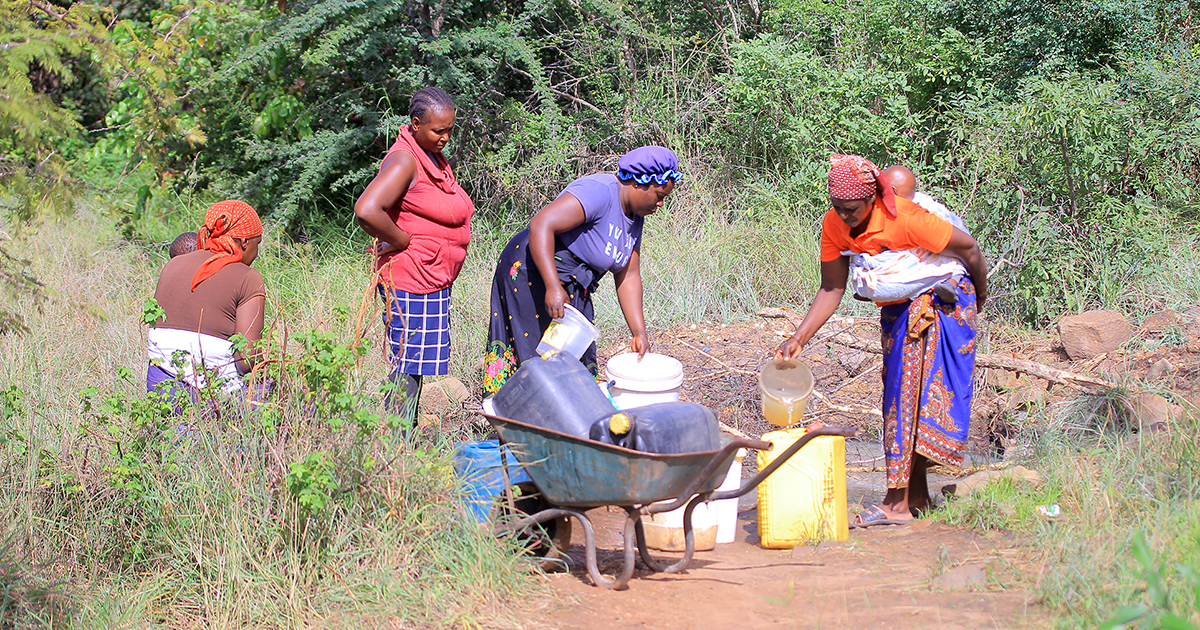
Last week, Limpopo Mirror visited the area and found residents collecting water in containers and buckets, transporting it to their homes using wheelbarrows. The village has two fountains on which many residents now rely.
Defney Chauke, a resident of Phugwani, said villagers are forced to collect water from a fountain in the bush because taps in the village have run dry.
“We do household chores using this water, including cooking and drinking. Not all of us can afford to buy water from those who drilled their own boreholes, because most of us are unemployed,” she said.
Chauke added that residents are relieved when it rains because the fountain fills with more water.
“But we are not safe because the fountain is in the bush,” she said. Residents also fear the water could be contaminated because the fountain is not protected. They have placed thorn tree branches around it to prevent animals such as cows and goats from polluting the water.
A member of the royal family, Freddy Mabasa, said the water problems began after illegal connections were made along the pipeline.
“Since the illegal connections, our village has been dry. The last time the municipality brought water tankers here was in October last year,” he said.
Mabasa added that residents were promised a borehole before the 2024 elections.
“The mayor promised that a borehole would be drilled after residents complained about the water shortage and threatened not to vote. But after we voted, nothing happened,” he said.
Simon Hasani, a community leader from Green Farm village near Phugwani, said the situation is similar in neighbouring villages. He said Green Farm, which has more than 1,000 households, has only one borehole supplying water to about 40 households.
“We spend about R250 to refill water tanks from private water sellers. Even elderly people use their SASSA grant money to buy water,” said Hasani.
Community leaders say they have been raising concerns about water shortages for several years. In a letter to the Vhembe District Municipality dated 21 November 2023, the Phugwani Water Committee asked the municipality’s technical manager to assist with drilling a borehole after residents had gone without water for an extended period.
Another letter from the Strategic Development Committee dated 25 June 2024 requested a meeting with the executive mayor of the municipality to discuss the need for a purified bulk water system for several villages, including Shibangwa, Green Farm, Phugwani, Nkovani and Makhasa.
Traditional leaders have also raised the issue. In March 2025, the Madonsi Traditional Council asked authorities to repair the main water pipeline from Malamulele to Tlhaveni, saying illegal connections had disrupted the water supply.
On Saturday, 7 March, the Collen Mashawana Foundation visited Phugwani village, meeting with residents and community leaders about the ongoing water challenges. The foundation promised to assist by drilling a borehole and making a donation to support the community.
Vhembe District Municipality spokesperson Moses Shivambu said water tankers are currently supplying Phugwani village while the municipality works on longer-term solutions. He said water is delivered once or twice a week to between 350 and 450 households through community water tanks.
However, residents dispute this claim, saying tanker deliveries are unreliable, which is why many continue to collect water from the fountain. According to Shivambu, the monthly operational cost of water tankering, including transport, fuel and personnel, is estimated to be between R180,000 and R250,000.
Shivambu said the Levubu River pipeline supplying parts of the area has experienced infrastructure challenges due to ageing components, leaks and pipe bursts, affecting the reliability of the water supply. He said technical assessments have been conducted to determine the extent of repairs required, and plans are in place to rehabilitate sections of the pipeline. Once budget provision has been secured and procurement processes finalised, drilling of a borehole could start within four to six weeks.
The full process, including drilling, testing water quality and connecting the borehole to the distribution system, is expected to take between six and eight weeks, depending on site conditions and groundwater availability.
Shivambu added that Malamulele, including Phugwani village, is expected to benefit from the pipeline going to Muswane, which runs parallel to the Giyani pipeline being implemented by the Department of Water and Sanitation as part of a long-term intervention to improve bulk water supply in the region.