
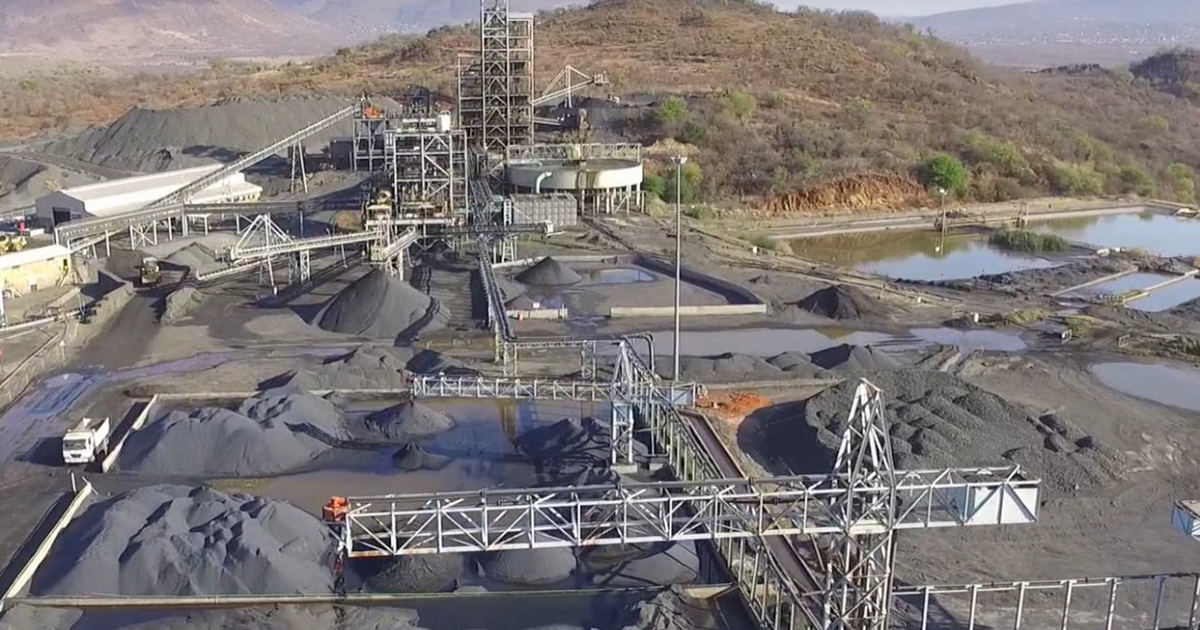
Amidst continued opposition from environmental groups against the Musina-Makhado Special Economic Zone (MMSEZ), MC Mining released its audited financial statements on Monday for the year ending 30 June 2025. The mining company stands at the centre of the controversy, particularly regarding its relationship with the Kinetic Development Group (KDG).
According to MC Mining, the company made a loss of 36 million US dollars (USD) this year. During 2025, the average USD to rand exchange rate was about R18.21 per US dollar, so the company made a loss of approximately R655 million. Last year's loss was USD 14.6 million, or approximately R266 million. Thus, the loss has more than doubled. MC Mining, however, explains that most of the larger loss arises from an impairment (a write-down in the value of its assets) rather than actual cash leaving the company. These "non-cash charges" jumped to about R470 million (compared with just R60 million last year). In short, MC Mining's reported loss looks much worse this year mainly because it had to record impairments—reducing the book value of some assets—rather than because the company actually spent that extra money in cash.
MC Mining's release of its audited financial statements comes amidst further controversy regarding the MMSEZ and the mining company's relationship with KDG.
During the 2025 financial year, KDG, a China-based coal-mining and -trading company, entered into a deal to acquire a 51% stake in MC Mining for approximately US$90 million in two tranches. At the time of the deal, the mining company stated that the Chinese investment aimed to advance MC Mining's flagship Makhado steel-making and hard-coking coal project into production and accelerate the development of other assets in the Vhembe region of Limpopo Province, including the Greater Soutpansberg and Vele Aluwani Colliery tenements.
Shortly after acquiring the majority stake in MC Mining, KDG announced plans to build a ferrochrome smelter on the southern site of the Musina-Makhado Special Economic Zone (MMSEZ) near Mopane. This multi-billion-rand investment, however, is contingent on township establishment approvals and environmental impact assessments.
KDG's announcement regarding the proposed smelter was once again met with opposition from environmental groups and other interested and affected parties, including local communities. The smelter is planned for initial production of 125,000 tonnes per year, with two electric furnaces, scaling up to 1 million tonnes annually with additional units over five years. Environmental groups, represented by legal advocates, formally objected to the Draft Environmental Impact Assessment Report (dEIAR) of the proposed smelter, citing significant flaws, including potential contamination from heavy metals and hexavalent chromium.
More controversy was to follow. Most recently, the Herd Reserve, Living Limpopo, and the Centre for Applied Legal Studies (CALS), represented by All Rise Attorneys, have rejected the dEIAR for the proposed ferrochrome smelter in the MMSEZ, describing it as "fundamentally flawed" and calling for it to be redone. The primary areas of concern include severe inconsistencies in the project's technical and financial feasibility, fundamental failures in climate- and health-impact assessments, resource-management inadequacies, and extensive non-compliance with environmental regulations.
For example, the All Rise Attorneys' submission of objection states that the dEIAR underestimates its Air Quality Impact Assessment (AQIA) emissions as a result of capacity misrepresentation. They assert that the assessment fails to accurately reflect the true scale of the air pollution threat because of these capacity inconsistencies. They highlight a flawed production assumption, as the AQIA only models emissions for Phase 1 of the ferrochrome smelter, assuming a static output of 125,000 tonnes per annum (tpa). However, this ignores the project's plan to ramp up production eight-fold over a five-year period to 1 million tonnes per annum, resulting in an understatement of the project's true air-quality and greenhouse-gas impacts.
"Our submission exposes deep technical and legal flaws in the draft Environmental Impact Assessment Report. From climate impacts and the risk of cancer-causing air pollution, to severe threats to the sole aquifer, impossible energy demands, threats to biodiversity in the Vhembe Biosphere Reserve, and irreversible loss of arable land—the report fails communities and nature on every front," said Kirsten Youens of All Rise Attorneys for Environmental and Climate Justice. Lauren Liebenberg of Living Limpopo added: "Even the dEIAR itself admits the gravity of the project's impacts: severe water stress and pollution, air quality and health threats, irreversible biodiversity loss, and high greenhouse gas emissions, with almost no lasting employment to offer—just 241 direct jobs! The only real beneficiaries are the Chinese corporate interests, while South Africans are left with the fiscal costs, the pollution, and the irrevocable loss of nature."
For Liebenberg, the direct link between MC Mining's Makhado Colliery and the proposed ferrochrome smelter is troubling. "These are all the same actors, and the mining and industrial projects are intimately connected," she said. She is critical of the government's role in the entire controversy. "It is the nexus of government failure to enforce compliance and uphold environmental law and environmental protection standards—all for foreign/Chinese investors entering South Africa to exploit our resources," she said.
Liebenberg also stated that MC Mining was conducting illegal strip-mining at its Makhado Colliery by operating without environmental authorisation, an accusation MC Mining vehemently denies. In August, the mining company stated that appeals lodged by groups opposed to mining "were considered and dismissed" over the years. While acknowledging "processes pending in the North Gauteng High Court and the Department of Forestry, Fisheries and the Environment," the company maintained it "lawfully commenced with the execution of listed activities" in June 2021, in accordance with its approved environmental authorisation, having duly notified the competent authority. MC Mining stated that it "continues to operate in accordance with its approved licensing and within the South African legal framework."