
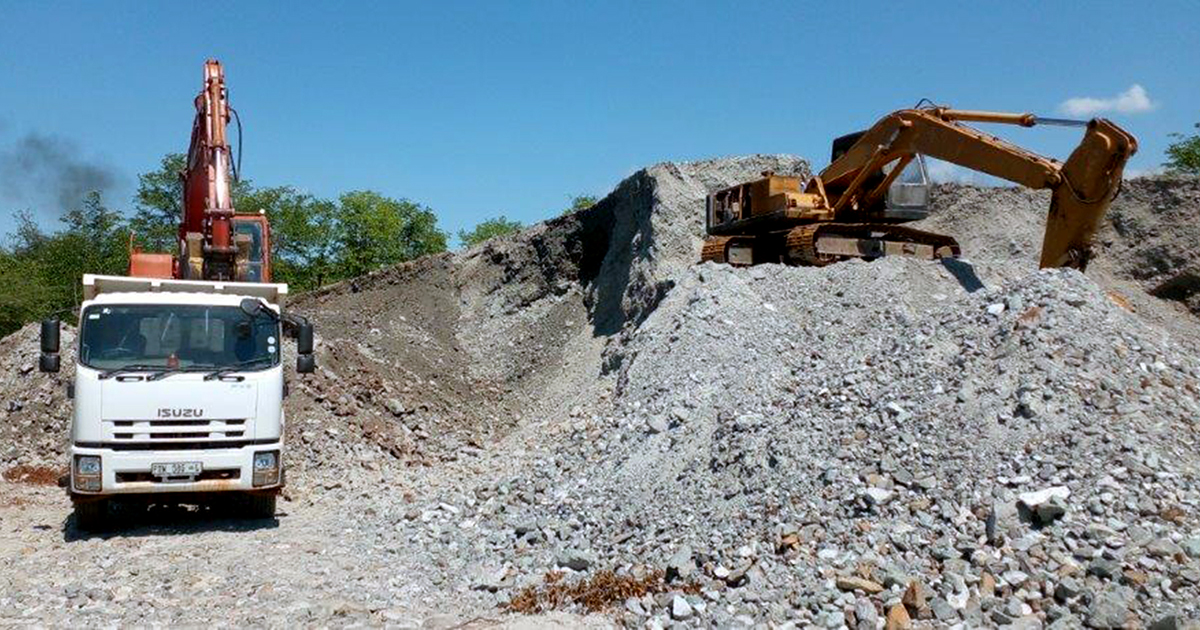
The state-owned company behind the controversial Musina-Makhado Special Economic Zone (MMSEZ) in Limpopo is facing a R12-million lawsuit after one of its subcontractors allegedly removed road-building materials illegally from a nearby, privately owned property.
A subcontractor on the MMSEZ project, Tshiamiso Trading 135, removed 35,000 cubic meters of crushed white rock, valued at R12-million, from an old mine dump owned by Boetie Visser Groep Kontrakteurs, without permission.
 |
|
An estimated 35,000 cubic metres of "white rock" road-building material stockpiled at Tshiamiso Trading's construction site, approximately two kilometres from Mr Boetie Visser's mine dump. The material was allegedly removed from Visser's site without permission. Tshiamiso maintains the removal was lawful. Photo supplied. |
An investigation by MMSEZ SOC found that the removal of the road material by Tshiamiso, run by Hlamani Bruce Mohlaba, is likely unlawful and criminal. But MMSEZ has rejected Visser's requests to be paid for the rocks or for the rocks to be returned. Visser has launched a court case in the Polokwane High Court to claim the R12-million he says is owed to him.
The MMSEZ has now told Visser to collect his rocks at his own expense, denying any involvement in the unlawful removal of the rocks.
The MMSEZ is a multi-billion-rand megaproject launched by President Cyril Ramaphosa in 2018. More than R100-million has been spent on the project, but there are still no roads, electricity or water connections.
Adding to the debacle is that part of the area on which this infrastructure is supposed to be built does not belong to the MMSEZ SOC, and the northern site has not been gazetted to allow for such a development.
The MMSEZ has, on several occasions, been accused of bulldozing ahead with development plans, while ignoring legal concerns and the fact that no sustainable plans are in place to secure water on the sites.
Unlawful mining
In 2022, Tshiamiso was awarded a R200-million contract with MMSEZ to build internal roads and stormwater infrastructure at the MMSEZ's northern site at Artonvilla, north of Musina. They also received an additional R100-million contract to build storm-water drainage.
On 2 August 2023, the MMSEZ obtained a permit from the Department of Mineral Resources (DMR), which allowed Tshiamiso to start mining for white rock to be used for the roads.
An old mine dump was fenced off by Tshiamiso, and the company started removing rocks and taking them to the construction site, about 2km away.
But it appears that the land, in fact, is owned by Boetie Visser, of Boetie Visser Groep Kontrakteurs CC.
In January 2024, Visser contacted the MMSEZ, claiming that Tshiamiso was, without permission, taking crushed stone material that belonged to him.
Visser sent several letters to the MMSEZ, requesting that they halt the excavation, but Tshiamiso continued. Visser sent a proposal to the MMSEZ on 10 January, offering to sell the high-quality stones to the company. During a meeting between Visser and MMSEZ officials on 22 January, the matter was discussed, and a follow-up meeting was planned to reach an amicable resolution.
On 25 January 2024, Visser's lawyer, advocate Elandré Bester, issued a memorandum about the unlawful removal of processed material from Visser's old mine dumps. The memo highlighted that Visser is the lawful owner of the old mine dumps and alleged that the conduct of the MMSEZ and Tshiamiso constituted "fraud, theft, and larceny."
 |
|
The contractor notice board on site displaying the names of all parties involved in the MMSEZ north site project. According to sources, the board has since been removed. |
MMSEZ investigates
Officials from the MMSEZ's Legal Services and Infrastructure Development units visited the site on 6 February to investigate. They found it was "highly unlikely" that Tshiamiso was extracting material from within the permitted area and that it was "clear that the mine dumps ... were outside the designated area of the borrow pit permit".
The MMSEZ investigators also met with Visser, where he presented copies of his mining permit and the purchase agreement for the dumps. Visser reiterated his willingness to sell the stones, failing which they should be returned.
At that stage, an estimated 35,000 cubic metres, at a value of about R12-million, of crushed stone had already been taken by Tshiamiso. It was agreed that the MMSEZ would provide Visser with feedback three days later, by 9 February 2024.
The day after the site visit, Mashile Mokono, the MMSEZ's Senior Manager for Legal Services, compiled a report. It concluded that Tshiamiso can be charged with conducting illegal mining and committing a criminal offence and said that the company should be held liable for damages.
The report recommended that the MMSEZ urgently instruct Tshiamiso to cease excavation, enter into negotiations with Visser to purchase the collected material, and produce records of all materials taken.
It also noted that Visser had instructed his attorneys to bring an urgent application for an interdict, which was likely to be granted.
Development stalled
By 9 February 2024, the MMSEZ had not provided Visser with feedback as promised. This prompted Visser to apply for an urgent interdict in the Polokwane High Court to stop the unlawful removal and recovery of the materials.
The matter was placed on the court roll for 27 February 2024, but on 5 March 2024 was dismissed because of a lack of urgency.
Visser is proceeding with court action and wants to be paid R12-million for the materials removed from his land.
In May this year, the MMSEZ board chairperson, Dr NF Mphephu, presented a report to the Limpopo legislature's portfolio committee on economic development. The report revealed that Tshiamiso had terminated its R200-million contract, citing non-payment of standing time and the ongoing court action. Tshiamiso had already been paid R50-million by the time of termination.
The report also revealed that the land earmarked for the project's northern site did not belong to the MMSEZ. The land belonged to the Department of Rural Development and Land Reform. Additionally, the area designated for the northern site had not yet been gazetted.
"Come and fetch your rocks"
Visser has still not received any payment for the materials. "I have done nothing wrong. They stole my stone, moved it unlawfully, and now I'm left with a bill and legal costs amounting to half a million rand. And I still don't have my stone back," said Visser.
Visser claims that SLM Engineers, the consulting engineers overseeing the project, had known that Tshiamiso had been extracting rocks from the wrong area.
In spite of his ongoing court action against MMSEZ, SLM and Tshiamiso, Visser on 15 July this year received a letter from Tshifhiwa Irish Bologo, acting CEO of the MMSEZ, telling him to collect the rocks at his own expense before August.
"As you are aware, MMSEZ was not responsible for the removal of the white rock material from your site as that was done by Tshiamiso Trading without any direct or indirect involvement of MMSEZ," stated Bologo.
This left Visser outraged. "I didn't put it there. They put it there – their contractors. Now I must transport it back at my own expense? … My offer was simple. I said, pay me, and I'll take my stone back. Now they're saying no, take it back at your own cost," said Visser.
In response to a media enquiry, Bologo said "Visser is currently engaging with MMSEZ on the removal of the white rocks."
Asked whether Tshiamiso had acted on instructions from SLM to retrieve the road-building material from Visser's old mine dumps, Bologo stated: "MMSEZ is not aware of any instructions by SLM to Tshiamiso Trading to collect the white rocks and therefore no action will be taken against SLM."
As for Tshiamiso, Bologo confirmed that the company still holds the R100-million contract for the bulk construction of sewer and waste treatment works. Regarding the R200-million road-building contract terminated after receiving R50-million, Bologo said the payment did not include the cost of the "white rocks" taken from Visser.
She confirmed that a new contractor will have to be appointed to complete the internal roads and stormwater infrastructure. "A completion contractor would need to be appointed, and it will exclude the work already done by Tshiamiso Trading," she said.
In response to questions, Mohlaba, Tshiamiso's director, said: "The removal of material occurred lawfully. The claims by Mr Visser presently form the subject matter of an application in the High Court. A cost order has already been granted against Mr Visser and is in the process of execution. The application is still pending," he said.
SLM Engineering said that part of the matter had been dismissed with costs by the court. "Thus, in respect of the law, we cannot comment any further at the moment as this matter is before the court," concluded Sello Matlakala, a director of SLM.
(The cost order referred to by Mohlaba and Matlakala relates only to the urgent application that was dismissed for lack of urgency, not Visser's ongoing court case).
A controversial contractor
Tshiamiso and Mohlaba are no strangers to controversy. In 2019, the company was taken to court by the Greater Tzaneen Municipality, which accused it of "undue enrichment" after the company was awarded a R26-million contract for the construction of a 5.8km road and stormwater drainage system. Costs escalated rapidly, and construction was halted when Tshiamiso demanded further payments.
It emerged in court that Tshiamiso had made errors in its bid calculations, which influenced the procurement process. The court ruled that the municipality's decision to award the tender to Tshiamiso was unlawful and constitutionally invalid from the outset.
At the time, Tshiamiso was also entangled in other similar disputes. In 2016, the Makhado Municipality awarded the company contracts for the construction of two roads, where costs escalated and the projects were halted.
Tshiamiso is listed as a legal contingency in the municipality's 2022/23 annual financial statements. At the time, the company was suing the municipality for R7.4 million in unpaid standing time, while the municipality lodged a counterclaim for R11.83-million, alleging "undue enrichment." The outcomes of these claims remain unknown.
During the Covid-19 pandemic, Tshiamiso diversified into the medical supply sector. It was one of 42 suppliers contracted by the Limpopo provincial government to deliver masks and infrared thermometers. (The article is co-published with GroundUp)