
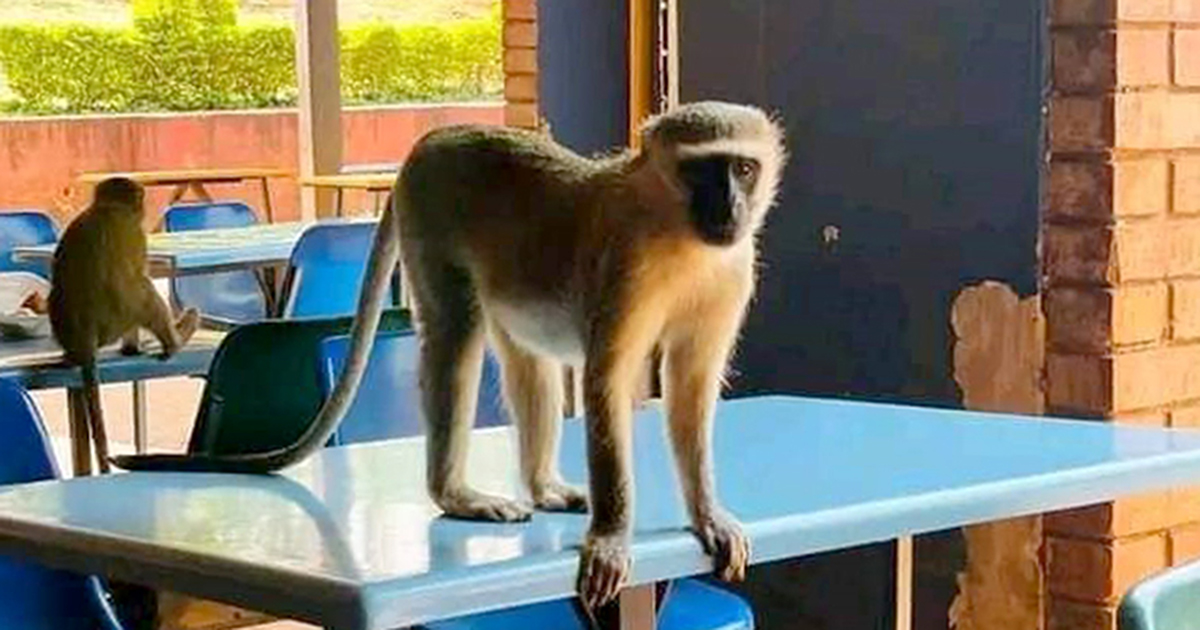
The Univen community and residents of the nearby Maungani village are living in fear, following a vervet monkey invasion in the area. Last week, a Univen staff member was attacked by a group of monkeys that terrorises people on campus.
The staff member, who has not been identified, was reportedly attacked and injured while he was attempting to flee from the invaders. On Thursday, 1 June, Univen's spokesperson, Dr Takalani Dzaga, issued a statement, warning the Univen community to be on the alert, following the incident. He said that although an attack was an unusual occurrence on the university's premises, students needed to exercise caution.
"The university community is also advised to change direction whenever they see a group of monkeys, for safety reasons. It is advisable that, when confronted by a monkey, do not look them in the eye, instead make yourself look as big as possible, such as by spreading open your coat, and backing away as quietly as possible without making sudden moves," said Dzaga.
He added that the university's protection services directorate was working on mechanisms to deter the animals from entering the campus.
Mashudu Mudau, a student at the university, said the incident had instilled fear among students. "We no longer feel safe here. The sooner the university comes up with something to deter these animals, the better," he said.
The founder of the Vervet Monkey Foundation in Tzaneen, Mr Dave Du Toit, said monkeys were not naturally inclined to attack humans as predators would. "Monkeys typically engage in aggressive behaviour to protect their troop, young, or food source. They may display threatening facial expressions, show their teeth, or make aggressive gestures to intimidate potential threats. In many cases, what may appear as an attack is actually a response to perceived danger or a desire to obtain food," he said.
Du Toit said that people often mistook these threatening displays as actual attacks and reacted by screaming or dropping their food, inadvertently reinforcing the behaviour. "To discourage such behaviour, it is important not to have food readily available or eat in front of monkeys. Feeding them directly can also encourage dependency and undesirable behaviour. By being mindful of these factors and avoiding situations that may provoke monkeys, we can promote peaceful coexistence and minimise any potential negative interactions between humans and monkeys," he said.