
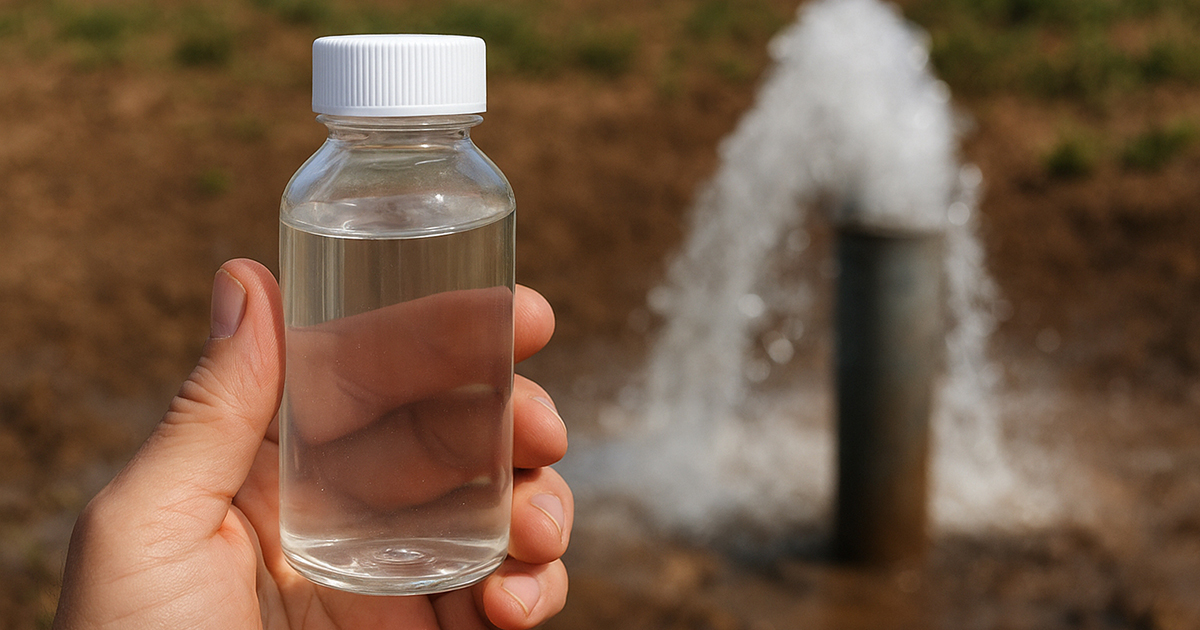
In July, water-quality tests conducted by the Vhembe District Municipality (VDM) found that several municipal boreholes supplying water to Musina residents failed to meet the minimum South African National Standard (SANS 241) requirements for potable water as a result of the presence of Escherichia coli (E. coli) and Total Coliforms. Last week, the VDM released new test results showing that at least some of these boreholes now comply with the minimum standards for safe drinking water.
On 15 July, VDM conducted water-quality tests at seven boreholes in Musina. The boreholes tested were Oorplaas Raw, Oorplaas Final, Musina Workshop, Musina Location, Campbell, Musina Reservoir, and Musina Show Grounds.
Results revealed serious concerns: five of the seven boreholes failed the SANS 241 requirements for potable water because of the presence of E. coli, a clear indicator of faecal contamination. The E. coli counts per 100 ml were: Musina Reservoir (8.4), Musina Show Grounds (8.6), Oorplaas Final (10.8), Musina Workshop (6.3), and Campbell (17.1). By comparison, no E. coli is permitted per 100 ml.
Additionally, four boreholes exceeded acceptable levels of Total Coliforms, further indicating potential treatment failure or contamination. The counts were Musina Reservoir (18.5), Musina Show Grounds (12.12), Oorplaas Final (16.9), and Musina Workshop (15.8). All four had also failed the E. coli test. The acceptable standard per 100 ml of water tested is fewer than 10 Total Coliforms.
At the time, Ms Hermien Roux (Pr. Sci. Nat), an aquatic scientist (M.Sc.) and freshwater lecturer at the University of Venda, confirmed she would not drink water from these boreholes, warning of the risk of diseases such as gastroenteritis, salmonellosis, dysentery, cholera, and typhoid fever.
For weeks, the newspaper awaited a response from VDM's technical department on whether the water from Musina's boreholes was safe to drink. A response to this question has yet to be received.
What the newspaper did receive last Wednesday from VDM was a new set of water-quality test results for four of the boreholes that had failed the 15 July test. The good news is that the boreholes at Oorplaas Final, Musina Workshop, Musina Location, and Musina Reservoir now all comply. This is according to water-quality tests performed by the VDM on 7 August.
Analysed on 8 August, the new results indicate that the E. coli counts for both Musina Location and Musina Reservoir, although they should not be present, were less than 1 per 100 ml, with the test sheet confirming that the boreholes comply. The Total Coliform counts for both boreholes were 2 and 3, respectively, also indicating compliance. It should be noted that during the 15 July test, Musina Location had also complied for both E. coli and Total Coliform counts.
In both the Oorplaas Final and Musina Workshop tests, no E. coli was detected, while no Total Coliforms were detected in Oorplaas Final's test. Musina Workshop showed a Total Coliform count of 10, just managing to comply.
Readers will recall that seven boreholes were tested in July, and the results received last week were for only four. No new test results for the Campbell borehole (which previously failed the E. coli count) or the Musina Show Grounds borehole (which previously failed both the E. coli and Total Coliform tests) were received, so their status remains unknown.
Some people, however, questioned the latest test results, especially regarding how "quickly" the groundwater cleared of E. coli and Total Coliforms in the "polluted" boreholes a mere 24 days later.
It turns out that this is possible, under the right circumstances. According to a report published by J F P Engelbrecht in January 2005, titled "The Survival of Escherichia coli in Groundwater", groundwater is often perceived as naturally clean due to the soil acting as a barrier against surface pollutants. However, Engelbrecht stated, E. coli and Total Coliforms could still contaminate it, with their clearance relying heavily on physical filtration.
According to Engelbrecht's report, key removal mechanisms include mechanical straining and sedimentation within porous sand. The surface layer of the soil is particularly effective in restricting bacteria from entering the subsurface. Efficient removal of these microorganisms, including enteric viruses, depends significantly on unsaturated flow, where deeper groundwater tables lead to greater reductions. Conversely, a fluctuating groundwater table can compromise this clearance by reducing the travel distance in unsaturated soil, thereby limiting filtration and adsorption.
While some research suggests pathogens reduce to negligible numbers within 60 to 90 days in soil, instances of bacterial survival for more than 40 days in laboratory settings and up to 300 days in prolonged groundwater tests have been observed. Survival times as long as 5 years have also been reported. Engelbrecht states in his report, however, that the die-off rate is largely controlled by environmental factors, notably temperature and moisture; bacteria survive longer in moist, cooler conditions and die faster in drier, warmer environments. Other critical factors influencing their survival and, consequently, their clearance, include bacterial type, sunlight, rainfall, soil moisture and composition, pH, and the availability of oxygen, nutrients, and organic matter, alongside interactions with existing soil micro-flora.
Asked whether the water pumped from the seven boreholes tested on 15 July was treated before being supplied to residents, VDM spokesperson Mr Moses Shibambu said on Monday that it was indeed treated. "Water is treated through a chlorination system," Shibambu said.