
The Musina Municipality tabled its 2026/27 budget last week, describing it as a “budget for the people”, but closer scrutiny suggests it is more heavily geared towards spending on officials and councillors, and may be overly optimistic regarding some of its projected sources of income.
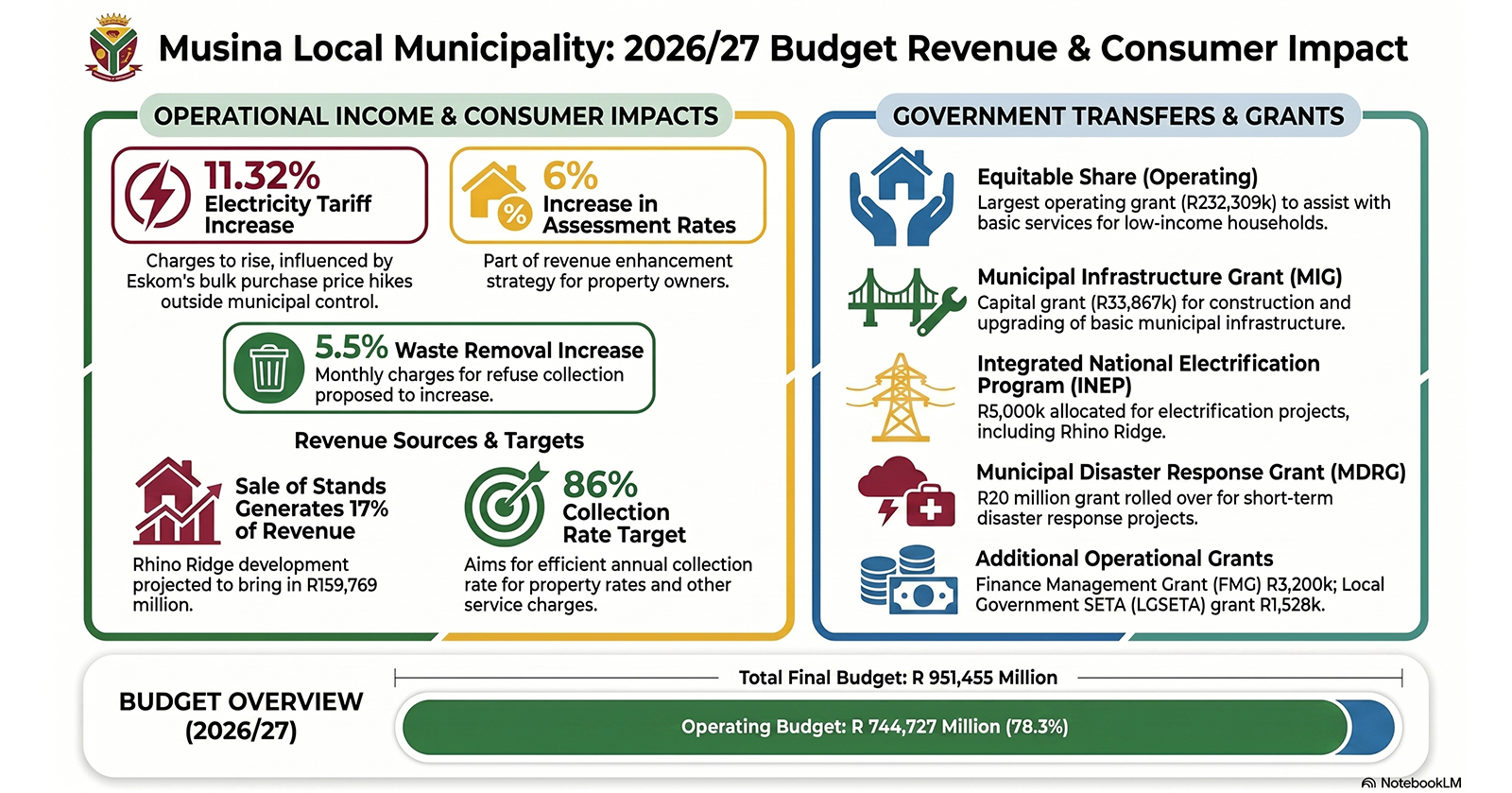
From 1 July 2026, consumers will pay 11.6% more for electricity, 5.5% more for waste removal and 6% more in property rates.
While the electricity hike was expected in line with Eskom’s tariff increase, the other increases left a bitter taste in the mouths of taxpayers, particularly given the municipality’s plans to spend significantly more on staff and related expenses.
One expenditure item that raised eyebrows was the R11.06 million budgeted for registration fees for national seminars, conferences, workshops and events. An additional R200,000 has been allocated for international events. In the previous financial year, R4.88 million was allocated for such expenses and, the year before, R3.44 million.
The cost of travelling to meetings, seminars and other events has also increased sharply, with more than R20 million budgeted for this item.
The travel budget is divided into several specific line items, of which “Transport in Own Transport” (R8.53 million) is the largest. Domestic accommodation is expected to cost taxpayers R8.37 million, while daily allowances have a budget of R1.82 million. In addition, the municipality has budgeted R1.49 million for Transport Provided as Part of Departmental Activities (Municipal Activities).
Where will the money come from?
The municipality has projected total revenue of R951.45 million. The largest portion, R488.90 million, is expected to come from service charges.
Electricity sales are projected to generate R402.25 million, while waste management services are expected to contribute R26.88 million. Property rates are expected to generate R37.93 million and interest earned is projected at R10.39 million.
Like neighbouring municipalities such as Makhado, the municipality hopes to supplement its income through land sales. The sale of stands in the Rhino Ridge development is expected to generate R159.77 million, representing 17% of total revenue. This follows several years of operational spending to develop the Rhino Ridge site, which is now ready for sale.
The municipality is not only relying on the sale of roughly 500 stands but also on the additional service charges these currently unsold properties are expected to generate. The budget report states that revenue collected from new stands, together with the rollout of new smart meters, will result in a 30% increase in revenue.
The new “smart” electricity meters, which will cost the municipality around R22 million, are expected to significantly reduce what is referred to as “bridging”.
Government to assist
The municipality is expected to receive grants totalling R281.89 million. This amount is divided between operational support and specific capital infrastructure projects.
The operational grants come from national government and are intended to fund the day-to-day delivery of basic services and municipal administration. The largest is the Equitable Share grant, which totals R232.31 million. This is supplemented by a Financial Management Grant of R3 million and an Expanded Public Works Programme grant of R1.93 million.
There are also three conditional grants intended to support infrastructure development. The largest is the Municipal Infrastructure Grant (R35.65 million). The Integrated National Electrification Programme adds R9 million to the municipality’s fiscus for projects such as the Sigonde and Tshenzhelani feeder lines.
The Municipal Disaster Response Grant provides a further R20 million. This is a rollover allocation from March 2026 intended for the construction of the Gondoza and Doreen bridges and the Freedom Park culvert.
Where will the money be spent?
On paper, the municipality’s single largest expense is bulk electricity purchases, for which R246 million is budgeted. This is the amount that must be paid to Eskom for electricity consumed by residents and businesses.
In practice, however, staff and contractors account for the largest expense. The budget for employee-related costs is R192.8 million. In 2022/23, direct employee costs were R153.9 million, representing 35.2% of total expenditure. In the new budget, direct employee costs account for 25.9% of total expenditure, which is generally regarded as a healthy ratio.
Many municipal functions are, however, outsourced. The budget for contracted services increased from R34.3 million in 2022/23 to R109.4 million in 2026/27. Notable items include R13.7 million for research and advisory services and R12.25 million for business and financial management consultants.
Outsourced security services cost the municipality R18.02 million. Refuse removal (R7.8 million) and printing services (R9.6 million) are among the other outsourced functions. A further R13.6 million has been budgeted separately from staff salaries for councillor remuneration.
If the direct salary bill (R192.8 million) is combined with contracted services expenditure, labour and service-delivery costs account for 40.6% of the total budget.
Main capital projects
The total capital budget for 2026/27 amounts to R226.66 million. Key projects include:
* Rhino Ridge Engineering Services: Budgeted at R22.25 million for design and construction work.
* Construction of Eagles Landing Road: A major new expenditure item valued at R20 million.
* Bridge and paving projects: Several projects are continuations or new phases of earlier work:
* Tshipise Paving Street Phase 1: R19.37 million (adjusted).
* Tshikotoni Bridge: R2 million for construction in 2026/27, following allocations of R6 million in 2024/25 and R11.4 million in 2025/26.
* Nancefield Paving/Stormwater: A recurring priority project, with R11 million allocated for stormwater channels in 2026/27, following various paving phases in 2024/25 and 2025/26.
How much of the revenue will be collected?
The municipality’s provision for debt impairment has shown a significant upward trend over the past five years, nearly doubling since 2022/23. This provision represents the amount the municipality expects to lose because consumers are unable or unwilling to pay their accounts, and it is a critical non-cash item used to determine realistically anticipated revenue.
In 2022/23, debt impairment amounted to R8.05 million. Last year’s adjusted budget provided for debt impairment of R15.37 million. The new budget provides for debt impairment of R15.77 million.
This represents an increase of approximately 96% over five years, indicating that the municipality expects a significantly higher level of uncollectible debt than it did previously.
The municipality’s revenue strategy is based on an annual collection rate of 86% for property rates and service charges. Any revenue billed beyond this collection threshold is effectively impaired.
Recent budgets have specifically provided for the write-off of debt owed by the Vhembe District Municipality, which has influenced the overall impairment figures. The municipality also cites ongoing challenges in the national and local economy, as well as high unemployment levels, as factors that negatively affect collection rates.