
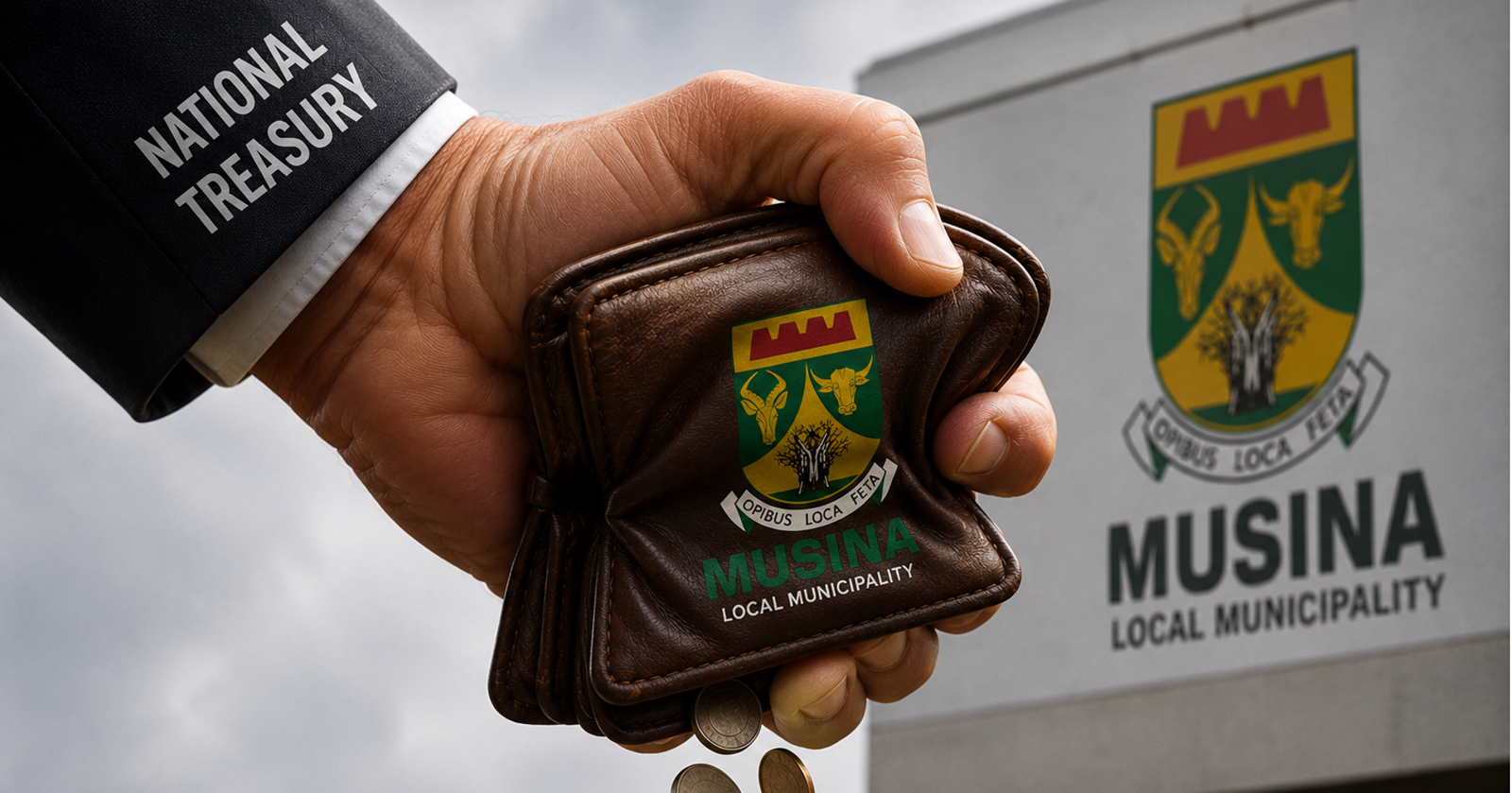
The R232.2 million Musina Municipality was hoping to get from National Treasury to help pay for its expenses may not arrive soon. Musina was identified as one of the roughly 68 municipalities countrywide where the Equitable Share grant was withheld, to force them to be accountable and stop wasting the taxpayers’ money.
On Tuesday (7 July), National Treasury announced it was withholding the July 2026 local government equitable share transfer from a group of municipalities countrywide. Treasury described this as a temporary measure in order to instil fiscal discipline at these municipalities and ensure that public money is properly managed.
The only municipality in the Vhembe district that appeared on the list was Musina. For many, however, this did not come as a surprise. The municipality has a long record of financial problems, including neglecting to pay Eskom for bulk electricity. The municipality did manage to get an unqualified audit report from the Auditor-General this year, but with findings.
Lots of fat – but not for the people
When the mayor of Musina, Cllr Nkhanedzeni Godfrey Mawela, tabled the 2026/27 budget last month, some of the expenses raised eyebrows. Above-inflation increases were announced for services and property rates to help pay for the increasing expenses.
It was clear that the municipality was depending on the sale of property to supplement its income. The sale of stands in the Rhino Ridge development was expected to generate R159.77 million, representing 17% of total revenue.
It was also clear that government grants would have to subsidise operational expenses. The Equitable Share grant represents roughly 31% of the municipality’s operational income. This grant is awarded to municipalities to help pay for expenses such as salaries. The grant is also intended to fund free basic services for poor households (indigents) and support municipal administration.
In Musina’s case, however, a big portion goes to what many describe as unnecessary luxuries and splurging on social events. One example is the R11.06 million that was budgeted for registration fees for national seminars, conferences, workshops and events. An additional R200,000 has been allocated for international events.
The cost of travelling to meetings, seminars and other events has also increased sharply over the past year, with more than R20 million budgeted for this item.
A lack of accountability
The latest report of the Auditor-General (AG) is not yet publicly available, but previous reports paint a rather dismal picture. Irregular expenditure rose significantly by roughly R13 million between the 2023/24 and 2024/25 financial years and stood at R35.59 million.
By 2024/25, the municipality was losing over R3 million to fruitless and wasteful expenditure, primarily due to interest charged on late payments. The 2025/26 mid-year report confirms this struggle, showing that the municipality owed R61.4 million for bulk electricity alone as part of its total R84.3 million in outstanding creditors.
The mid-year report already characterises the municipality as being in “financial distress”, noting that it struggles to pay creditors within the required 30-day period.
A recurring material finding in both AG reports is the total lack of consequence management. The municipality failed to investigate unauthorised, irregular and fruitless and wasteful expenditure to determine if any official should be held liable.
Withholding the money will have a devastating impact
When asked about the impact of National Treasury’s decision to withhold funds, the spokesperson of Musina Municipality, Wilson Dzebu, said that it will have a “moderate” effect. “The municipality is taking necessary measures to minimise the impact on service delivery and key objectives of the municipality,” he said.
The July 2026 portion of the Equitable Share grant that is being withheld amounts to R96 million, Dzebu added.
Dzebu explained that the main reason National Treasury provided for this drastic step is the municipality’s inability to pay creditors within the stipulated 30 days. The municipality’s biggest creditor is Eskom, which was owed R52.1 million as of 31 March 2026.
“The municipality has entered into a repayment agreement with Eskom during May 2026 that sets out conditions of services and settling the debt. The step taken is in line with the National Treasury requirements for the release of the temporarily withheld Equitable Share tranche for July,” he said.
Dzebu said that the municipality is confident that the issue will be resolved by the end of the second week of July. “Residents are assured that the municipality is hard at work to ensure that governance and service delivery is not compromised,” he said.
Will something now happen?
According to National Treasury, municipalities were given sufficient written notice and urged to change their financial management positions ahead of the withholding, and were also given a platform to submit written reasons why their funds should not be withheld.
Musina seemingly did not act on that opportunity.
To secure release of the withheld funds, municipalities must implement remedial actions by 30 September 2026. These include establishing active disciplinary boards with evidence that financial misconduct cases are being referred for investigation, civil recovery or criminal proceedings. Signed payment agreements with bulk suppliers such as Eskom and water boards, as well as third-party creditors like SARS and pension funds, must be submitted.
Treasury emphasised that the withholding of funds is only for a short-term period, describing the decision as corrective rather than punitive.
Criticism from opposition parties
Reacting to the decision, Jacques Smalle, the Democratic Alliance’s Limpopo spokesperson on Provincial Treasury, described the intervention as confirmation of a “deep municipal financial governance crisis” in the province. He said the DA would ask the Limpopo Legislature’s Portfolio Committee on Provincial Treasury to call the affected municipalities and the ANC-led provincial executive to account over what it says are years of financial mismanagement and poor oversight.
He said the intervention was not unexpected because National Treasury had spent years providing guidance, training and direct support to municipalities. Despite this, he said, many continued to adopt unfunded budgets, failed to deal with unauthorised, irregular, fruitless and wasteful expenditure, neglected consequence management and defaulted on statutory financial obligations.
He warned that without effective oversight, financial misconduct would become normalised, infrastructure would continue to deteriorate and public confidence in local government would decline. He said residents were ultimately paying the price through declining basic services.