
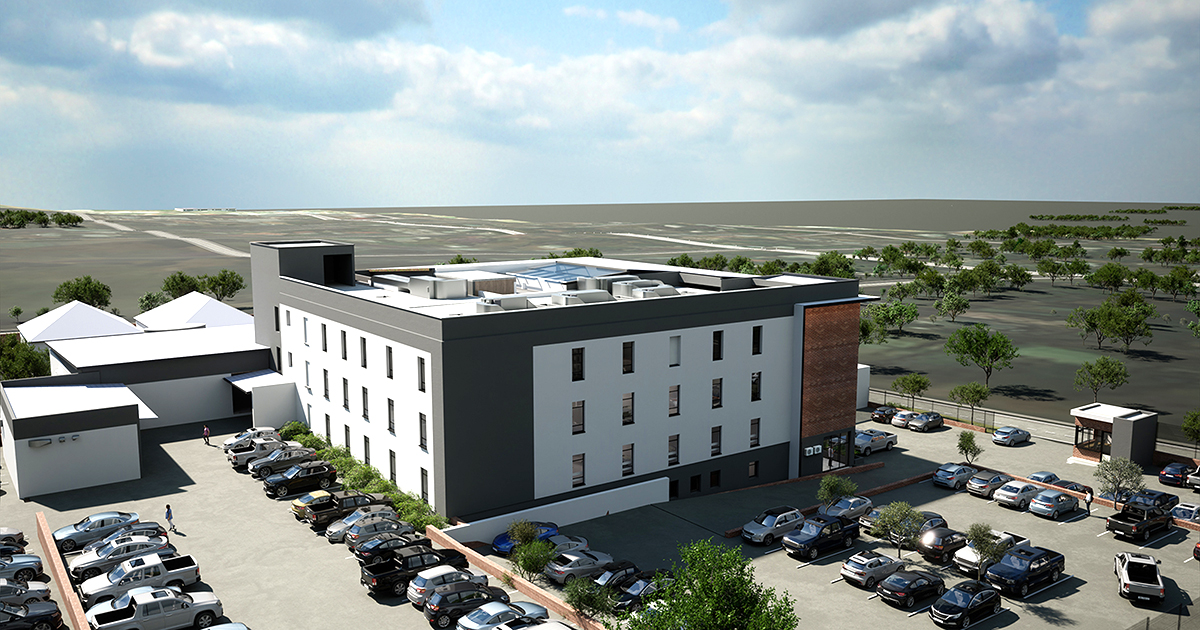
Investors and local politicians were given a closer look at what exactly is being planned for the new 92-bed Zoutpansberg Private Hospital (ZPH) in Louis Trichardt during a hospital-expansion visit to the site on Tuesday, 16 August. The guests included members of the hospital's board of directors, the investment partners Summit Africa, shareholders, the mayor of the Vhembe District Municipality, Cllr Dowelani Nenguda, and the mayor of the Makhado Municipality, Cllr Samuel Munyai.
The new ZPH is being built to serve not only the Makhado area, but the greater Vhembe District with the aim of delivering world-class health care, without patients' having to travel vast distances to get these elsewhere.
As an introduction, Mr Kevin Hinde, on behalf of A3 Architects, gave a brief overview of the project so far. "We are very blessed and honoured to have been involved in the project since 2018, and I know we had a brief two-and-a-half year interruption of all of our lives, so that obviously contributed substantially to the delay," said Hinde. He was, however, excited about the progress made to date. "But the project we are sitting with right now is a project that has evolved. I think we went through 14 or 15 different revisions in the concept design in order to get the modelling right," said Hinde. He explained that they ended up deciding just to build a new hospital, rather than trying to tie it into the existing hospital. The plan is then to repurpose the existing building as support infrastructure.
The new hospital is essentially a four-storey building (ground level plus three floors). The ground floor will feature a very comprehensive radiology unit, a reception area at the front door, a coffee shop, some administrative offices, a pharmacy and all the public services. At the back, it will tie into the existing hospital, through an access passage, which is going to become support and consulting facilities.
On the first floor will be a 27-bed medical ward and an eight-bed paediatric ward. "So, your medical/paediatric component will be on the first floor … What is essentially on the first floor ties into the service level because of the fall in the [slope of the] site and a comprehensive new arrangement of services in the new facility, including a kitchen, laundry, new engineering and backup water. The building is going to be completely self-supporting and a stand-alone structure," Hinde said.
Coming up to the second floor, this floor will consist of a 19-bed surgical ward, all rooms with en-suite bathroom arrangements, typical of private-hospital planning, as well as the necessary support infrastructure and facilities. "What we've also done is we've separated the clinical services and supply services from the movement of patients and public. You don't want to mix those two. So, as far as possible, in a very tight footprint, we have managed to contain the services course as separate from the public circulation course to give you a sense of well-being as an end-user. It also then allows the staff to move freely and uninterrupted without mixing with the public and patients," said Hinde. Also on the second floor is a dedicated maternity ward and neonatal and delivery rooms.
On the top (third) floor will be the operating theatres because of all the equipment and air-conditioning on the roof, from a technical perspective, to service the theatres underneath. It will have three theatres, with the potential for future expansion, and a post-op unit, 10-bed ICU/HCU ward, central sterile services department and theatre staff resting and changing area. "This will be the super-specialised floor," said Hinde.
Hinde concluded his presentation by stating that the building has been planned to allow for future expansion along all its edges.
ZPH manager Ms Anneke Stroebel expressed her gratitude towards Summit Africa as investors and said she was excited to see the new hospital taking shape. "We salute Summit Africa for investing in our vision. This community will be forever grateful," said Stroebel.
In his opening remarks, Mr Ngange Nongogo (Zoutpansberg Management Committee board chairman and Summit Investment principal and partner) said that at the time they (Summit Africa) were contemplating getting involved with the expansion of the hospital, the R200 million investment into the Makhado district was the second-largest private investment into the area in the last 20 years. "What I want to say is a big thank you to my fellow executives on the board. A significant thank you to the management team that has supported us through this endeavour and while we are going through this process in keeping the lights on and making sure the people who come through the hospital are more than well serviced. A big vote of thanks as well to the Summit team … as our primary investors into this expansion that you see in front of you and the great set of doctors. There are over 20 doctors who have committed to come on board and support us in this growth initiative. All have really taken ZPH from being primarily a maternity-based hospital to a 92-bed acute hospital with three theatres servicing the greater community, not only in the Makhado area but the greater Vhembe District. I hope that when we speak in five years' time, we will talk about the numbers of lives we've saved by making sure people don't have to travel these road to get to quality health care and that they are actually treated at our fine facility," said Nongogo.
Also present at the function was Mr Tomi Amosun (Summit co-founder and managing partner). He thanked the ZPH management for backing Summit Africa as their investment partner. "Summit is all about partnerships … We can have an idea, but without a partnership, that idea would have stayed an idea on paper," he said.
According to Amosun, the project is more than just numbers. "Numbers are important because, at the end of the day, we are investing to make a return. We are investing pensioners' money to make a return for those pensioners. But equally, we are investing to make in impact in the community, and that impact needs to be felt even after the investment has been made," said Amosun.
So what does that mean?
"Ngange mentioned we are investing R200 million on behalf of the investors. But the investment does not stop there. The goal in this particular facility is to create at least 80 jobs - new jobs. The new jobs are in the clinical side of the facility, as well on the administrative side. But the facility cannot stand on its own. It needs cleaning, it needs catering, it needs laundry, security – it needs all kinds of services that are spinoffs of the investments that we have made. What we measured is that for every R1 million of investment that we make in a community like this one, you create at least another R1 million of expenditure for local SMEs. So, what we believe is that by investing R200 million into this project, we create another R200 million. And that is annual expenditure, not just a once-off," said Amosun.
On behalf of the people of the Vhembe district, Cllr Dowelani Nenguda thanked all those involved in the project. "To the management of ZPH, the leadership of Summit Africa and other partners, I want to say we really appreciate this initiative. This is not only going to help in taking care of our health, but also in terms of poverty alleviation," said Nenguda.
The completion date for the new hospital is set for October 2023.