
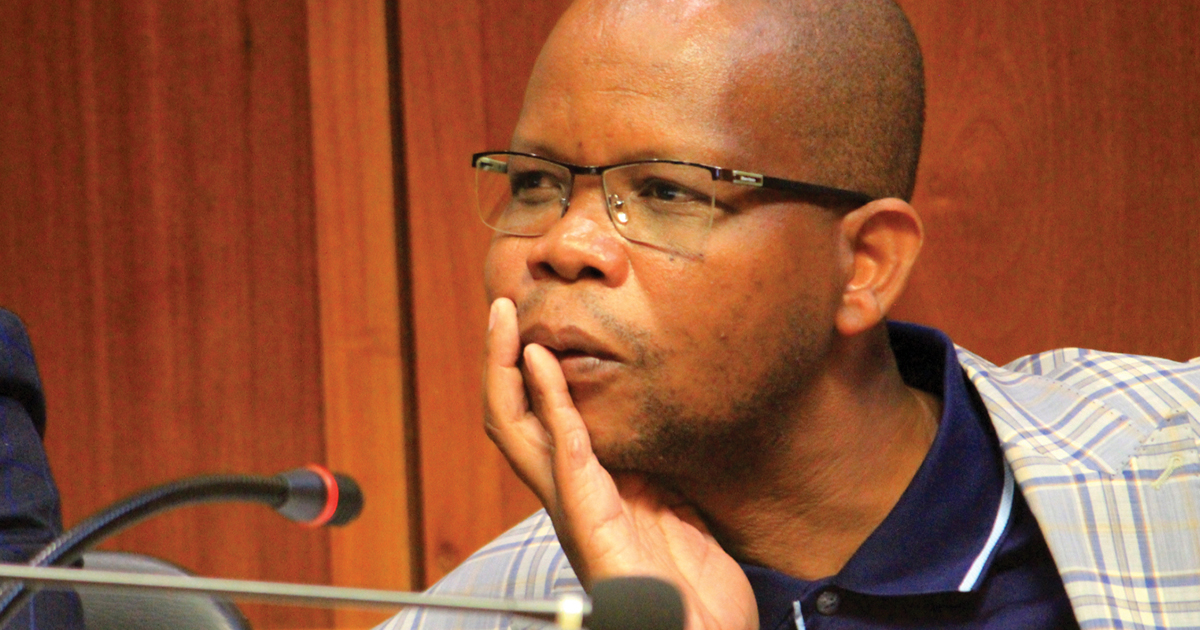
The clouds have not cleared over the troubled Mphephu royal household, with the threat of bankruptcy looming. Earlier this month, the high court ruled that the former king of the Vhavenda, Toni Peter Mphephu, must repay the millions he received from the VBS Mutual Bank looters. However, he appears to have no funds to settle the debt.
“[Toni Mphephu] is unemployed, receives no salary, and would in fact qualify for the Social Relief of Distress grant of R370 per month,” said his lawyer, Ramovha Tshikonelo, this week. He was speaking after the Gauteng High Court’s ruling on 3 March that his client and his former attorney, Oscar Thovhakale, must repay more than R17 million to the liquidators of VBS.
Tshikonelo said they will appeal the ruling of Acting Judge Johann Gautschi, arguing it was procedurally flawed and failed to consider constitutional protections for cultural practices. “We have already filed an appeal last Thursday,” he said.
Former king collected millions, court told
In court papers, the joint liquidators of Vele Investments (Pty) Limited argued that much of the looted money was channelled to Mphephu and his associates.
Vele Investments was founded by the former Vhavenda king and his financial adviser, Tshifhiwa Matodzi. Matodzi, also the chairman of VBS Mutual, served as director and chairman of Vele Investments, but Mphephu had no official position in the company. Vele Investments held a 53% stake in VBS and used the bank to channel money to its other businesses.
The liquidators argued that R17,292,254 was paid from Vele Investments as “dispositions without value”- payments made for which the company received nothing in return - while the company was insolvent.
The court noted several significant admissions by Mphephu during a prior inquiry:
He received R300,000 per month from Vele Investments despite never being employed by the company.
He was not expected to provide any value in exchange for these monthly payments.
Vele Investments paid for his luxury vehicles (including a Range Rover, a BMW, and two Mercedes-Benz cars) and funded refurbishments for his residence in Dainfern.
A substantial payment of R11,985,682.15 was made to his attorney, used to settle the bond on the Dainfern property and cover legal fees.
“It was nduvho,” answered the former king
Mphephu’s primary defence rested on African customary law, specifically the practice of uluvha (also called nduvho). He argued that, as a traditional leader, it is customary to receive gifts from businesspeople seeking to support the royal family and gain communal favour. He contended that these “gifts” belonged to the VhaVenda people and were used to further the interests of the royal house.
The court rejected the king’s “customary gifts” defence, noting that it focused on movable and immovable property (cars and the house) but did not address the undisputed monetary payments made to his personal bank accounts.
A further issue was that the “favours” were granted by Vele Investments, a corporate entity. Judge Gautschi pointed out that a company cannot practise a custom - only human beings can.
One strategy of the defence was to deny the liquidators’ claims, including that Vele Investments was insolvent at the time of the payments. The court ruled that the defence needed to prove solvency, which they did not, entitling the liquidators to set aside the payments under the Insolvency Act.
What must Mphephu and his former lawyer pay back?
The court ordered Toni Mphephu to repay the liquidators R4,389,529.24, the total of 57 payments made by Vele Investments for his direct benefit, including monthly cash payments, vehicle financing, and payments made directly into Mphephu’s personal “Royal One” account at VBS Bank.
The Dzata Trust must repay R8,121,886.88. This trust, established for the benefit of Mphephu and his wife, also owns the Dainfern property, the luxury residence where the couple once lived. Vele Investments made 12 payments totalling R917,042.88 directly into the Dzata Trust bond account. A larger sum of R7,204,844.00 was paid to settle the bond. The trust was provisionally sequestrated on 5 July 2023.
Mphephu’s former attorney, Oscar Thovhakale, must repay R2,996,420.50, representing the 25% legal fees he retained. Mphephu and Thovhakale are jointly and severally liable for an additional R1,784,417.65, which could not be declared. The respondents were also ordered to pay the costs of the application.
“We will appeal,” says Mphephu’s attorney
Mphephu’s lawyer, Ramovha Tshikonelo, raised concerns about the conduct of the proceedings in an interview earlier this week.
He said the presiding judge took nine months to hand down the judgment, well beyond the prescribed three-month period, and there was overlap of jurisdiction and processes. Tshikonelo argued that the properties in question had already been sold under a previous court order related to the VBS judgment. “This judgment is confusing even to those who wrote it,” he said.
He added that vehicles allegedly purchased for the former king were sold at auction for far below market value, only to be resold privately at much higher prices, resulting in broader asset losses.
Tshikonelo said that the principle of nduvho is a customary practice of presenting gifts to a king, part of Venda customary law protected under the South African Constitution. “When you bring a nduvho to the king, he does not ask where you got it from; he accepts it,” he explained, drawing parallels to international examples, including a reported aircraft gift to US President Donald Trump from Qatar and gold presented to Queen Elizabeth II.
The attorney suggested Mphephu may have been unwittingly exploited, with individuals leveraging his royal influence to solicit bank investments without his full knowledge or complicity. “People used his influence to their advantage. They would send him to certain people and ask them to invest in the bank, and those people would agree because of his standing as a king.”
Tshikonela also complained about the misperceptions created by the judgment, such as that Oscar Thovhakale is Toni Mphephu’s nephew. “There is no family relation,” he said.
He concluded by expressing concern about the reputational damage to his client. “My client has been painted badly in the eyes of the people; now, every negative judgment is laid at his door, even when it is not fair.”