
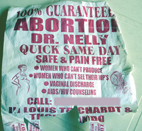
Suppose a young girl has discovered that she is pregnant. She walks down the street and sees an advertisement on a street pole, offering a quick, same-day abortion, guaranteed, safe and pain-free, but no address is supplied and no questions will be asked or answered.
The above-mentioned advertisement is real and appears on the streets of Louis Trichardt. Community members have complained about it. The advert in question was never approved by the Makhado Municipality, the municipal manager said this week.
Should a girl or woman even consider responding to such an advert?
"No, never. Since abortion has been legalised, there are safe, hygienic places to go where professional treatment is given, where no one is shy to answer questions. A pregnant lady should first be counselled by properly trained persons, so that she can make an informed decision about her choices and the help offered. Abortion may result in physical problems as well as emotional problems," says Sister Juanita van der Berg, nursing manager of the Zoutpansberg Private Hospital.
"I was shocked, to say the least, to see so many pamphlets pasted on electricity poles and street signposts in the town, advertising quick, same-day abortions," says Pastor Maanda Ravele of the Evangelical Lutheran Church´s Dzanani Parish. Pst Ravele, who resides in Louis Trichardt, considered the abortion advert highly offensive and a trap to teenage girls. The advert named the areas of Louis Trichardt and Thohoyandou.
Only a telephone number was given. The person was phoned but seemingly could not or would not understand much English. She refused to supply a physical address and only wanted to know how many months the enquirer was pregnant. She did, however, oblige us by giving the cost of the abortion, which became more expensive the more advanced the pregnancy was. She continued to refuse to supply an address, but offered to come and pick up the enquirer. When other questions were posed, she seemingly got aggravated and slammed down the phone. No information could be obtained as to the qualifications or the nationality of the advertiser or the professional standard of the environment where the abortion would take place.
One of the local group of doctors said that he could not comment on the quality of the abortion service offered by the advertiser.
"Same-day, safe abortions are possible, but there should be proper equipment. If there is no address, there could be a reason for that. But I have never heard of such a person." The doctor did say that there are strict regulations for advertising in the medical profession. "You may give notice of a new service once and may not advertise special offers," he added.
According to the code of Advertising Standards Authority (ASA) "no advertisement may offend against good taste or decency or be offensive to public or sectoral values and sensitivities, unless the advertising is reasonable and justifiable in an open and democratic society, based on human dignity, equality and freedom."
"As professional persons we should be sensitive to the values of our community," the doctor said and added that there are qualified doctors in town rendering professional services, including abortion. The Family Planning Centre at the Louis Trichardt Memorial Hospital offers counselling and abortion.
"A project to train counsellors for crisis pregnancy centres all over the area will commence on November 5 at the AFM in Louis Trichardt," says Ms Trinette Claassens, social worker at Shiloh Place for abandoned babies.
"Please don't abort your baby. We are able to care for the baby and find a place for him or her, whether it is by adoption, foster care or at a place of shelter," says Ms Claassens.
Statistics show that the number of women younger than 18 having abortions at state medical facilities has more than doubled since 2001. According to news24.com, Health Minister Manto Tshabalala Msimang said last week that 4 423 persons under the age of 18 requested termination of pregnancies in 2001 and 9 895 in 2006. The Choice on Termination of Pregnancy Act was promulgated in 1996. In terms of the Act, only the consent of the pregnant woman is required for an abortion to be performed.