
By Chris Gilili
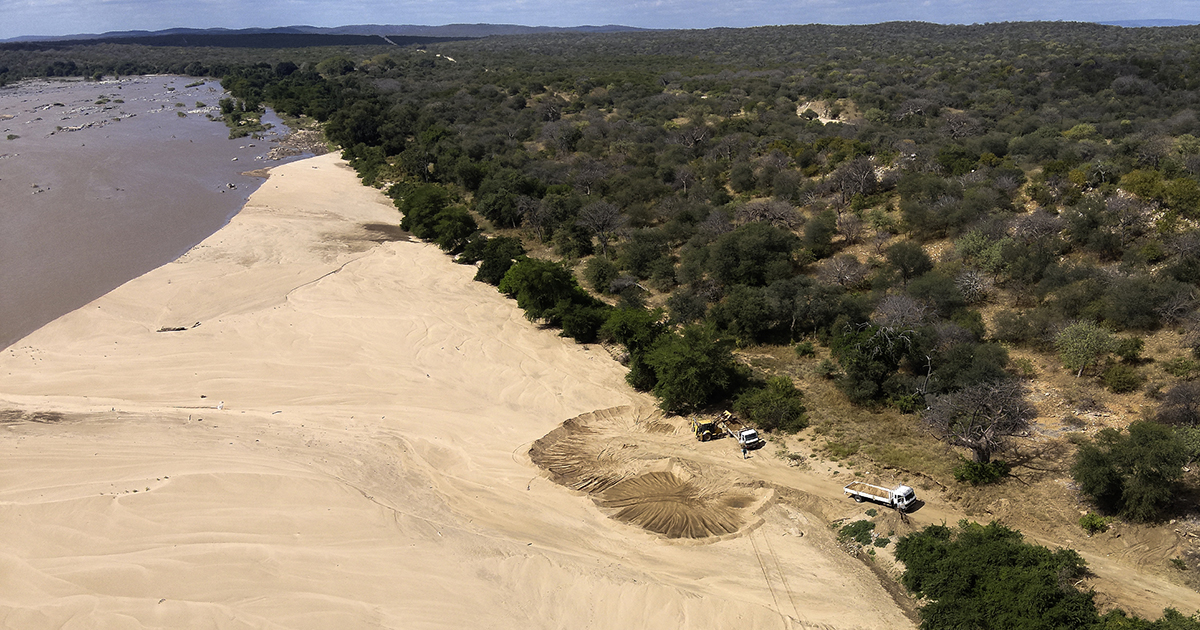
Weeks after the Limpopo High Court ordered her to halt operations in one area, other companies linked to businesswoman and Musina municipal employee Maria Munyai continue to mine sand on a farm bordering the Limpopo River.
The farm's manager, Jacque Turner, says the continued mining is illegal and marks the latest chapter in a years-long dispute with Munyai and her companies, which Turner has reported to the police numerous times and challenged in court over several years.
The Department of Mineral Resources and Energy (DMRE) recently confirmed that Munyai had stopped mining on the permit and on the parcel of land that had prompted many of Turner's complaints. The department added that two other companies with separate permits continued to mine on the farm's banks.
Those companies are registered to Munyai's husband and daughter, and Turner believes they are fronts for the same operation. Munyai, however, insists she has a right to mine on the farm Vrouwensbrom.
Just days after securing a judgment with costs against Munyai and DMRE on 19 June 2025, Turner filmed trucks dumping sand, which he said was illegally mined by Munyai.
"The DMRE will deny everything. They are very reluctant and they are not abiding by the law. Before a permit is issued there must be consultation with the landowner, there must be public participation. They can't rock up and say they have a permit without that happening," Turner said.
He accused Munyai of exploiting the system. "She knows the other company has broken many laws and there are many complaints about her company," he said, adding that appeals have been lodged against the issuing of both permits.
In the past, Munyai challenged Turner's standing to report her, arguing the sites she mined did not belong to him.
The court found that Munyai's original company had continued mining even after its permit had lapsed in 2023. Without enforcement from the police and DMRE, the ruling had had little impact on her operations.
The court also found that more than 130 criminal complaints filed against Munyai at Tshamutumbu Police Station went nowhere, with officers referring complainants back to DMRE, which in turn referred them back to the police. Judge Du Plessis wrote that it was "evident that neither the DMRE nor the SAPS fulfilled their legislative obligations."
The court set aside any mining permit that might still be claimed as valid and ordered costs against Munyai and the state.
A well-connected miner
The June court order was clear: Munyai's permits had expired, her company had mined outside legal areas, and she was in contempt of a 2020 court order requiring mediation with Turner.
Munyai, however, is no ordinary miner. She has worked for 20 years as an administrator at Musina Local Municipality while building a parallel career in logistics, construction, and sand mining.
According to Munyai, the municipality is also a client, buying sand and bricks for construction projects. The municipality, however, said: "Activities by Mrs Munyai in supplying materials for RDP houses are not known to the municipality."
Locals know her as a benefactor, buying clothes for poor children at Christmas. But neighbours like Turner see her as a mining magnate who treats environmental regulations as optional.
Munyai's company, TD Nhlamulo and His Mother Enterprises, initially held a mining permit that expired on 17 March 2023, which she had admitted under oath. Instead of closing operations, she expanded, including through new companies registered to family members.
During an interview on 1 August 2025, she claimed the "river is no man's land" and insisted she had rights to the sand, citing government letters she did not produce when requested.
Farmers pushed to the brink
The Munyai-Turner conflict reflects broader tensions between Limpopo's farmers and environmentalists on one side, and sand-mining entrepreneurs on the other.
Farmer associations, environmental activists, and political parties have long raised alarm over illegal and destructive sand mining on the Limpopo Riverbanks. Miners, they say, have learned to skirt regulations and exploit authorities' reluctance to act.
"The government must regulate, and if they don't, it means they are not fulfilling their duties. Sand mining has a massive impact on the biosphere and the environment," said Jacques Smalle, the DA's provincial leader in Limpopo. He said the party had written to the national DMRE and would continue to fight illegal mining.
For Turner, who manages Tshipise Safaris on land adjoining the river, the fight has been exhausting. He says he has spent millions on legal fees to stop Munyai. At one point, he installed concrete bollards to mark the legal boundary, which Munyai's workers allegedly tore down.
"Everything that Maria (Munyai) is doing on my farm is illegal. The court has said it. Yet she continues, and the authorities allow her," Turner said.
Other farmers tell similar stories. Rudzani Netswera, a pensioner near Thohoyandou, saw his three-hectare farm stripped bare by illegal sand miners in 2023. He spent his savings on lawyers but lost everything. "They left irreparable damage to my land," he said.
These cases show how small-scale farmers, often with limited resources, are left to fend off industrial-scale operators with excavators and trucks, sometimes under threat of violence.
A wider Limpopo crisis
Munyai's case is not unique. Across Limpopo, the sand trade is booming and largely unregulated.
"Unregulated sand mining destroys riverbank vegetation, destabilises banks, erodes soil, and causes biodiversity loss," said Lauren Liebenberg, chair of the Vhembe Catchment Management Forum. "This leads to a collapse in ecosystem services on which poor rural communities especially depend."
Agri SA's Janse Rabie said permits were meant for small, two-year operations covering no more than five hectares. Unscrupulous miners regularly apply for multiple adjacent permits, as Munyai is accused of doing with companies registered to family members.
"Although this is not supposed to be allowed, it seems to be a standard way of giving such applications a semblance of legitimacy," Rabie said.
The result is that once-pristine estuaries are gouged into craters, with water for farming and households disappearing. Communities reliant on these rivers are left impoverished.
The Aggregate and Sand Producers Association of South Africa (ASPASA) estimates the DMRE is aware of barely half of the country's illegal sand mines. Despite repeated reports, most illegal operations continue.
Sand is South Africa's most extracted mineral — more than coal or platinum — but unlike those, it is governed by weak permitting regimes. As demand for housing, cement, and infrastructure grows, so does the incentive to mine illegally.
The Limpopo River, which straddles an international border, has become a frontline. What happens there affects ecosystems and communities in both South Africa and Zimbabwe.
"This is ecological violence, driven by greed and reckless indifference. If the state does not act, the river will not survive," said Liebenberg. She said Munyai's case reflected a system in which laws were flouted, regulators were complicit, and rivers were sacrificed for profit.
Right of reply
Neither the police nor the DMRE responded substantively to queries, despite being called out by Judge Du Plessis.
The SAPS defended Maj-Gen Eddie van der Walt, commissioner of the Vhembe District: "It must be stated categorically that the district commissioner is not involved in the administration of mining licences, since that is the competency of the Department of Mineral Resources and Energy. The SAPS and DMRE are working closely to ensure that illicit mining activities are prohibited."
DMRE spokesperson Johannes Mokobane said permits were valid for the specified period, not exceeding two years, and might be renewed for three additional periods of up to one year each. Mining areas must not exceed five hectares, and the mineral must be mined optimally within the period.
Regarding Munyai's continued operations, the department said it was not aware of mining on her lapsed permit. "The department has recently issued two mining permits adjacent to the lapsed permit of TD Nhlamulo and His Mother and Business Enterprise to Mendes Vanessa Trading Enterprise (Pty) Ltd and Rotewa Holdings Trading and Enterprise (Pty) Ltd, and those permits are still valid," the department said.
Munyai did not respond to follow-up queries about her continued operations, in spite of the court order and did not answer repeated calls and messages.
*This report has been produced by the Southern Africa Accountability Journalism Project (SA | AJP), an initiative of the Henry Nxumalo Foundation with the financial assistance of the European Union. It can under no circumstances be regarded as reflecting the position of the European Union.