
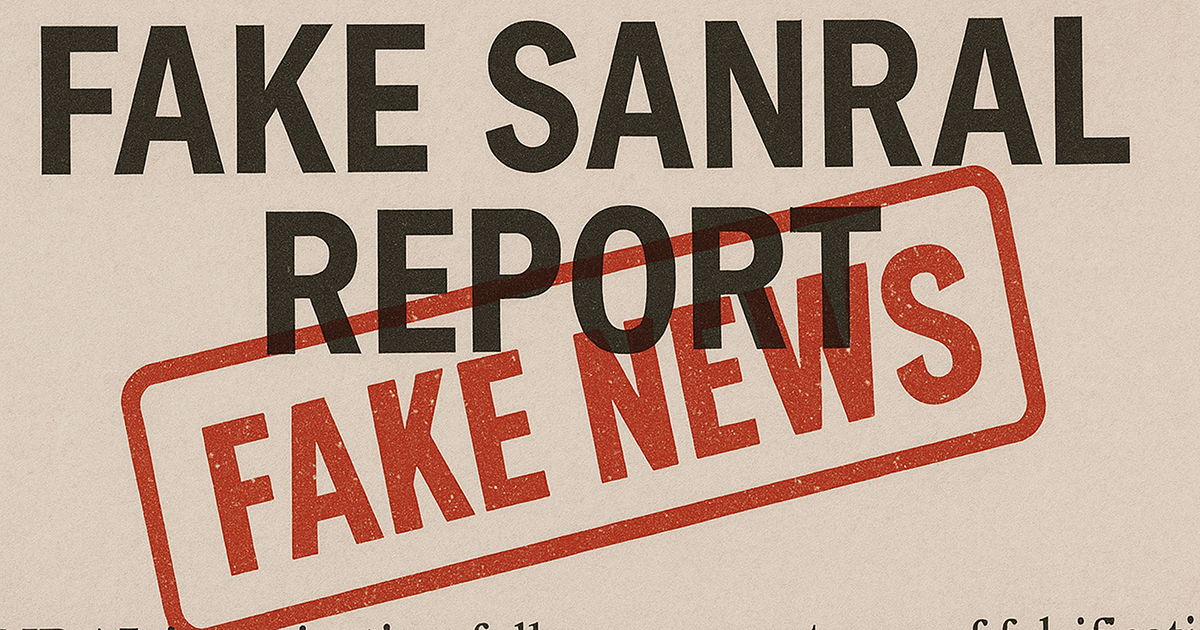
The South African National Roads Agency SOC Limited (SANRAL) warned citizens this week not to fall victim to bogus reports that there will be a national reduction in speed limits from 1 July this year. This again places the emphasis on the growing problem of fake news, with more and more people struggling to differentiate between fake and legitimate news sources.
"SANRAL would like to put it on record that a communique that is currently being circulated, purporting to emanate from SANRAL, that the roads agency is in the process of revising speed limits and enforcing stricter laws to reduce fatalities on the country's roads is false," said SANRAL in a media statement.
Mr Vusi Mona, SANRAL's general manager for communication and marketing, goes on to explain: "SANRAL has a distinct mandate to manage the country's national road network. This mandate encompasses the financing, planning, development, improvement, maintenance, and rehabilitation of the national roads, as prescribed by the SANRAL Act of 1998. The SANRAL mandate does not include any enforcement rights, be that related to speed, safety or security."
According to the communique that is being circulated, effective from 1 July, SANRAL Highway Law will implement adjusted limits across South Africa's national highway system. This will include:
* Urban roads reduced from 60 km/h to 50 km/h
* Rural roads adjusted from 100 km/h to 80 km/h
* Highways and national routes capped at 110 km/h, down from 120 km/h
* Heavy vehicles limited to 90 km/h on all roads, and
* School zones to have a strict 30 km/h speed limit during school hours.
"We encourage members of the public to contact SANRAL's hotline number on 0800 204 508 or email at sanral@tip-offs.co.za if they pick up suspicious information being circulated," added Mona.
Unscrupulous websites often use fake news as a means to drive web traffic and, in turn, generate advertising income. By publishing sensational or misleading headlines—commonly known as clickbait—these sites exploit readers' curiosity or emotions to lure them into clicking on the articles. Every click translates into advertising revenue, regardless of the accuracy or integrity of the content being consumed.
The danger of fake news extends beyond misleading readers. In some cases, artificial intelligence-powered platforms trained to summarise or verify news have also been duped into accepting and confirming these false reports. This occurs when such platforms rely on the sheer volume of online references, which can be manipulated by coordinated fake news campaigns. As a result, misinformation can gain an undeserved veneer of credibility, making it even more difficult for readers to distinguish fact from fiction.
Adding to the concern is the growing use of AI to generate entirely fabricated news stories that mimic the style and tone of legitimate journalism. This not only floods the information space with falsehoods but also undermines the credibility of authentic news sources. As AI-generated fake news becomes more sophisticated, it poses a serious threat to the legitimate newspaper industry, which relies on public trust, rigorous editorial standards and fact-checking. In a crowded digital environment, readers may struggle to differentiate between trustworthy journalism and AI-driven misinformation, eroding confidence in all news media and threatening the financial sustainability of credible news outlets.
From the Zoutpansberger's side, we will continue to reflect news that is accurate and true, as we have done for the past 40 years since our establishment.