
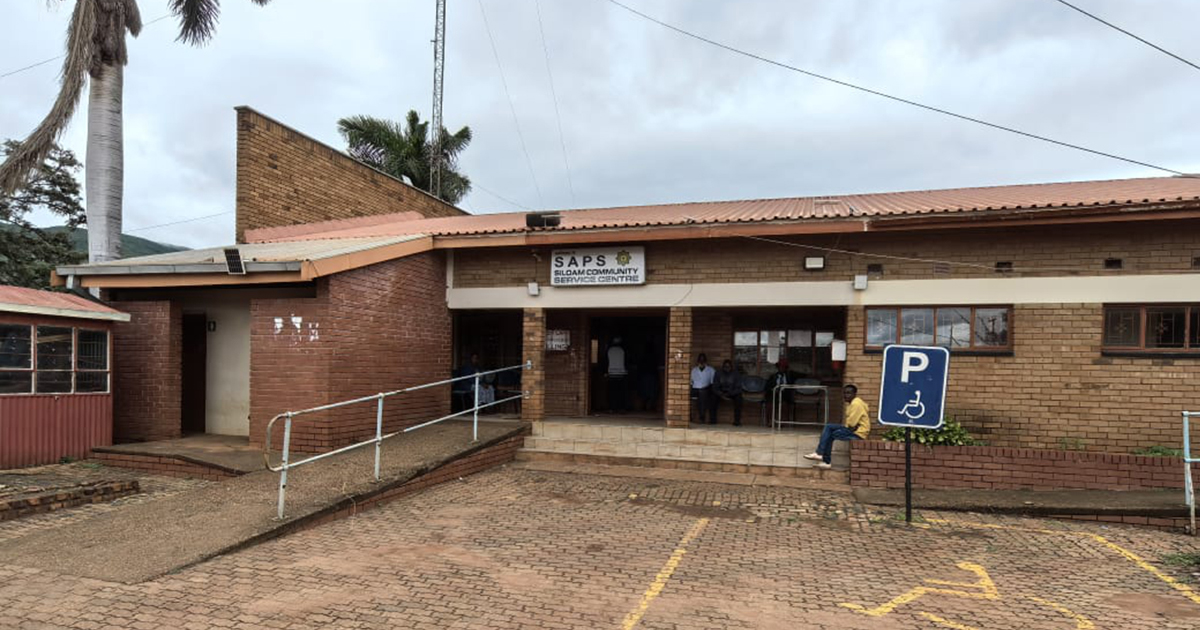
More than three decades after it was built, the Siloam Police Station is crumbling under severe structural decay, prompting the closure of detention cells and forcing police to move detainees to other stations while authorities search for a long-term solution.
The station, constructed in 1990, serves more than 84 villages, mostly in Nzhelele. With parts of the administration block now declared unsafe for occupation, the situation has raised growing concerns about public safety, operational efficiency and the state of government infrastructure in rural communities.
Police officers are currently required to transport detainees to neighbouring stations, a temporary measure that community members and safety structures warn is placing strain on already limited resources. Community members describe the building as severely run down, with visible cracks, ageing walls and signs of structural fatigue, intensifying fears about its integrity.
Responding to media enquiries, Limpopo police spokesperson Lt Col Stephen Thakeng confirmed that the building is “not in good condition for employees, detainees and members of the public”.
He said a meeting was held in December 2022 between the Department of Public Works, the Department of Employment and Labour and a Limpopo SAPS delegation led by retired Deputy Provincial Commissioner for Corporate Services, Major General Morakaladi, to conduct a physical inspection of the building.
According to Thakeng, Public Works indicated at the time that structural engineers would be dispatched to assess the building and fast-track the restructuring of the state property.
Despite those assurances, conditions have worsened. Thakeng confirmed that the Department of Employment and Labour visited the station on 4 February 2026 and ordered the immediate closure of the detention cells and two offices in the administration block after declaring them unsafe.
“The situation is treated as an emergency because detainees must be transported to nearby police stations,” Thakeng said, adding that the district commissioner’s office and specialised units had been requested to assist with crime prevention and the transportation of detainees to neighbouring stations and courts.
He noted that the construction and renovation of police stations fall under the Department of Public Works, which has implemented temporary measures to ensure service delivery is not hampered.
However, community safety structures argue that temporary measures come at a cost.
Zone 4 Crime Watch, a community group assisting police in crime prevention, works with four police stations in the Vhembe district: Mphephu, Siloam, Tshitavha and Waterpoort. Its leader, Richard Mukhaninga, said the government must expedite the process of building a new station or undertaking major renovations.
Transporting inmates to other holding facilities, he argued, is an unnecessary drain on public funds.
“Other police stations are between 20km and 50km away. If every suspect apprehended here has to be taken to another station, imagine how much state resources are being used daily,” he said.
Mukhaninga added that the arrangement places strain on officers who must travel long distances, sometimes multiple times a day, to detain suspects and transport them to court.
Beyond the financial implications, he warned of safety risks.
“We must also think about the safety of police officers who work here. The building is decaying. We must not wait for it to collapse before we act. It must be fixed now while it is still functional,” he said.
Residents have also raised concerns about the impact on families of detainees, particularly those from remote villages. With suspects being held at stations such as Biaba and Matatshe, families often struggle to afford transport for visits. Community members say this has social and humanitarian implications, especially for families who rely on regular visits to provide food and emotional support.
The Limpopo Police and Prisons Civil Rights Union (POPCRU) added its voice to growing concerns.
POPCRU provincial chairperson Nelson Maesela said the union is aware of unsafe police stations across the province, including the one at Siloam.
“We had a discussion with management on the issue, both at the bilateral and SSSBC level (Provincial Bargaining Chamber). A task team was established to verify the extent of the problem across the province. However, SAPS management continuously indicates that the matter of maintenance of buildings rests with the Department of Public Works,” Maesela said.
Maesela said the union’s Provincial Executive Committee had resolved to engage the Department of Public Works directly while also calling for the closure of unsafe police stations.
He further revealed that POPCRU plans to launch “Operation Vala” in the second half of the year to raise the matter publicly.
“We have already exhausted all internal avenues,” he said.