
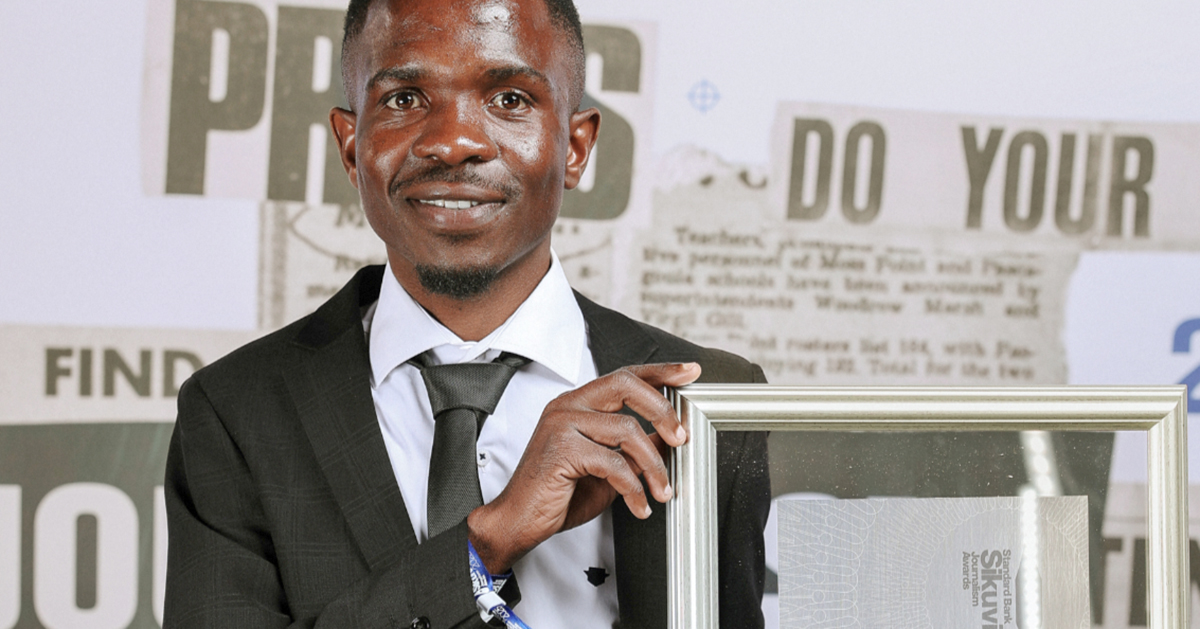
On Saturday night, 28 June, at The Venue in Melrose Arch, Johannesburg — a space usually reserved for seasoned editors and city-dwelling media giants — the voice of Elim village echoed loudly and proudly. That voice belonged to Thembi Siaga, a young journalist from the rural heart of Limpopo, who was named runner-up in the Community Service Reporting category at the 2025 Standard Bank Sikuvile Journalism Awards.
The awards were hosted by the South African National Editors' Forum (Sanef), in partnership with Standard Bank. Tammy Jane Fray from the East London based GO! & Express, won the community media category with her report, Maternity ward mayhem. Thembi Siaga, who writes for Limpopo Mirror and Zoutpansberger, as well as online publication GroundUp, was the runner-up.
Siaga's hard-hitting story, Unregistered school in Mpheni may soon be closed, exposed the shocking reality of Ziggy Primary School — a facility that had operated illegally for years, enrolling learners and taking fees while offering substandard and unregulated education. His reporting forced the Limpopo Department of Education to act, resulting in the school's closure and the relocation of 94 learners to registered public schools.
"Honestly, I was in shock," Siaga reflected. "I never imagined hearing my name called out in a room full of South Africa's top journalists. It was overwhelming — pride, disbelief, deep gratitude. But most of all, it reminded me why I chose this path: to give voice to communities that are often overlooked."
What made the story even more impactful was the persistence behind it. The school's owners refused to engage, lawyers stonewalled, and responses were scarce. But Siaga — armed with grit, a pen and a purpose — kept digging.
And that, says Limpopo Mirror editor Anton van Zyl, is what sets him apart.
"Thembi is one of those rare journalists who builds trust by consistently delivering high-quality work," said Van Zyl. "He operates in an environment where resources are limited, threats are personal, and yet he manages to stand tall. Even at his young age, he's become an inspiration to other rural journalists."
Van Zyl added that community-based investigative journalism was often seen as a luxury. "There's no financial gain in it — it's a loss, if we're honest. But we keep doing it because if we don't, our communities will suffer even more. Thembi represents exactly why we persist."
For Siaga, the award is more than a certificate — it's a signal to keep going. "Personally, it reminds me that voices from Elim, from rural Limpopo, matter. Professionally, it's validation. This recognition gives me the courage to aim even higher and keep telling stories that challenge power and uplift the voiceless."
He says what keeps him going is seeing the real-world impact of his work. "When a mother tells me, 'Thank you for telling our story,' or when someone finally gets an ID after our coverage — that's what fuels me. I didn't become a journalist for fame or money. Someone has to hold the line, especially in places where no one is watching. If I don't do it, who will?"
Looking ahead, Siaga's vision is wide and deep. "There are still so many untold stories in rural Limpopo — education inequality, climate injustice, youth unemployment, broken health care. But I also dream of doing long-form investigative pieces that cross borders. There's still so much work to be done."
His message to aspiring rural journalists is as honest as his work: "Never let your location define your worth. You don't need a fancy newsroom or the latest gear to tell powerful stories — you need heart, courage and persistence. Learn to write from the ground up, literally. Your story matters. And so do you."