
By Anton van Zyl and Bernard Chiguvare
Traditional leaders may not "tax" their communities or raise compulsory levies. This was ruled by the Constitutional Court on 20 December last year, confirming a judgment made in November 2023 by the Limpopo High Court.
The High Court also instructed the Minister of Cooperative Governance and Traditional Affairs to produce a plan within one month, outlining how traditional leaders will be informed that they are not permitted to charge fees for services rendered, such as issuing a permission-to-occupy (PTO) letter to residents.
The Constitutional Court ruling has created significant uncertainty, particularly in areas such as Vhembe, where the practice of charging residents for various services is common. In many areas, traditional councils rely on these levies and charges as a way to cover the costs of providing services.
Some traditional authorities also impose fees for other services, such as issuing hawkers' permits and business licenses, practices that are not only irregular but also appear to be illegal.
Unconstitutional legislation
The case initially brought before the Limpopo High Court involved 11 applicants, who argued that they were subjected to "tribal taxes" indiscriminately imposed by traditional leaders. The applicants live in rural Limpopo, under tribal authorities such as Modjadji, Moletjie, and Machaka. The 12th applicant was the Nkuzi Development Trust.
Examples of these levies presented in court included an annual fee that ranged from R20 to R150. Other levies were imposed for access to common resources, such as allocating a stand, running a business, or burying a family member. Residents were also charged for services that should be free, such as obtaining a proof-of-address letter. Fines were often imposed for failing to pay these levies.
Justice Leona Theron, delivering the Constitutional Court's ruling, noted, "The non-payment of these levies is punished by withholding certain services, such as refusing to provide a proof-of-address letter, which is needed when poor households apply for social relief grants." Her colleagues on the bench unanimously agreed with the ruling.
The court considered the historical context of compensating traditional leaders. "Before colonialism, communities in Limpopo paid tributes to their traditional leaders, often in the form of goods or labour. With the advent of colonialism and apartheid, these practices were corrupted as traditional leaders were co-opted to act as servants of the state, collecting taxes both for themselves and for the colonialists," the judgment reads.
To formalise the imposition of these levies, the Limpopo Traditional Leadership and Institutions Act 6 of 2005 was enacted. Section 25 of the Act states: "A traditional council may, with the approval of the Premier, levy a traditional council rate upon every taxpayer of the traditional area concerned."
However, this provision was ruled unconstitutional by both the High Court and the Constitutional Court. Both courts held that only legislative bodies are authorised to impose taxes, citing Sections 228 and 229 of the Constitution. "Because of the democratic centrality of the taxing power, the Constitution carefully regulates who can impose taxes, and how they must exercise that power. It expressly confers and circumscribes taxation powers on provincial legislatures and municipal councils," the ruling states.
The judgment highlights that only democratically elected legislative bodies may impose taxes.
"It is not a tax"
One of the defenses raised in court was that the payments traditional leaders ask for are not taxes but voluntary contributions rooted in customary practices, subject to consultation and agreement with community members.
However, the courts found that in most cases, residents were left with no choice but to pay. If they failed to do so, they were subjected to sanctions, such as being denied permission to bury their loved ones.
Justice Theron explained, "In my view, the rates and levies share all the characteristics of traditional taxes – they are compulsory charges, uniformly imposed, paid into a general fund, for the public good or the provision of services. The High Court was correct to conclude that Section 25 of the Limpopo Act is unconstitutional and invalid. The order of invalidity of that Court must be confirmed."
The High Court ruled that the Minister of Cooperative Governance and Traditional Affairs and the Limpopo MEC for Cooperative Governance, Human Settlements and Traditional Affairs must publicise the ruling to ensure that all traditional authorities, leaders, and community members are aware of the court's order and its implications. The plan for this was to be submitted to the court within one month.
It is unclear whether the process of implementing the ruling has started. Questions were sent to the Legal Resources Centre (LRC), which represented the applicants in the case. On Tuesday, the LRC's Communications and Marketing Officer, Jean-André Deenik, said he was still waiting for feedback from the legal team.
Repercussions of the ruling
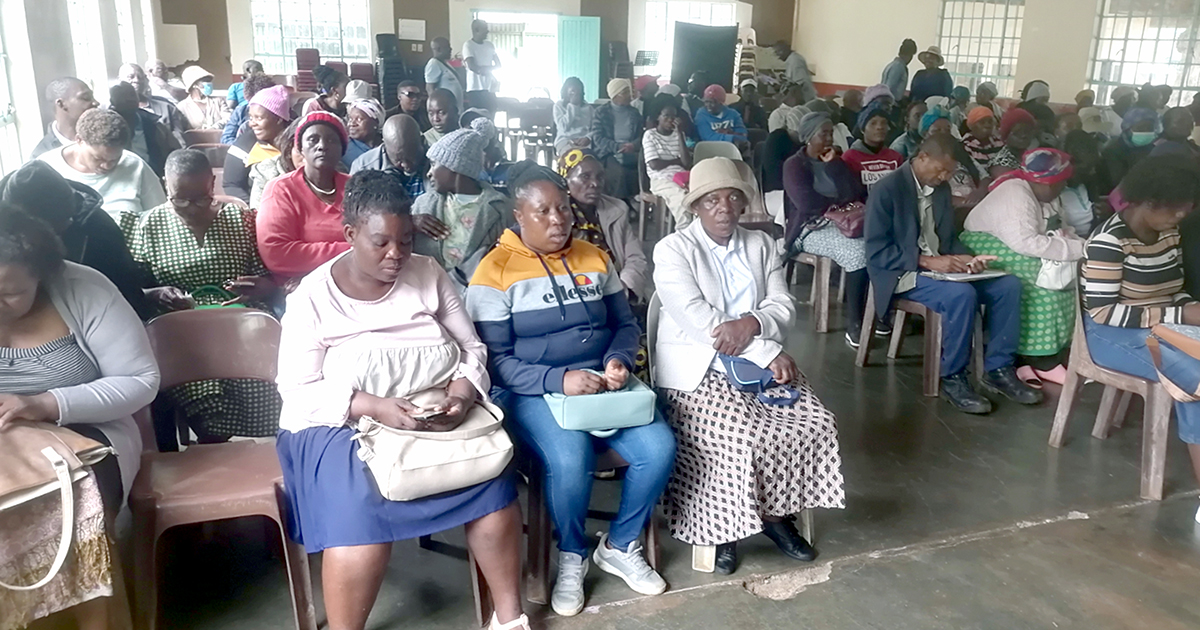
The ruling has already had significant repercussions. On Thursday, 9 January, the Zoutpansberg Community Development Forum (ZCDF) convened a meeting at the Makhado Show Grounds, attended by nearly 100 members affiliated with the organisation.
While attendees discussed various matters related to payments made to traditional leaders, the primary focus was the issuing of permission letters for spaza shops. ZCDF chairperson Patrick Sikhutshi said the organisation wanted to bring the court ruling to the attention of the Vhembe District Municipality.
"For residents to register spaza shops, they must go through traditional leaders, who demand substantial fees from vulnerable communities. Traditional leaders are supposed to assist in developing the local economy," said Sikhutshi. He explained that anyone intending to open a business in an area under a traditional authority must consult the headman, the tribal council, and the municipality, with fees charged at each stage. He estimated that these costs amount to approximately R9,000 per year for spaza-shop owners.
The meeting resolved that residents should bypass traditional leaders and deal directly with the municipality when registering businesses.
Representatives from the Limpopo Economic Development, Environment and Tourism Department (LEDET) and the Limpopo Department of Cooperative Governance, Human Settlements and Traditional Affairs (Coghsta) were also present. Viwe Sibelekwana, a director at LEDET, said the department was studying the judgment and would support its implementation. Coghsta Director of Communications Tsakani Baloyi confirmed that a plan was being developed to address the court order, with further communication to follow.