
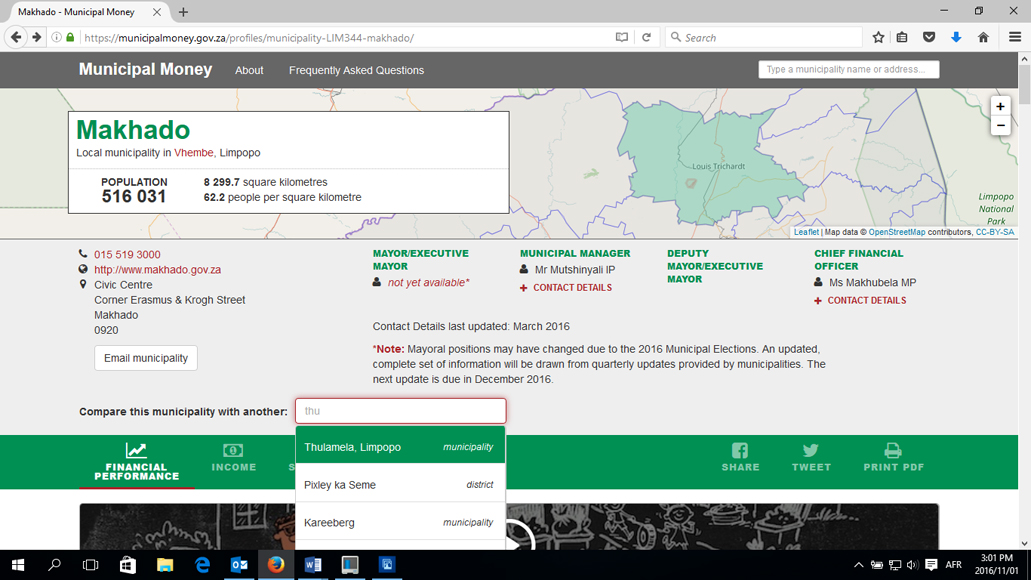
The Makhado Municipality has enough money to keep them going for the next 24 days, which is not a great situation to be in, but their situation is by far better that the Thulamela Municipality, who has zero days of extra money should things suddenly go catastrophically wrong.
These interesting facts are contained on a website now freely available to the general public. The website, municipalmoney.gov.za, was launched last week. It was developed by the national Treasury Department in partnership with Code4SA. "The premise is simple: the tool exposes every South African municipality's finances, so you get an idea of where money is spent, how it is raised, and if the municipality is financially well-run. But it's the detail that really makes this tool shine: the great explanatory videos spread liberally throughout the site (some even in multiple languages); little explanation drop-downs that don't talk down to people; an opinion on whether every number is good, meh, or very poor. This results in a tool that is really accessible to everyone," said Code4SA's Jason Norwood-Young.
Municipal Money is a web-based tool specifically designed to give citizens insight into their local municipality's financial affairs and performance and even allows the public to do comparisons between municipalities. The aim of this tool is to make extensive municipal financial data, collected over several years, available to the public to promote transparency, strengthen civic oversight and promote accountability. It gives you a year-to-year breakdown of municipality's finances.
What makes the site great is that it is presented in a way that everyone, even people who might not have a financial background or knowledge, will be able to understand what they are looking at. This is smartly done by making use of a variety of visual tools, including interactive maps, charts, graphs and short videos. They have also provided different levels of detail in explaining key financial concepts, so that the general public can select the amount and level of information they want access to.
The Zoutpansberger decided to take the new site for a "test drive" and find out how the Makhado Municipality's financial affairs compare to that of neighbouring Thulamela Municipality?
Although the Makhado municipal area is bigger than that of Thulamela (8 299.7km² compared to 5 834.3km²), Thulamela is more densely populated. Thulamela houses 618 462 inhabitants against Makhado's 516 031 inhabitants. Thulamela therefore has more people to keep happy per square kilometre (106 people per km²) than Makhado's 62,2 people per km².
As mentioned, Makhado has cash coverage for 24 days as calculated for the period July 2014 to June 2015. Cash coverage measures the length of time, in months, that a municipality could manage to pay for its day-to-day expenses using just its cash reserves. So, if a municipality had to rely on its cash reserves to pay all short-term bills, how long could it last? Ideally, a municipality should have at least three months' of cash cover. Thulamela has zero days coverage, which is obviously reason for great concern.
Apart from the two municipalities' cash coverage looking a bit bleak, Makhado did reflect a very good cash balance for the period, totalling R47 449 950.
Did you know: A municipality's cash balance refers to the money it has in the bank that it can access easily. If a municipality's bank account is in overdraft, it has a negative cash balance. Negative cash balances are a sign of serious financial management problems. A municipality should have enough cash on hand from month to month, so that it can pay salaries, suppliers and so on.
It would therefore be safe to say that Thulamela has serious financial management problems, reflecting a –R189 272 193 cash balance for 2015.
On a positive note, both municipalities had an average score when it came to spending their operating budget. Makhado underspent their budget by 7%, while Thulamela underspent by 7.6% for 2015.
Did you know: This indicator is about how much more a municipality spent on its operating expenses than was planned and budgeted for. It is important that a municipality control its day-to-day expenses to avoid cash shortages. If a municipality significantly overspends its operating budget, this is a sign of poor operating controls or something more sinister. Overspending by up to 5% is usually condoned, while overspending by more than 15% is a sign of high risk.
In contrast to underspending when it comes to the operating budget, underspending on a municipality's capital budget is not a good thing. In this, regard both Makhado and Thulamela scored very poorly for 2015. Makhado underspent 25.75% of their capital budget, while Thulamela underspent by 25.86%.
Did you know: Capital spending includes spending on infrastructure projects such as new water pipes or building a library. Underspending on a capital budget can lead to an underdelivery of basic services. This indicator looks at the percentage by which actual spending falls short of the budget for capital expenses. Persistent underspending may be due to underresourced municipalities who cannot manage large projects on time. Municipalities should aim to spend at least 95% of their capital budgets. Failure to spend even 85% is a clear warning sign.
Again, on a more positive note, Makhado's liquidity ratio stands at a healthy 1.73 for the period July 2015 to the fourth quarter of June 2016. The same, however, could not be said about Thulamela, who scored a bad 0.79 liquidity ratio.
Did you know: Liquidity ratios show the ability of a municipality to pay its current liabilities (monies it owes immediately, such as rent and salaries) as they become due, and their long-term liabilities (such as loans) as they become current. These ratios also show the level of cash the municipality has and/or the ability it has to turn other assets into cash to pay off liabilities and other current obligations. A liquidity ratio of more than 1 is good and less than 1 is bad.
The Makhado Municipality is also doing very well when it comes to debt collection. Their current debtors' collection rate for the period July 2015 to the fourth quarter of June 2016 is 106.57%. Again, Thulamela's financial situation as to their current collection rate for the same period is very bad, standing at a mere 34.45%. National Treasury views a collection rate of more than 95% as very good and less than 95% as very bad.
Did you know: Municipalities don't manage to collect all the money they earn through rates and service charges. This measure looks at the percentage of new revenue that a municipality collects. It is also referred to as the Current Debtors Collection Ratio.
Municipal Money also explains, in fairly good detail, where both municipalities' money comes from and how it is being spent.
On the income side, the Makhado Municipality generates 42.56% of its income locally, while Thulamela generates 33.82% of its annual income locally. This was for the period July 2014 to June 2015. The rest of both municipalities' annual income (57.44% for Makhado and 66.18% for Thulamela) comes from national government in the form of equitable shares and grants.
Did you know: The more funds a municipality generates, the more self-sufficient it is. Municipalities should not be too reliant on transfers and grants from other spheres of government.
As to how the money is spent, 29.93% of Makhado's total income for the period July 2014 to June 2015 went into staff wages and salaries. For the same period, 30.85% of Thulamela's total income went into their staff wages and salaries.
Did you know: Employee-related costs are typically the largest portion of operating expenditure, but they should not grow so large that they threaten the sustainability of the operating budget. The normal range for this indicator is between 25% and 40% of total operating expenditure. Municipalities must guard against spending too much on staff while also making sure they have the people they need to deliver services effectively.
Over the next couple of weeks, the Zoutpansberger will use this web-based tool to dig a bit deeper into the local municipality's financial affairs. In the meantime, residents can themselves go and dig a bit deeper into the municipality's finances by visiting municipalmoney.gov.za. It is free and no registration is required.