
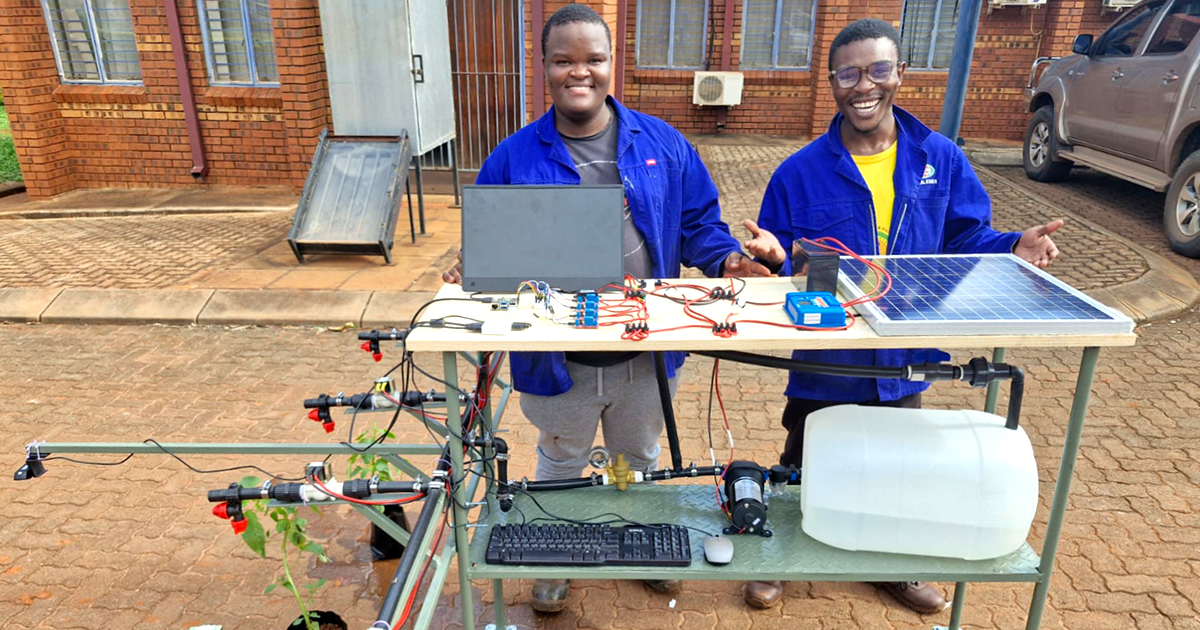
Two final-year agricultural and rural engineering students at the University of Venda (Univen) have developed a smart herbicide sprayer that reduces chemical waste and protects the environment.
Ipfi Tshivhase, from Tshilapfene village, and Thapelo Ramphisa, from Elandskraal, designed, built, and tested the device as part of their final-year agricultural and biosystems engineering project.
"We designed a sprayer for smallholder farmers that captures images with a camera. The images are processed in real time, using a weed-detection algorithm we trained ourselves. Using control logic and electromagnetic valves, it sprays only where the weeds are," Tshivhase explained.
The system runs on a Raspberry Pi 5 microcontroller and operates on battery power, which can be recharged via solar energy, making it environmentally friendly. Unlike conventional sprayers that blanket entire fields with herbicides, the smart sprayer targets only the weeds, reducing chemical use and environmental contamination.
"It does not spray the main crops or soil. This means less herbicide seeps into the soil, protecting the environment," Tshivhase said.
One of their biggest challenges was that the BSc Agricultural and Biosystems Engineering programme is relatively new at Univen, with limited technical support in electrical and mechanical engineering.
Collaborations with Vhembe TVET College and the Agricultural Research Council (ARC) proved crucial. The TVET College helped with welding and connecting the electronic circuit, while Prof Khaled Abutaleb and Dr Tingmin Yu from the ARC guided them on the machine-learning models.
The prototype is designed for farms between one and five hectares big and is manually operated. Users push the sprayer while it detects and targets weeds automatically. It has four nozzles, two cameras, and a 25-litre tank, though specifications can be adjusted to suit farmers' needs and budgets. It can also be adapted to existing conventional sprayers.
"This technology aims to reduce chemical runoff into water bodies and soil contamination, while also minimising farmers' exposure to chemicals," Tshivhase said.
The students see their work as part of a broader push to modernise small-scale farming in Limpopo. "We should not shy away from implementing technologies that solve local problems. Innovation is possible here if we invest in developing relevant skills. We are grateful to the University of Venda for equipping us with critical skills and hope the programme continues to drive change in smallholder agriculture," Ramphisa said.
To any young innovators looking to gain technological skills to help their fellow farmers in South Africa, the two students encourage them: "Come join the BSc Agricultural and Biosystems Engineering programme at the University of Venda."