
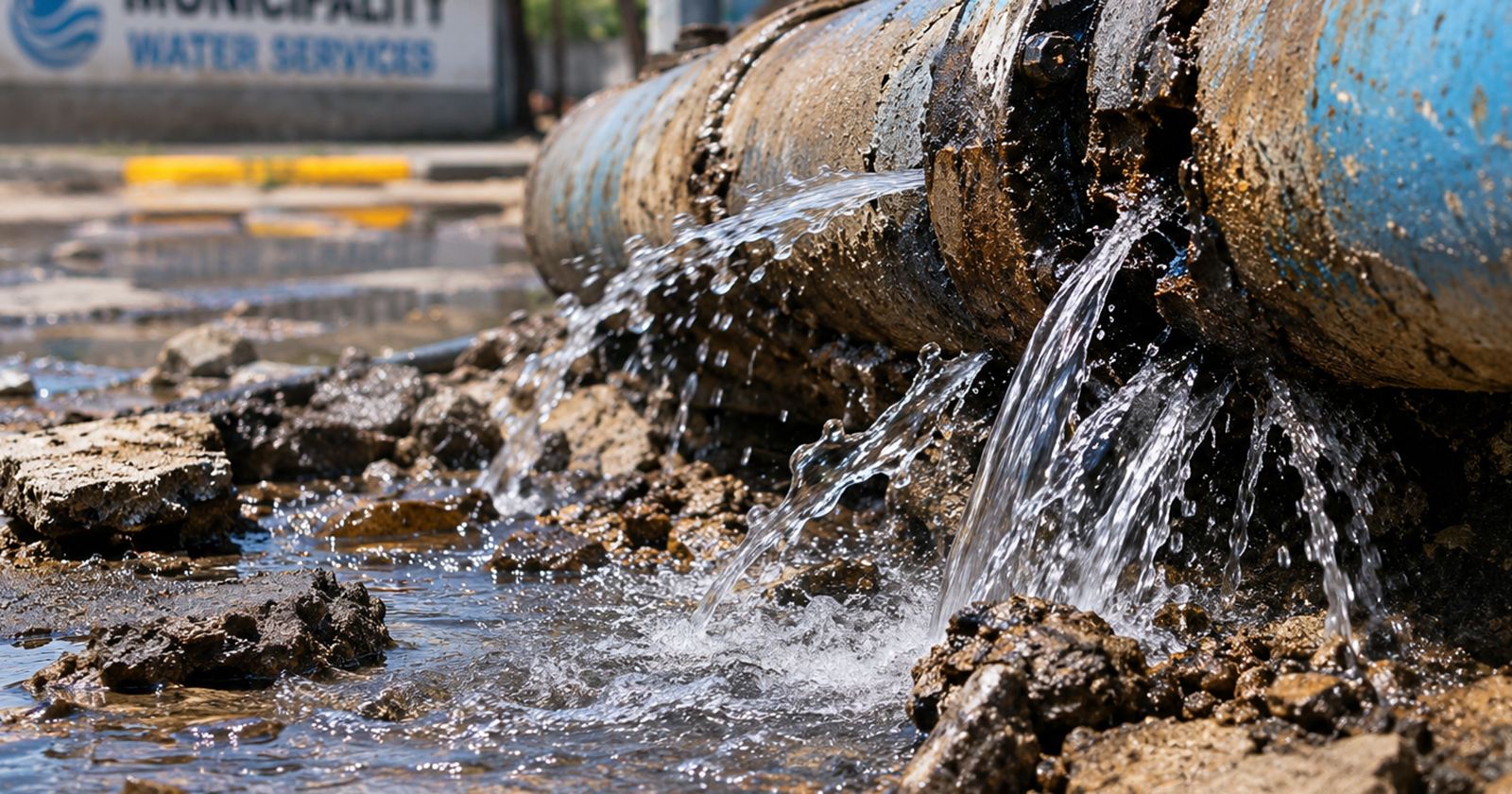
The Vhembe District Municipality (VDM) records water distribution losses of almost three quarters of the water it supplies to towns and villages, mainly because of dilapidated infrastructure, inadequate maintenance of assets, and inaccurate reporting and data management.
This is one of the key findings highlighted in a Limpopo Provincial Treasury report on the state of municipal finances in the province during the first six months of the financial year.
The report, dated 31 March 2026, presents a mixed picture, with some municipalities showing improvement while others experienced a deterioration in their financial systems. Three of the five municipalities in the Vhembe district – Vhembe District, Musina and Collins Chabane – are classified as being in financial distress.
Collectively, the municipalities in the Vhembe district collected R4.88 billion, or 90%, of their year-to-date operating revenue budget. While capital expenditure reached a healthy 96% of the year-to-date budget (R1.07 billion), the district faces significant debt management challenges.
About 93% of the district’s total debt of R4.88 billion has been outstanding for more than 90 days, indicating difficulties in implementing effective credit-control measures.
The report also highlights persistent problems, including incomplete indigent registers, spending on unbudgeted items, and an excessive reliance on consultants to compile asset registers and review financial statements. In addition, all five municipalities were found to have failed to cascade staff regulations to junior levels, limiting individual accountability.
Musina in distress
The region’s smallest municipality, Musina, appears to be facing the greatest financial challenges. Last week, National Treasury announced that it was one of 69 municipalities nationwide where part of the Equitable Share allocation would be withheld. In Musina’s case, the amount is R96 million. The decision was attributed to persistent financial mismanagement and the municipality’s inability to pay creditors.
Musina had regressed into financial distress by March 2026 and adopted an unfunded budget for the current financial year, meaning Treasury is not satisfied that projected revenue will cover budgeted expenditure.
The municipality’s financial recovery plans have reportedly failed to produce the desired results. Musina also recorded electricity distribution losses of 13% and reported that it was unable to prepare interim Annual Financial Statements (AFS).
Another concern is that its unauthorised, irregular, fruitless and wasteful expenditure (UIFW) balance increased by 4% to R385.6 million.
Vhembe records major water losses
The Vhembe District Municipality is also classified as being in financial distress as of March 2026. It adopted an unfunded adjustment budget, while its proposed 2026/27 budget also remains unfunded.
The municipality faces increased financial risk because its UIFW balance rose by 10% to about R795 million. It currently holds a qualified audit opinion.
As the municipality responsible for water distribution in the district, VDM faces particularly serious operational challenges.
According to the report, its water distribution losses of 74% are the result of infrastructure neglect and management failures.
A lack of consistent and adequate maintenance has contributed to the deterioration of water infrastructure. This is reflected in the municipality’s significant underspending on repairs and maintenance, with expenditure 55% below its year-to-date budget.
The report attributes the high losses to ageing and dilapidated infrastructure. It notes that replacing these assets is costly, making it difficult to address leaks and distribution failures.
The municipality is also criticised for providing inaccurate information on the number of kilolitres of water purchased and/or purified. This lack of reliable data complicates efforts to manage the system effectively and identify the root causes of water losses.
Some silver linings
The remaining three municipalities in the district have shown signs of improvement.
Makhado Municipality successfully emerged from financial distress between March 2025 and March 2026. Although it adopted an unfunded adjustment budget, its proposed 2026/27 budget is funded.
Makhado recorded the biggest improvement in UIFW, reducing its balance by 93% to R4.3 million. It is also being targeted to improve its audit outcome from unqualified to clean.
Collins Chabane Local Municipality remains classified as being in financial distress, but recorded a positive 40% variance in spending on repairs and maintenance against its year-to-date budget.
Like Makhado, it is being targeted for a clean audit. However, it continues to face challenges with incomplete billing and poor management of its indigent register.
Thulamela Local Municipality is not classified as being in financial distress. It reduced its UIFW balance by 77% to R42.8 million. It currently has a qualified audit opinion and is being targeted to improve to an unqualified audit opinion.
DA calls for DWS intervention
In a statement released earlier this week, the Democratic Alliance (DA) said it would ask the Department of Water and Sanitation (DWS) to intervene in what it described as the continued deterioration of the water value chain in Limpopo.
“Against the backdrop of staggering water losses, Limpopo municipalities spend on average 3% on repairs and maintenance,” said Jacques Smalle, the party’s provincial spokesperson for Economic Development, Environment and Tourism.
He said years of neglect, the failure to comply with minimum standards and a lack of experienced officials had left many communities without water, while others were subjected to water load reduction despite having existing distribution systems.
“The DA cannot allow the provincial government to disregard the basic right of access to water and request the DWS to initiate a comprehensive turnaround plan where municipalities face a collapse of water infrastructure and billing systems,” he said.