
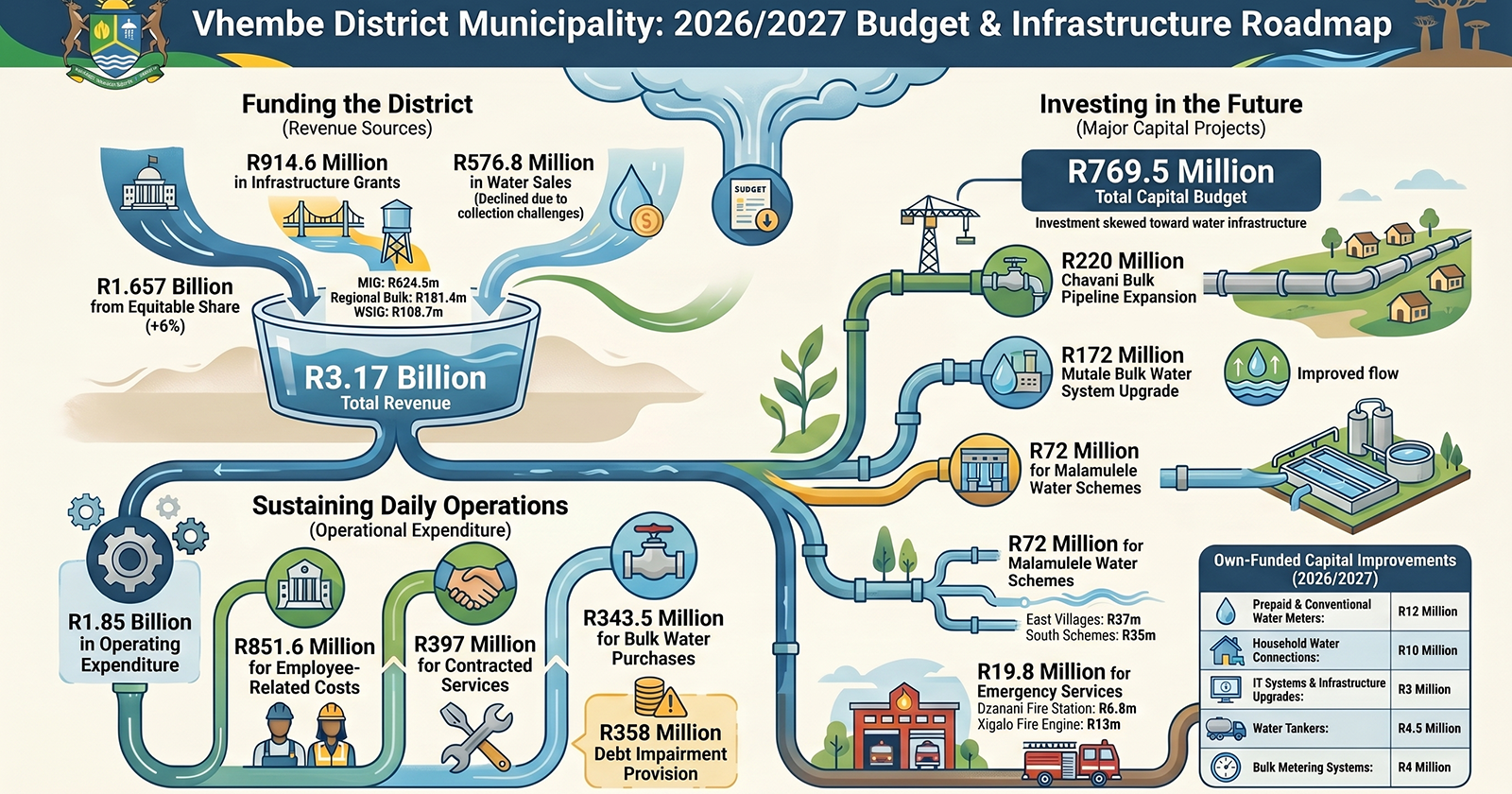
Vhembe District Municipality (VDM) executive mayor Cllr Miyelani Gladstone Chauke tabled a R3.17 billion budget for the 2026/27 financial year on Friday, including a 6.3% increase in water tariffs from 1 July.
Delivering the State of the District Address (SODA) at Christ Worship House in Shayandima on 5 June, Chauke said the municipality had made a debt impairment provision of more than R558 million during the year under review, highlighting ongoing challenges with revenue collection.
The budget is 2% lower than the previous year's adjusted figure of R3.239 billion but is projected to increase to R3.34 billion in 2027/28 and R3.43 billion in 2028/29.
Chauke said the tariff increase forms part of the municipality's efforts to move towards cost-reflective pricing while protecting indigent households. For the coming financial year, the debt impairment provision has been reduced to R358 million, while a new Debt Relief Programme aims to encourage residents with historic arrears to settle outstanding balances and improve revenue collection.
Revenue
The municipality's income base rests primarily on government grants and service charges. The largest single allocation is an equitable share grant of R1.657 billion, up 6% from the previous year. The Municipal Infrastructure Grant (MIG) contributes R624.5 million, while the Regional Bulk Infrastructure Grant adds R181.4 million. The Water Services Infrastructure Grant (WSIG) brings in R108.7 million, a significant 32% increase on the previous year.
Water sales remain a key source of own revenue, budgeted at R576.8 million, although this reflects a decline from the previous year because of collection challenges.
Expenditure
Total expenditure for 2026/27 is budgeted at R2.62 billion, comprising operating expenditure of R1.85 billion and capital expenditure of R769.5 million. This leaves a projected budget surplus of R546.9 million.
The largest operational cost driver is employee-related expenditure at R851.6 million, followed by contracted services at R397 million, bulk water purchases at R343.5 million and the debt impairment provision of R358 million. More than R200 million has been allocated to repairs and maintenance across the medium-term expenditure framework.
Capital projects
The R769.5 million capital budget – rising to R811.6 million by 2028/29 – is heavily weighted towards water and sanitation infrastructure. Water management accounts for R713 million of this total, while wastewater management receives R20 million.
Own-funded capital projects total R67.4 million and include household water connections (R10 million), prepaid and conventional water meters (R12 million), bulk metering systems (R4 million), water tankers (R4.5 million), borehole development across multiple villages (R450,000 per site), and IT infrastructure upgrades (R3 million).
Key MIG-funded projects for the coming year include:
• The Mutale Bulk Water System Upgrade, valued at more than R172 million, targeting supply improvements in areas including Guyuni and Gundani.
• The Vondo Water Treatment Works upgrade, budgeted at more than R40 million.
• Water supply schemes in Ngwenani, Ngulumbi, Ngovhela and Phindu, with a combined budget of nearly R89.5 million.
• The Chavani Bulk Pipeline expansion, valued at more than R220 million, to extend services to additional communities.
WSIG-funded projects continuing into the new financial year include the Malamulele East Water Supply Scheme (two contracts of R18.5 million each), Malamulele South Water Supply Scheme phase 1 and phase 2 (R17 million and R18 million respectively), and Musina bulk water upgrades valued at more than R18 million per contract.
Wastewater and disaster recovery
Wastewater projects under way include the Shayandima Wastewater Booster Pump Station (R10 million), Vuwani Wastewater Ponds (R14.2 million), Mutale Wastewater Ponds (R17.7 million), and Harper wastewater treatment infrastructure (R15.5 million).
Disaster recovery funding is being used to repair flood-damaged pipelines and water treatment works in Mutshedzi, Xikundu and Makhado, with individual project values ranging from R200,000 to R3.8 million.
Employment and community programmes
The Expanded Public Works Programme (EPWP) created approximately 1,600 job opportunities during the current financial year at a cost of R17 million. The target for 2026/27 is 2,000 EPWP work opportunities, supported by a projected budget of R24 million.
To strengthen disaster management capacity, the budget provides for the construction of the Dzanani Fire Station at a cost of more than R6.8 million and the procurement of an additional fire engine valued at more than R13 million for the Xigalo Fire Station. This follows the procurement of three fire engines during the outgoing financial year at a combined cost of R21 million.