
By Anton van Zyl and Thembi Siaga
The basic cost of living is becoming more expensive, and in the past month, our Vhembe basket of essential food items has increased by almost R85. This means that local pensioners and people relying on a SASSA grant have had to absorb a 2.5% price hike.
The main "culprits" driving the increase appear to be fresh produce such as tomatoes and onions. Products such as sugar and even bread have also shown alarming increases. Potatoes and eggs, however, have seen a drop in prices.
 |
|
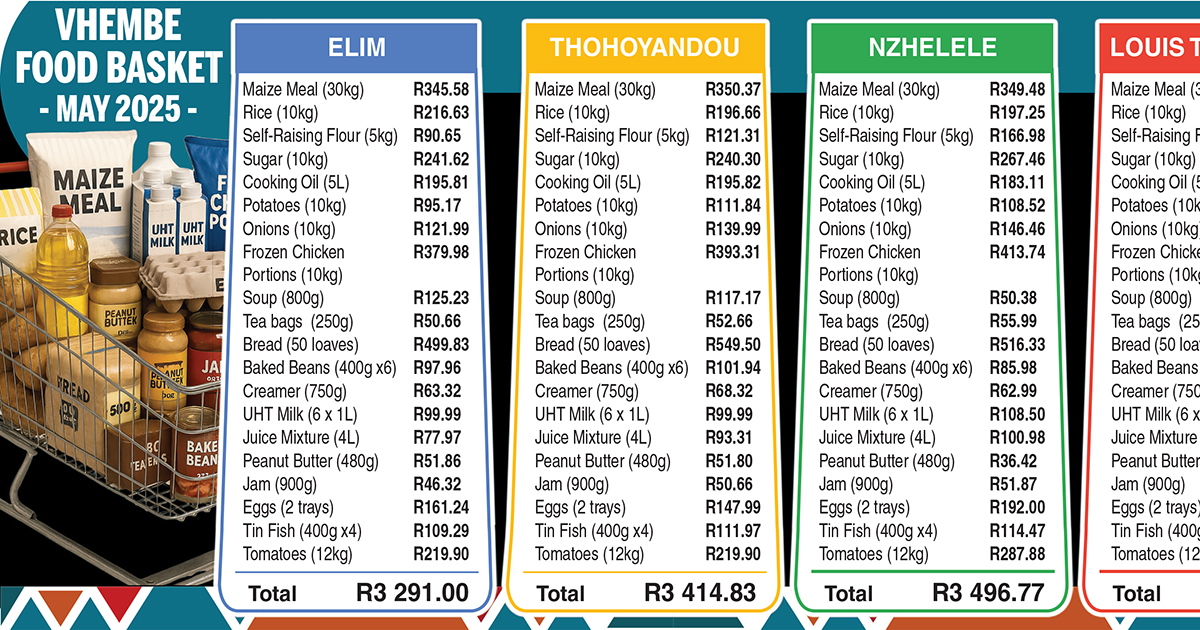
Comparative analysis of Vhembe food baskets. |
These are some of the findings from our Vhembe food-basket survey for May. This was our third survey of the year. The first was conducted in March, inspired by the data journalism site The Outlier. Its methodology is based on the work of the Pietermaritzburg Economic Justice and Dignity Group (PMBEJD), which tracks the prices of a 44-item food basket typically bought by women in low-income households.
The challenge was to limit the basket to essential food items for a family of seven, working within a monthly budget of about R3,500.
As we do not have the capacity to track so many items, our study is limited to 20 essential food items. Where possible, we used the PMBEJD's quantities, calculated over a one-month period.
In May, we visited 14 stores across four regions in Vhembe. We opted to exclude the prices at one store in Louis Trichardt as we realised it would skew the results. Initially, prices were obtained from the Checkers, Boxer, Shoprite and Spar stores in town. Checkers, however, appears to target a slightly higher-income group, placing less emphasis on keeping essential items affordable. This skewed the average prices in Louis Trichardt upwards. As we did not collect Checkers prices in other regions, we decided to exclude them.
To improve the reliability of the comparison, all prices were collected on the same day — 26 May.
Where is the cheapest region?
When we conducted our first survey in March, the Elim region was the most expensive. Since our second survey, it has become the cheapest. In the latest survey, it is R231.90 cheaper than the most expensive region, Louis Trichardt. Worryingly, Elim's average food-basket cost has still increased by R84.31. In Elim, three stores — Shoprite, Boxer and Spar — were surveyed.
Nzhelele, a region that previously performed well, came in at an average of R3,496.77 for the basket, which is R103.25 more expensive than the April survey. This placed Nzhelele third, with Thohoyandou moving into second place at R3,414.83. Thohoyandou saw a R23.46 drop from last month's average. Prices in Thohoyandou were collected at Spar, Shoprite and Boxer.
Louis Trichardt remains the most expensive place to shop for essential food items. Although the basket price only rose by R5.77, the total came to R3,522. Prices were collected from Checkers, Boxer, Shoprite and Spar, but the Checkers prices were later excluded.
Should one shop around?
Consumers should be encouraged to shop around before they start stacking their trolleys. In both Louis Trichardt and Nzhelele, the difference between the lowest and highest marked prices exceeds R1,000. A good example is onions, where the price difference between the cheapest and most expensive options was more than R200. The recommended volume for a family is 10kg per month.
At Shoprite in Louis Trichardt, onions were sold at R99.99 per 3kg bag. This works out to R332.97 for 10kg. At Spar in Louis Trichardt, a 10kg bag of onions cost R129.99. However, Shoprite offered the cheapest prices on products such as sugar.
There are many more examples of dramatic price differences on certain food items. Notably, these variations are more pronounced with fresh produce, where freshness and quality play a role. At Shoprite in Nzhelele, 1kg of tomatoes cost R28.99, amounting to R347.88 for 12kg. The brand used (Fresh Roma) is widely recognised for its firm texture and ability to hold up well when cooked. It looked far more appetising than some of the cheaper tomatoes found at other stores.
 |
What went up and what went down?
The biggest price hike was in tomatoes, which increased by an average of 33.11% to R244.53 for 12kg. The worst-affected region was Elim, where the price rose from R153.94 to R219.90 – a 42.85% increase. In Louis Trichardt, the price went from R159.94 to R223.92.
The second-largest increase (29.28%) was in onions. From an average of R119.55 for 10kg in April, the price jumped to R154.55 in May. This was especially noticeable in Louis Trichardt (up 41.97%) and Thohoyandou (up 37.71%). In Louis Trichardt, the price for 10kg of onions reached R201.98.
Bread saw a 6.76% increase. The changes were subtle and not immediately noticeable. In Thohoyandou, for example, two stores charged between R1 and R2 more per loaf of 700g bread. When multiplied by 50 to cover a month, this pushes up the total cost of the food basket.
Fortunately, there were some price drops as well. Eggs showed an 18.51% saving, coming in at R186.60 for 60 eggs, compared to R229.09 last month. In Thohoyandou, consumers paid an average of R309.98 for 60 eggs in April. In May, this dropped by 52.26% to R147.99. In Nzhelele, however, prices rose to an average of R192.00 – up 26.52% from last month's R151.75.
Are we getting poorer?
The answer depends largely on where you live and where you shop. If you reside in Elim and bought your groceries at the local Spar, your basket would have come down slightly – from R3,150.63 to R3,074.60. However, if you shopped at Shoprite or Boxer, you would have paid about R160 more. On the other hand, if you searched for the cheapest items across all three stores, your basket would have cost R2,878.10 – even cheaper than April's R2,929.90.
The reality, however, is that most consumers do not shop around and compare prices between stores. This is why we place more emphasis on the average food basket, which increased by R84.69.
We could find no specific reason for the rise in prices of certain items. Fresh produce – especially items such as tomatoes – is dependent on market prices. Stores such as Spar, which also procure produce locally, were able to absorb price increases more effectively.
It must be emphasised that with any price comparison, it is not always possible to "compare apples with apples". The tomatoes at Spar may not be of the same quality or variety as those at Shoprite, for example. In our survey, however, we focused on what is available to local consumers at the cheapest price in each specific store.