
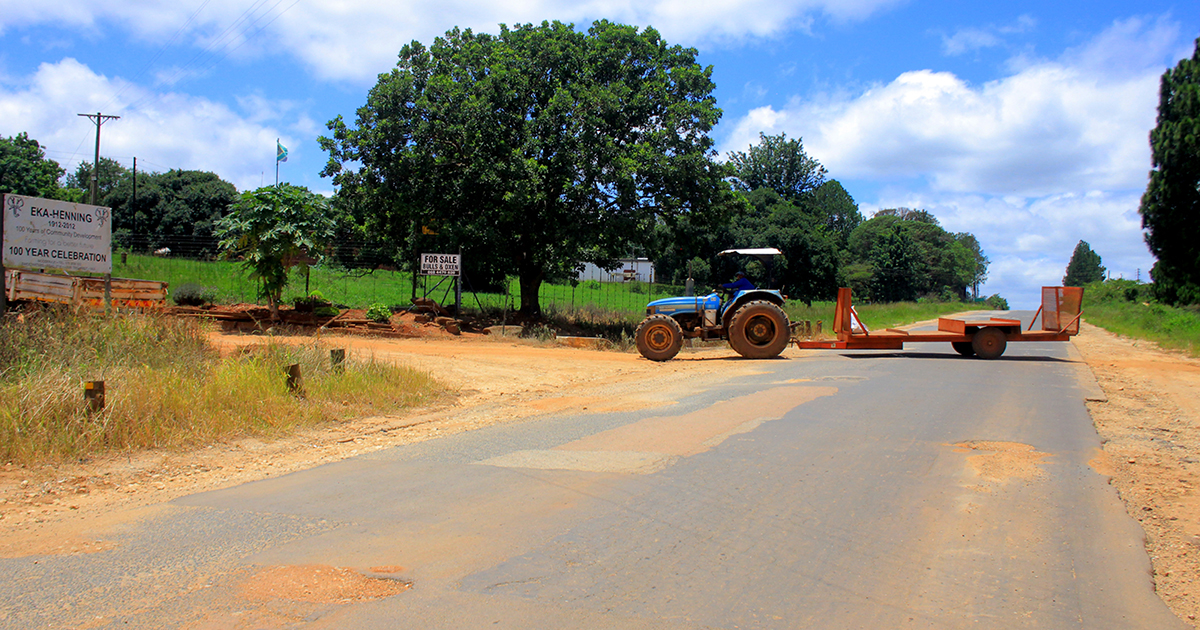
Local farmers in Vhembe are battling to sustain their agricultural businesses as deteriorating pothole-riddled roads continue to disrupt operations. The poor state of these roads is driving up transport costs and delaying produce deliveries.
Previously reliable routes connecting farms to markets and processing facilities have become a major challenge. Fragile crops such as avocados, macadamia nuts, and tomatoes are particularly affected, as transportation costs have soared, and vehicles frequently require repairs because of road damage.
Two weeks ago, we reported on pothole patching along the D4 road via Elim, which sparked public outrage. Residents and motorists have expressed frustration with the slow progress on the road linking Elim to the N1. Efforts seem focused on patching countless potholes instead of fully reconstructing the road.
Mr Carl Henning, a farmer near Elim at Mununzwu (Newco EKA-Henning Farm), one of the oldest farms in the area, shared his frustration over difficulties in delivering produce to markets. He said transport companies charged extra because the deteriorated roads caused significant wear and tear on their vehicles. "These added costs get passed on to us. Recent repairs on the road are already cracking – it's a waste of taxpayers' money. Uneven roads bruise fruit, causing it to spoil faster and reducing its shelf life," he said.
Henning explained that the road was poorly constructed in 2005, with a thin tar layer over dirt that quickly deteriorated. Attempts to resurface it in 2010 or 2012 did not last, and the road has worsened from a lack of maintenance.
In desperation, he said, they had tried to repair the road themselves three years ago, using JCB loaders and gravel to fix sections. "We managed to complete a stretch in two to three days, but rain quickly undid our work. While local authorities occasionally conduct repairs, they're poorly executed and ineffective. The problem lies with untrained supervisors, underpaid labourers, and contractors who abandon incomplete projects," he said.
According to Henning, this creates an illusion of progress while leaving communities with unfinished roads. "The dangerous road conditions have caused tragic accidents, including a fatal crash involving one of our workers," he added.
Limpopo Mirror also spoke with other farmers who believe the lack of investment in road maintenance threatens their livelihoods. Mr Gene Likhanya, CEO of Madimbo Mac's Pty in Mashau, said damaged roads between Mashau and Bungeni created constant stress.
"Buses refuse to use the gravel road when it's too slippery or damaged, forcing workers to walk long distances. By the time they arrive, they're either late or exhausted. Two years ago, trucks couldn't load tomatoes during the rainy season due to poor road access. The roads are rough on vehicles and equipment," he said.
Mr Mashudu Seaba, owner of TSHIF Farming in Thohoyandou, said pothole-filled roads also hurt his egg-distribution business. "Some eggs crack during transport, leading to losses while navigating these bad roads," he said.
Mr Danny Legodi, RAL's senior communications manager, said that maintenance of Road D4 was planned for 100 km. He explained that the road is divided into two sections: Malamulele to Elim (73.1 km) and Elim to N1 (26.9 km), with work set to occur in five phases.
"Phase one, which started in July 2021, completed 46 km covering three phases. The remaining 54 km is in progress, with most at the design stage, awaiting budget allocation for construction," he said.