
The Vhembe District Municipality (VDM) is seldom high on the popularity list of local residents. At the best of times, service delivery is intermittent and, in some areas, residents have given up any hope of seeing water flowing from their taps. Often described as one of the most dysfunctional municipalities in the country, this is sadly the municipality that needs to provide water and sanitation to the whole of the Vhembe District.
Judging by the VDM's latest audited annual financial statements (AFS), the situation is unlikely to improve in the next year or two. The municipality is almost totally dependent on government grants for survival and once salaries and consultants have been paid, a big part of the budget is already depleted. Problems with irregular and unauthorised spending are still haunting the VDM.
In the latest report of the Auditor-General (AG), she complains about a total of R644 million that was spent where management ignored supply-chain-management regulations or simply splashed money on expenses that were not budgeted for.
The VDM's billing system is in a complete state of disarray and, apart from that, more than half the water being distributed gets "lost" in the distribution network.
That the VDM received a qualified audit report, with the AG raising concerns over various matters, is therefore not surprising.
To get a better picture of the situation, however, analysing the 2021/22 AFS bit by bit, along with the AG's report, will be best.
Where does the money come from?

VDM's own revenue comes mainly from service charges. It distinguishes between exchange transactions and non-exchange transactions. Exchange transactions refer to income such as a consumer who gets a bill for water usage. A service has thus been rendered and the bill needs to be paid. Non-exchange transaction refers to instances where a certain "value" is supplied, such as infrastructure, but no specific service. An example of such a transaction would be an infrastructure grant received from national government.
As far as the exchange transactions are concerned, the VDM charged consumers R515,08 million in 2021/22 for water and waste management. This, however, seemed to be a complete guestimate and in her report, the AG points out several discrepancies. The AG states that several accounts had been identified that should have had service charges, but these had not been billed and recorded.
Local consumers can also testify to the fact that VDM's billing system is, to put the matter bluntly, a mess. Accounts do not get sent out to consumers and water-meter readings are either not done or not reliable.
The discrepancy between what was charged the previous financial year also caught the attention of the AG. In 2020/21, the total for service charges was R309,28 million. The only explanation VDM could supply for the more than 66% rise in billings the following year was a note that said: "The movement was as a result of an annual CPI increase and increased billing."
The AG did not accept this and pointed out that understatements occurred in one year and overstatements in another. "I was unable to obtain sufficient appropriate audit evidence for service charges, due to a lack of proper record keeping of the meter readings," she says.
The municipality also did not charge consumption units in accordance with the approved tariffs. "Consequently, the revenue from exchange transactions and receivables from exchange transactions is overstated by R26 198 697," the AG found.
Not much of this seems to matter, since the municipality writes off most of its consumer debt. At the end of the financial year, the balance for consumer debtors stood at R1,197 billion (up from the previous year's R611 million). The VDM, however, made provision for impairment totalling R1,195 billion, leaving a balance of only R2,64 million.
This is not surprising, seeing that the bulk of the consumer debt lies in the 210 days and more category (R897,37 million). In the current period, the outstanding amount was R40,86 million and in 30 days it was R39,14 million.
To make matters even more confusing, the VDM seems to be banking on the interest charged on overdue accounts. The municipality's second biggest earner of "own" revenue was interest received on investments. This escalated from R29,02 million in 2021 to R59,04 million in 2022.
The breakdown provided for this item shows that the bulk of the amount (R48,54 million) is for interest charged on overdue customer accounts. VDM also collected R10,5 million in interest on money in its bank accounts.
As far as the remainder of the exchange revenue is concerned, operational revenue (water connections and sanitation) brought in R1,28 million (R545 232 in 2021), while the sale of tender documents collected R976 434 for the municipality. (In 2021, this item collected an astonishing R2,9 million.)
Government to the rescue

The bulk of the municipality's income, however, came from government grants. This is not strange, as the Vhembe District is a rural district where a large portion of its residents are very poor and central government needs to assist.
The biggest portion of the grant money (R1,134 billion), comes from the Equitable Share Grant. This is an unconditional grant and is meant to help subsidise the provision of services to indigent community members.
Three other grants, namely the Rural Road Asset Management Systems Grant (R2,18 million), the Expanded Public Works Programme Grant (R2,25 million) and the Financial Management Grant (R2,9 million) take the total for operating grants to R1,142 billion.
Vhembe seems to have done quite well in spending the conditional grants, such as the Expanded Public Works Programme Grant, which is meant to promote labour-intensive projects and boost employment. The Financial Management Grant was also fully utilised. This grant is used to promote and support the financial management staff and systems. Only with the Rural Road Asset Management Grant had the municipality failed to spend about R115 000. This grant is meant to assist VDM to set up rural roads and asset-management systems.
Vhembe also received two capital grants from central government, namely the Water Service Infrastructure Grant (WSIG), totalling R31,15 million and a Municipal Infrastructure Grant (MIG) of R546,05 million. The MIG is supposed to be used to eradicate the backlog in providing the infrastructure to deliver water and sanitation services to poor households. The WSIG is aimed at assisting the municipality with the planning and implementation of water and sanitation projects.
The VDM's annual statements reflect that the grants were utilised in full, bar some balances that came from previous years and the R115 000 in the Rural Road Asset Management Grant. The AG, however, had a different view and criticised VDM for not spending R12,84 million of the WSIG.
How was it all spent?

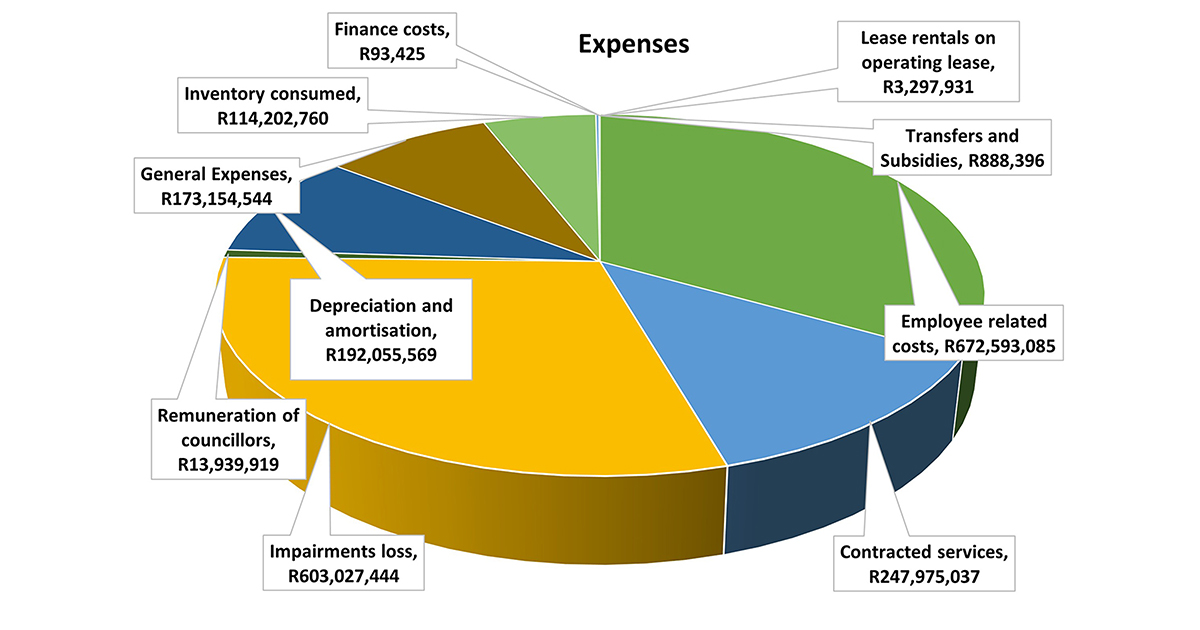
By far the biggest expense for VDM is its employees. The bill for employees, councillors and contractors totals R934,5 million, or 46,24% of the total expenditure. The salary bill (R665,9 million) constitutes 33,28% of the expenses. The VDM paid out R72,32 million in overtime, which is almost 11% of their salary bill. The workers also received R33,62 million in car allowances.
The spending on various contractors and consultants is reason for concern. This item came down slightly from almost R300 million in 2021, to R247,97 million in 2022, but certain expenses increased dramatically.
From a total of R14 700 in the 2020/21 financial year, the catering services bill jumped to a staggering R2,46 million. No explanation was provided for this steep increase.
The bill for maintenance of equipment by outside contractors came down from R210,5 million in 2021 to R174,12 million in 2022. The reason given for this was that some of the work could now be done internally by employees of the municipality, after having returned to work after the Covid-19 restrictions were lifted.
VDM still had to pay R12,49 million to consultants to assist with business planning and advisory services. The previous year, these consultants cost VDM R11,58 million. Business and advisory services were also outsourced to private contractors at a cost of R13,9 million.
Money in the bank, but many obligations
Overall, the problem with VDM is not that no money is available. The AFS lists that it has assets of almost R6 billion. At the end of the financial year, VDM boasted R131,56 million in its bank accounts, with R313 733 in short-term deposits.
A small part of the VBS debt, R22,15 million, was recovered by the liquidator during the year, which was offset against the enormous loss incurred when the municipality, contrary to treasury regulations, made a massive investment in the scandal-ridden bank. The VDM had to write of more than R317 million of this VBS investment in 2017/18.
The municipality has several liabilities, the biggest being outstanding supplier bills (R128,5 million) and retention money (R203,49 million). It also received R33,27 million in advance payments.
The VDM failed to spend R12,85 million of a Municipal Water Infrastructure Grant. This was a conditional grant, which implies that money not spent in the year needs to be returned, but it can also be ring-fenced until the projects are completed.
In its AFS, the municipality lists debts totalling R1,083 billion to two municipalities and the Department of Water Affairs. It owes the department R739,98 million, the Makhado Municipality R33,88 million and Musina Municipality R309,17 million. The notes on this debt state that the VDM is servicing the debt by doing payments of R3 million per month to Makhado and to the department. The VDM "is engaging with Musina Local Municipality on resolving the inter-municipal balances" it states.
The VDM is also involved in a number of court cases, and the total liability is estimated to be around R400 million. The cases vary from instances where a resident fell into a ditch dug by VDM's workers, to a mother who sues the municipality after a water tank fell on her husband and killed him.
The biggest case is against the Minister of Water and Sanitation, with R318,5 million at stake. "The Department of Water and Sanitation is suing the Municipality [for R307,08 million] for water that has not been paid by the district," the AFS notes state. The court has apparently appointed a master who will assist both parties to reach an agreement.
Another court case with quite a high value attached to it, is the one against the Getrusberg Communal Property Association. The CPA is suing the Makhado Municipality for just over R17,3 million for drawing borehole water from its premises without consent. Makhado Municipality has joined VDM as a Water Services Authority and they are defending the case.
And finally – the VDM still has the dubious reputation of "losing" more than half of their "stock". In the 2020/21 financial year, the water loss caused by leakages on the various distribution lines, up to the point where it reaches the consumers, was estimated to be 41,5%. Last year, the VDM lost an estimated 52,1% of its water.