
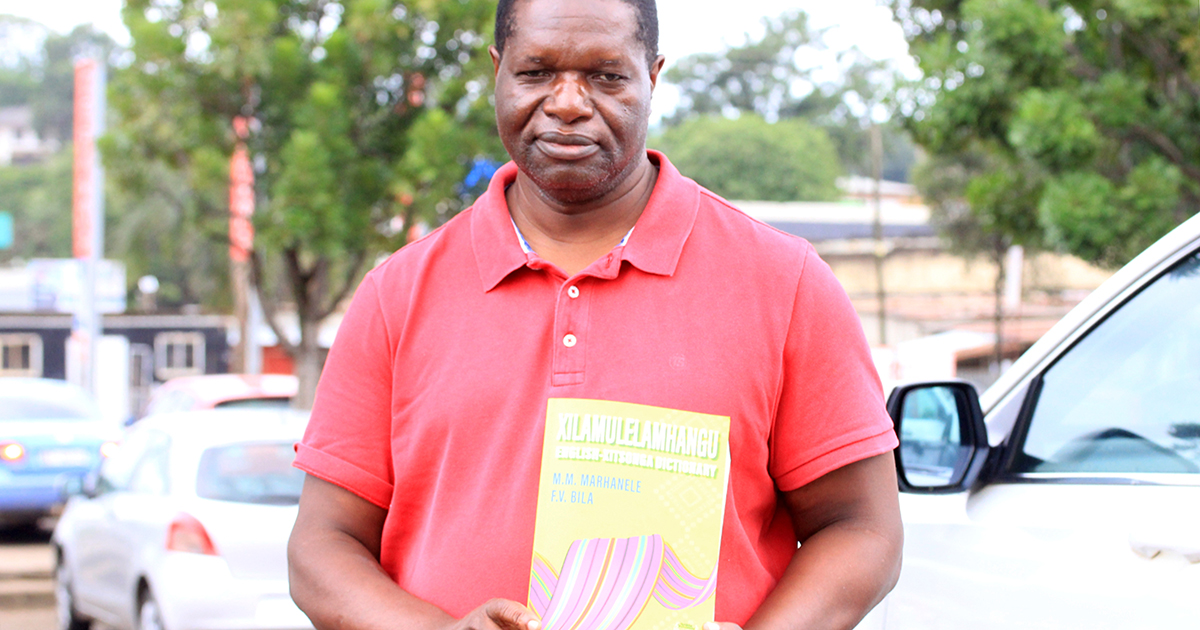
After years spent nurturing words like seeds in fertile soil, Vonani Bila – renowned author, poet, and son of Shirley Village near Elim – has gifted the world with Xilamulelamhangu, a monumental English-Xitsonga dictionary. Eight years in the making, the 1,348-page work was officially released on 5 April, marking a significant stride in education and the preservation of indigenous languages.
Bila, who lectures in English at the University of Limpopo, collaborated with renowned poet Dr Max Marhanele and a team of educators and language experts. The dictionary helps users translate English into standard Xitsonga and includes general vocabulary as well as specialised terms from fields such as medicine, agriculture, computing, business and law.
To reflect local usage better, the team included South African English terms and informal expressions. Xilamulelamhangu is published by Timbila Publishing, an independent publishing house founded by Bila. In 2016, he also published Tihlungu ta Rixaka, a monolingual Xitsonga dictionary.
According to the 2011 census, about 2.3 million South Africans – or 4.5% of the population – speak Xitsonga as their first language, primarily in Limpopo and Mpumalanga, with additional communities in Gauteng, Mozambique and Zimbabwe.
The dictionary was made possible with funding from the National Heritage Council's Presidential Stimulus Programme. Speaking to Limpopo Mirror, Bila said the dictionary had been developed in response to the lack of accessible and comprehensive Xitsonga-language resources.
"We realised that such a resource was a rarity. Without doing it ourselves, there was no way other people would do it for us with the same commitment. The available literature in Xitsonga is scant, so it became necessary to collect both new and old words to create a linguistic resource for young and old," he said.
He added that the absence of a comprehensive English-Xitsonga dictionary had pushed them to take on the challenge. He said they knew that if they had not done it themselves, speakers of other languages would not approach it with the same conviction or care.
"We believe this dictionary will help users communicate more effectively and assist learners in understanding their subjects and improving their marks. The best way to use language properly is by mastering vocabulary across different fields," Bila said.
The team hopes the dictionary will help expand Xitsonga's role beyond the arts and religion, and strengthen its use in education, business, law and science. They were motivated to keep the language relevant, up to date and user-friendly, to prevent it from facing extinction like many other indigenous African languages.
The editorial team included Masocha Lubisi, Hlamalani Vukela, Lilian Bilankulu and Mkomati Mongwe. The afterword was written by Prof Tinyiko Maluleke, vice-chancellor of the Tshwane University of Technology. The dictionary also features idioms, set phrases, borrowed words and modern terms.
"It avoids dialects, opting instead for standard Xitsonga to ensure consistency. For words without direct translations, we included explanations or borrowed terms," he said.