
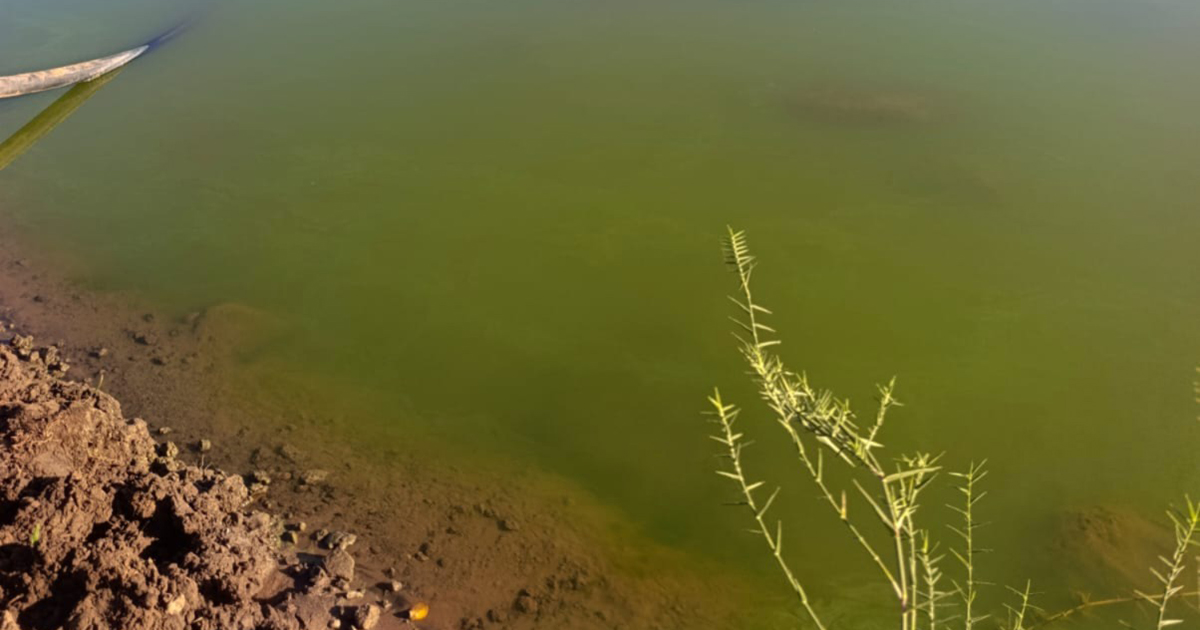
The water of the Limpopo River, which suddenly turned green, caused widespread concern over the past week amid fears that it might be the result of a large-scale pollution incident. Both government and private institutions have since started collecting and sending water samples for analysis.
A voice note that began circulating in Musina over the weekend added to the panic. In the recording, the speaker—who does not identify himself or say where he is from—warns residents not to drink municipal water or water from the river. "We suspect that there may be pollution from a mine upstream in Zimbabwe," the message states, among other things. The person also attached photos of the green water to the message. To see how green the water is, click HERE. The video was supplied.
By Monday, the Vhembe District Municipality responded to the claims and issued an official warning to residents, including via WhatsApp groups. "Musina residents are requested to be careful regarding the use of water in the Limpopo River, which is currently green in colour. Vhembe District Municipality will take samples to check the quality of the water tomorrow, and further information will be communicated to the residents after the water has been tested," the warning read.
Municipal spokesperson Mr Moses Shibambu confirmed on Wednesday morning that water samples had indeed been taken on Tuesday and sent for analysis. "We expect results within three to four days. The Border Management Authority and the Department of Public Works have also dispatched personnel to investigate any possible illegal activities along the river," said Shibambu.
The Democratic Alliance (DA) in Limpopo also responded to the issue on Wednesday, calling for an urgent investigation into the pollution of the Limpopo River, which they say poses a direct threat to farmers and water safety.
"The DA in Limpopo has sent urgent representations to MEC Tshitereke Matibe of Economic Development, Environment and Tourism (LEDET), requesting an immediate investigation into the source of a major pollution incident affecting the Limpopo River.
Farmers from Tom Bourke, located near the upper reaches of the Limpopo west of Pontdrift, as well as those from Pontdrift, Platjan, and the area between the Nzhelele and Sand Rivers, have all expressed concern over the incident. Farmers report that the river's water turned a strange turquoise-green colour and emitted a strong chemical smell," said the DA's provincial spokesperson for LEDET, Jacques Smalle, in a statement.
In his statement, Smalle pointed out that the Limpopo River basin includes some of South Africa's most productive agricultural regions, contributing to food security and foreign currency through exports. "There is speculation that the pollution may have been caused either by a sludge dam spill from an upstream coal mine, possibly in the Thabazimbi or Ellisras region, or by a significant sewage spill," Smalle said.
From the agricultural sector, Fanie Havinga, chairperson of the Soutpansberg District Agricultural Union and TLU SA Limpopo, said they were aware of the problem but suspected that the water originated from the heavily polluted Hartbeespoort Dam, which flows into the Limpopo River via the Crocodile River.
Havinga confirmed that some farmers along the river had also taken and submitted water samples for analysis. Reports from the Mapungubwe area indicated that the water there was clean. "So yes, the water is green. At one stage, it was extremely green in the Tom Burke area, but it has since flowed past them. It is now the water flowing past Musina. Everyone suspects it's water from Harties, not from a mine, that has flowed into the Limpopo via the Crocodile River," said Havinga.
Although it seems the water is now flowing eastwards out of the system, Havinga said this does not mean that farmers are no longer concerned. On the contrary, he said, the incident is more serious than people realise. "What's concerning is that if the rumours are true that the water came from Harties, then it's South Africa that is polluting international water. In that sense, it's a very serious allegation," said Havinga. The Limpopo River forms the border between South Africa, Botswana, Zimbabwe and Mozambique, and all of these countries draw water from the Limpopo.
The Zoutpansberger will keep readers updated on the results of the water samples sent for analysis as soon as they become available.