
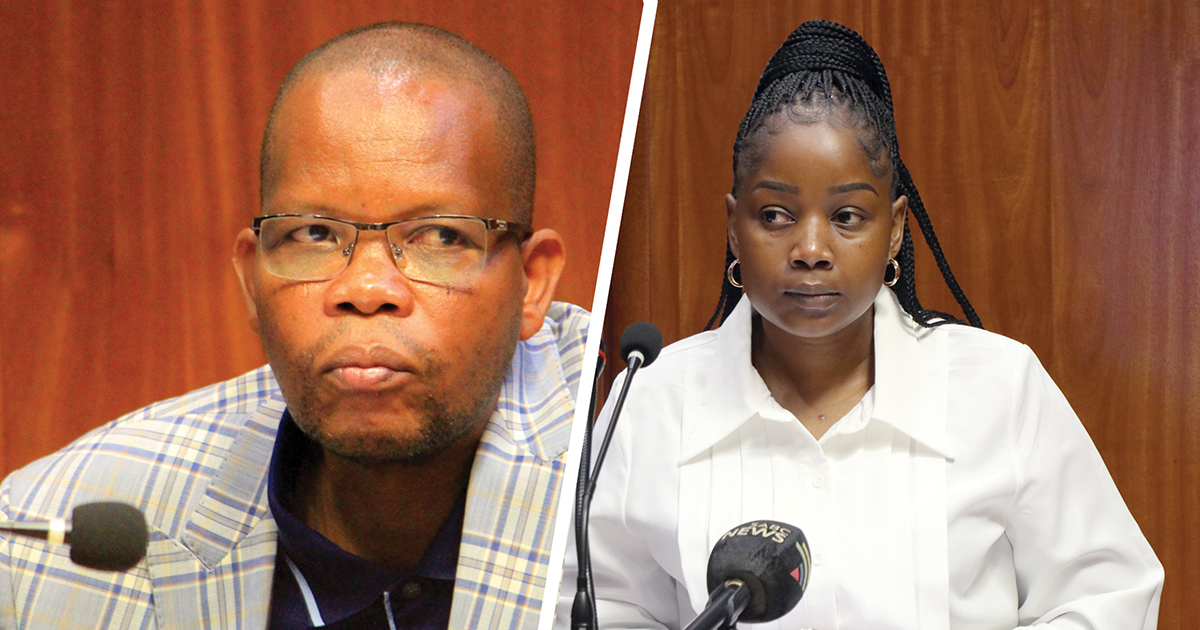
Will Toni Mphephu be announced as the king of the Vhavenda once more, or will princess Masindi Mphephu rewrite history and become the first queen? The decision as to what will happen now is in the hands of three High Court judges.
The judges had to listen to closing arguments over the past week in a case that is now more than a decade old. Nine years ago, in December 2016, Masindi's attempt to stop the coronation of Toni Mphephu was refused in the High Court in Thohoyandou. The case then found its way to the Supreme Court, where she won. A later attempt by Toni Mphephu to reverse this ruling in the Constitutional Court failed.
The Supreme Court found that the criteria used to select a new heir effectively promoted gender discrimination and sent the case back to the Limpopo High Court for a full hearing on merits. The royal family's decision to propose Toni as regent had to be reviewed.
Since the hearing restarted on 15 July this year, dozens of witnesses had testified. The Judge President of the High Court in Limpopo, Judge George Phathudi, Judge Gerrit Muller, and Judge Thogomelani Tshidada had to listen to expert witnesses as well as to the views of members of the royal family.
The case also offered a rare glimpse into the history of the Vhavenda people, their customs and how these were often adapted to suit specific circumstances. It gave unprecedented insight into how the royal family is supposed to operate, its perceived prejudices and the manner in which it tries to protect customs that are often centuries old.
A queen in the waiting?
Masindi's legal counsel, led by the very eloquent Adv Alan Dodson, was the first to deliver closing arguments on Monday.
Dodson explained to the court that, when the previous king (Dimbanyika) had died in 1997, the royal family had messed up badly. Dimbanyika's ndumi, Toni Mphephu, should have stepped into the role of khotsimunene, with Mavis Mphephu becoming the makhadzi. They should have facilitated the process to elect a new leader.
He told the court that the ideal candidate was Masindi. "Applying Vhavenda custom, the choice was a simple one. Dimbanyika had one dzekiso house with Fulufhelo [his wife and Masindi's mother] and a single child - the applicant - from that house," he said. At the time, Masindi was five years old, which would have implied that a regent would have had to be appointed to take care of the kingdom until she came of age.
If this only child of Dimbanyika's had been a boy, there would have been no problem, the court was told. But because of gender discrimination, Masindi was overlooked and isolated.
Dodson argued that the royal family was now in a self-inflicted crisis, because of the "unconstitutional and unlawful manipulation" that took place. Only five members of the royal family are left. "[With] David [Vho Japan] having passed away, we have no idea who the five are and whether, as elderly people, they are mentally capable of taking decisions. In any event, they have no khadzi or ndumi to give effect to their decisions," he said.
Dodson argued that the royal family was clinging onto outdated and often irrational interpretations of customs.
"Primary amongst these are the alleged birth-sequence rule and the so-called collapse rule, which operate to exclude legitimate heirs of an appropriate age and generation and to push the search for decision makers and heirs backwards through the generations to older and older people," he said.
Customary law has to be developed
In line with what the higher courts have ruled, customary law must be developed, and the courts must guide this process, Dodson said in his closing arguments. He referred to evidence led in the case that Fulufhelo, Masindi's mother, had met all the requirements of a dzekiso wife. The lumalo was paid and the rituals, such as checking that she had not been pregnant before the marriage, were conducted. Yet, the royal family now wants to exclude her on certain perceived technicalities.
One of the expert witnesses that Masindi's legal team called was Dr Sindiso Mnisi Weeks. She told the court more about the dynamics of customary law, and how the rules were often not cast in stone. She referred to a "normative ideal," where communities, when they were asked about their laws, articulated already crisp and clear rules, but when you looked at what they did in practice, you found that there were exceptions.
Dodson tried to address what he believed were the inconsistencies in the arguments from the royal house. One of these was that Masindi was born before her father was inaugurated as king. That would, according to the interpretation by the royal family's legal team, have meant that her mother could not have been from a dzekiso house.
He raised a disputed example of Patrick Ramaano, who was born in 1925, more than a year before his father, King George Mbulaheni, was inaugurated. He also raised the example of the Vhavenda king, Ramabulana, identifying Makhado as his successor, along with several other examples of where the presented version of how the customs are rigid rules, just did not seem to be tenable.
"Together, these archival documents leave in tatters the carefully constructed and rigid conception of customary law constructed by the Eighth Respondent's witnesses," he said.
Leave our sacred customs intact
The attorney for the Mphephu-Ramabulana Royal Family, Shonisani Onesimus Ravele, differed from Dodson's arguments and said that the issue of a legitimate dzekiso wife was not negotiable. "The applicant's mother was not married to a king but a prince. She was not married to bear a successor, and her mother did not perform utanula," he said.
Ravele told the court that the inauguration of a king sets in motion a process, one of these being the identification of a dzekiso wife. If the king dies without having a child with the dzekiso wife, the house collapses and the royal family then has to look at the other royal houses for an heir who meets the criteria.
He also warned against a court's just forcing parties to develop customs in a vacuum. "Development of customary law does not mean that the court simply chooses between two sets of norms and then replaces one with the other. Rather, development of customary law implies a process that takes the tradition of the community concerned into consideration," he said.
Ravele briefly addressed the issue of male primogeniture, saying that this issue was not before the court for consideration. He said the SCA had stated that "the Vhavenda (not this case) have an obligation to develop the criteria for identification of a king or queen to bring it in line with the Bill of Rights." He emphasised that the SCA had not declared the Vhavenda criteria to be inconsistent with the Constitution.
Advice from a friend
On Monday, Adv Alpheus Tshepo Raselebana made a submission as an Amicus Curiae, or a "friend of the court," on behalf of the Commission for Gender Equality.
"During the hearing of oral evidence, the key thing that made it difficult for the royal family to consider females/women for positions of traditional leadership, happened to be the fear that the customs like dzekiso, utanula and khadzi would fall away if a female person were to ascend to the throne," he said.
Raselebana said that the status and role of traditional leadership, according to customary law, were fully recognised. "The courts must apply customary law when that law is applicable: subject to the Constitution and any legislation that specifically deals with customary law," he said.
He added that customary law was not static. "The true nature of customary law is as a living body of law, active and dynamic, with an inherent capacity to evolve in keeping with the changing lives of the people whom it governs," he said.
Raselebana also warned against applying foreign legal concepts to customary law, "instead of within its own settings."
He mentioned the example of Vho Phophi Mphephu, who was appointed to act as regent by the royal house, to demonstrate that women were capable of being the senior traditional leaders. "… indeed the royal family … has authority to make [a] decision around who must ascend to the throne."
"We submit that, indeed, the Mphephu–Ramabulana customary practices are at odds with the spirit, purport and the aims of both the Constitution and the Bill of Rights, including other enabling legislation that seeks to address rights such as equality and unfair discrimination based on gender," he concluded.
Whereto from here?
It appears from the oral arguments that both Masindi and Toni want the court to appoint them directly as successor. On 28 November this year, Toni's legal team attached a draft order, requesting declaratory relief exempting the kingship from the gender-equality provisions of the Constitution and the relevant Act. He also wants the royal council to recognise him as the successor.
Legal experts we spoke to, however, reckon it is unlikely that the three judges will be so bold as to make such a decision.
The more likely scenario is that the High Court will refer the matter back to the royal family, but with directions to ensure the royal family conducts itself in a manner compliant with both the Constitution and customary law, as developed where necessary.
The likelihood of any of the parties' appealing the decision is quite high. This means that the Vhavenda nation may have to wait a few more years before inaugurating a new king or queen.