
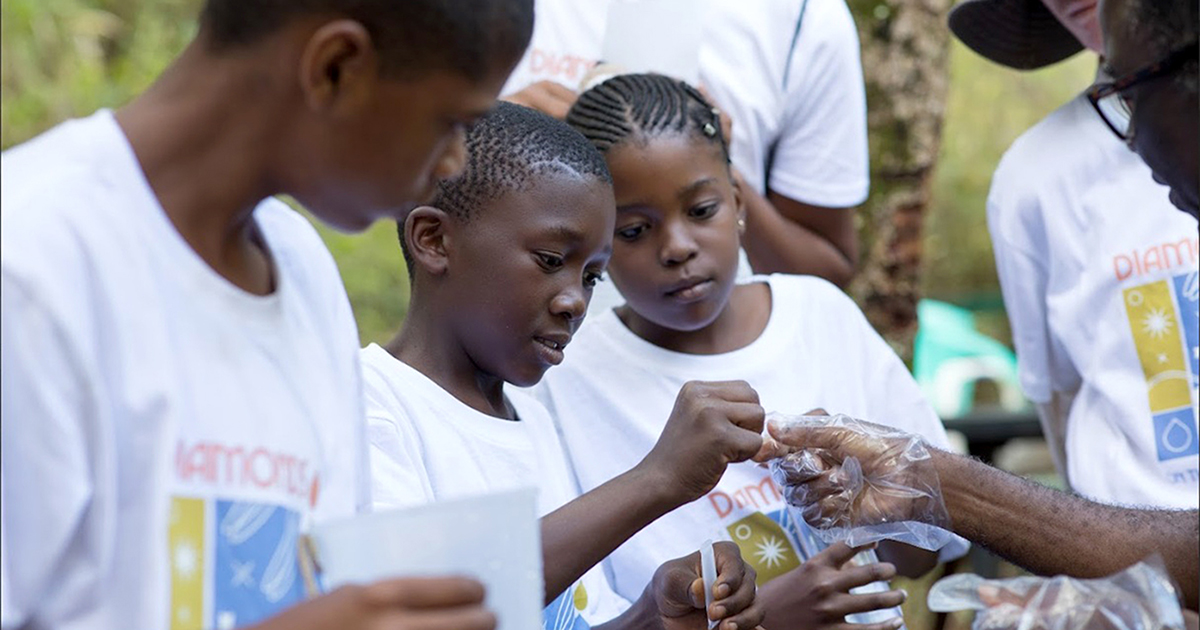
A group of children from Mara Primary School in Buysdorp turned into budding young environmental scientists last week, when they visited the nearby stream to take water samples and have these analysed. Much to their delight, it turned out that they have a "healthy" water source, with very little contamination.
The outing last Tuesday (9 May) formed part of the "Diamonds on the Soles of Our Feet" project, funded by the National Research Foundation and managed by a team from the University of the Western Cape and the Department of Water and Sanitation. This is an award-winning citizen science project, through which not only local water sources get monitored, but local communities are taught about the importance of protecting clean water resources.
"The project is transforming volunteers in these remote rural areas from being passive and not engaging with science, to becoming scientists themselves," said Prof Jacqueline Goldin, an associate professor extra-ordinary in the Faculty of Natural Sciences, Centre for UNESCO Chair in Groundwater, at the University of the Western Cape. Prof Goldin is the spokesperson for the project.
The "active" part of the project was thoroughly enjoyed by 42 of Mara Primary School's learners. The children, from Grade 5 to 7, visited the stream flowing from the mountains at Buysdorp where they helped collect samples, using special water-health testing kits.
According to Mr Murendeni Mavhungu, the science field manager of the project, the goal of the project is not only to gather reliable data on water health, but also to encourage a sense of pride, belonging, dedication and empowerment through their actions. The local teachers are also involved and are taught how to use a scoring system to check the health of rivers and wells.
The citizen scientists use Mini SASS, a uniquely South African scoring system, where they calculate the number of aquatic invertebrates to determine the river health. The freshwater-quality monitoring kit supplied by a non-profit organisation, Earthwatch Europe, is a special kit that determines the level of phosphate and nitrates in the water as well as the turbidity of the water.
Once the results are available, these are transmitted via cellphone straight to official data-collection centres, which compile data required for the formulation of water policy as part of SDG 6.3.2. The data platform has been designed and is managed by Earthwatch.
Learners are also encouraged to raise awareness in their municipalities, schools, businesses and tribal authorities about the water conditions in the rivers and wells in their area.
Rosina Kgadima, the principal of Mara Primary School, reckoned that the project was not only beneficial to the school but to the whole community. "Learners were very happy participating in this project," said Kgadima.
The tests conducted at Buysdorp last week showed no presence of nitrates and phosphates in the water. The scoring system showed that the river had a score of greater than 6.9, meaning the river water is still in its original condition.